
135' Telescoping Boom with Jib 4WD Diesel Rental
Posted by United Lift LLC on
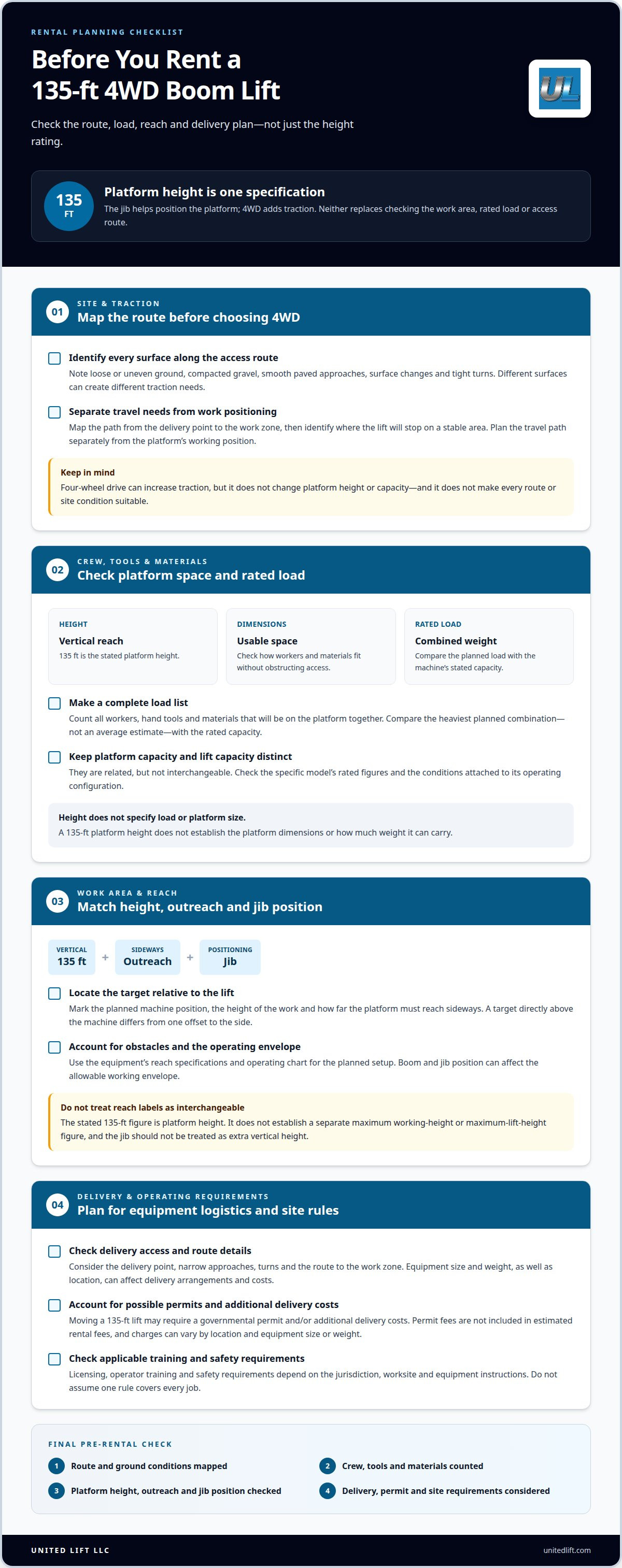
A 135' telescoping boom with jib and 4WD diesel power combines a 135-foot platform height with added reach from the jib and increased traction from four-wheel drive. It’s designed for utility, maintenance, and industrial construction work at height. Choosing one for a rental means looking beyond the height rating to the work area, platform capacity, reach, and delivery needs.
Height matters, but it’s only part of the decision. You also need to understand how the jib helps position the platform, whether four-wheel drive suits the terrain, and how rental arrangements account for oversized equipment. This guide explains the key specifications to weigh, what can affect delivery and permit costs, and how to match the lift to the job. You’ll come away with a clearer way to assess whether this diesel boom lift fits your work and what to consider before arranging a rental.
Key Takeaways
- Use four-wheel drive as a factor when matching the lift to your worksite terrain and traction needs.
- Compare platform capacity and size with the people, tools, and materials needed for the task.
- Look beyond the 135-foot platform height: the jib also helps position the platform for the work area.
- Plan for delivery logistics, since oversized-equipment permits and delivery costs can vary with location and equipment size or weight.
Four-wheel drive
A 135-foot telescopic boom lift with four-wheel drive uses that feature to increase traction. On a jobsite, traction matters when the route includes uneven or loose ground. It can help the machine maintain movement across challenging surfaces, but it doesn’t change the lift’s working height or platform capacity. Treat four-wheel drive as one part of matching the equipment to the site, not as a substitute for assessing the route and work area.
Start with the ground the lift must cross. A route over compacted gravel, for example, can present different traction needs from a smooth paved approach. Note surface changes, uneven sections, and tight turns. These details help determine whether four-wheel drive suits the access route. They also distinguish travel requirements from work-positioning needs: the lift may cross one surface before reaching a stable area for the task.
Next, map the route from the delivery point to the work zone. Include narrow approaches, turns, and transitions between surfaces. A 135' telescoping boom with jib and 4WD diesel power may suit a project where increased traction is a priority, such as industrial maintenance across a rough access area. That example doesn’t establish that every surface or site condition is suitable. The actual route and work zone remain central to equipment selection.
Four-wheel drive does not eliminate the need to plan movement carefully. Identify where the lift will travel, where it will stop, and how the surface changes along the route. Plan the travel path separately from the platform’s intended work position. For a utility or construction task, map the access route first, then mark where workers need to reach overhead. This makes traction one practical selection factor, rather than the only one.
Lift capacity and platform size
For a 135-foot boom lift, platform height describes vertical reach, not carrying capacity. Match the platform’s rated load and usable space to the crew, tools, and materials planned for the task.
Platform Capacity
Platform capacity is the total load the platform is rated to carry. Count all workers, tools, and materials that will be on board together, rather than assessing each item separately. A crew carrying tools and replacement parts, for instance, should consider the combined load. Compare that total with the machine’s stated platform capacity before choosing a lift.
Platform size affects how that load fits. A compact work area may call for a different layout than a task requiring several tools within reach. Consider how workers will stand and where materials will sit without obstructing access to the work. A 135-foot platform height doesn’t tell you the platform’s dimensions or its load rating, so treat those specifications as separate selection factors.
Lift Capacity
Lift capacity describes the load the machine can handle within its operating configuration. It is related to, but not interchangeable with, platform capacity. Review the rated capacity and the conditions attached to it. The jib and boom position may also affect the allowable working envelope, so use the model’s specifications for the planned setup.
Make a load list before comparing equipment: include every worker, hand tool, and material that must travel on the platform. A maintenance task involving a technician and replacement components, for example, has different loading needs from a visual inspection with minimal tools. Use the heaviest planned combination, not an average estimate, to compare capacity.
Keep three specifications distinct: platform height, platform dimensions, and rated load. The 135-foot figure refers to platform height; it does not establish the weight the platform can carry. A larger platform may offer more room, but its capacity still depends on the specific model and configuration. Match the rated figures to the job’s actual crew and equipment.
For a practical next step, compare boom lift options from United Lift LLC against the platform space and load your task requires. This keeps the selection focused on both the work area and what must travel with the crew.
Working height and horizontal reach
The 135-foot platform height gives a clear vertical reference, but it doesn’t describe every part of the lift’s reach. Compare vertical height, horizontal outreach, and jib positioning with the actual work area.
Platform Height and Outreach
The listed 135 ft. telescopic boom lift has a platform height of 135 feet. That figure describes the platform’s vertical height, not horizontal outreach. The jib provides extended reach, helping position the platform toward work beyond the machine’s base. For a maintenance task beside an elevated structure, assess both the height of the work and how far the platform must extend sideways.
Map the target work area relative to the lift’s planned position. A work point directly above the machine calls for a different boom position from one offset to the side. Account for obstacles between the machine and target, too. Use the equipment’s reach specifications and operating chart to assess the actual setup.
Maximum Lift Height
Maximum platform height, maximum working height, and maximum lift height aren’t interchangeable labels. The available fact for this model gives a 135-foot platform height; it doesn’t establish a separate maximum working-height or maximum-lift-height figure. Don’t add an assumed allowance to the stated height or treat the jib as extra vertical height.
For elevated work, identify the platform height the task requires, then assess horizontal outreach separately. Reaching an elevated point across an obstruction, for example, depends on boom position and outreach, not platform height alone. The lift’s specifications define its operating envelope.
In the United States, licensing, operator training, and safety requirements depend on the applicable jurisdiction, worksite, and equipment instructions. Account for those requirements before operating the lift; do not assume one licensing or training rule covers every job.
Moving a 135-foot lift may require a governmental permit and/or additional delivery costs. Those fees aren’t included in estimated rental fees, and permit fees may vary by location and equipment size or weight. Trailer selection and delivery planning also depend on the lift’s dimensions, weight, and route. Include access constraints when planning transport.
Diesel telescopic boom lift rental
Rental planning starts with the job, then matches equipment, delivery, and rental terms to its requirements. A 135-foot diesel lift is intended for utility, maintenance, and industrial construction work at height.
Diesel Boom Lift Rental
Before arranging a rental, define the work area, access route, required platform height, and task duration. These details shape both lift selection and delivery planning. An industrial maintenance project, for example, may call for a diesel model to reach elevated work across an outdoor site. Include the jib’s positioning role and four-wheel-drive traction needs in the equipment requirements.
Plan transport as well. Oversized equipment may require a government permit and additional delivery costs, which may not be included in estimated rental fees. Permit fees can vary by location and equipment size or weight. Factor these transport requirements into the schedule and rental plan.
Model Comparisons
JLG and Genie models should be compared by the specifications relevant to the task, rather than brand name alone. Review each model’s platform height, horizontal outreach, jib configuration, platform capacity, and drive type. A 135-foot platform height doesn’t establish the same outreach or load capacity across different models.
Compare the operating envelope with the job’s access route and target work area. For a work point beyond an obstruction, outreach and jib positioning matter alongside vertical height. Base the decision on the specific model’s data and the task requirements.
Rental Rates
Rental rates typically vary with rental duration, equipment configuration, delivery distance, and local transport requirements. Permit fees and additional delivery costs may also affect the total. Because oversized-equipment permit fees vary by location, size, or weight, these factors are more useful than a generic rate estimate.
Build the rental plan around the work schedule and required setup. Review equipment rental and transport-related charges separately to see which project requirements shape the total.
Dimensions, Weight, and Ground Clearance
Dimensions, weight, and ground clearance depend on the specific 135-foot model. Use its equipment specifications to plan trailer selection, route access, and the space needed at the worksite. A route with tight turns or limited clearance can affect delivery planning.
For a practical equipment comparison, review boom lift options alongside the job’s height, reach, and access needs.
Follow the lift’s operating instructions and applicable requirements for maintenance and inspection. Emissions requirements depend on the engine and the rules that apply at the operating location.
United Lift: Boom Lifts
United Lift sells boom lifts for businesses that need to own equipment rather than arrange a short-term rental. If your work involves repeated access at height, purchasing a lift may suit your needs better than a temporary rental. Match the equipment to the required platform height, outreach, platform capacity, and site access.
For a single project, rental planning still depends on the machine’s specifications and transport needs. For ongoing work, compare boom lifts with other equipment types based on the tasks they need to handle. United Lift also offers forklifts, telehandlers, and scissor lifts, giving you options for different material handling and access requirements.
Share the work you need to complete and the equipment requirements you have identified. Contact United Lift to discuss boom lift options for your operation.
Choose the Right Path for Your Next Project
Before committing to a rental plan, consider how often your operation needs comparable access equipment. A one-time project and recurring work can call for different purchasing decisions. If you’re evaluating a 135' telescoping boom with jib and 4WD diesel power, use the job’s demands to guide your next step, then consider whether owning a boom lift better fits your ongoing workload.
United Lift sells boom lifts for businesses considering an equipment purchase, as well as forklifts and telehandlers for other material handling needs. Share the work you need to support and the equipment criteria that matter to your operation. This gives the conversation a practical starting point, without treating every job as the same.
Contact United Lift about boom lift options and take the next step with a clearer plan for your equipment needs.
Frequently Asked Questions
Which boom lift models have a 135-foot telescoping boom, jib, 4WD, and diesel engine?
A 135-foot diesel telescopic boom lift with a jib and four-wheel drive fits this equipment category. JLG and Genie are established boom lift brands, but the brand name alone doesn’t identify a model with every feature. Compare model specifications for engine type, drive configuration, jib, and platform height. Match the complete configuration to the job rather than assuming features are shared across a brand’s range.
What are the platform height, working height, horizontal outreach, and platform capacity of 135-foot boom lifts?
The listed 135-foot telescopic lift has a platform height of 135 feet and includes a jib for extended reach. Working height, horizontal outreach, and platform capacity are separate specifications, not values that can be derived from platform height. For example, a task across an obstruction depends on the model’s outreach and jib configuration. Use the equipment’s specifications for its capacity and working envelope.
What terrain, gradeability, and wind limits should operators consider for a 135-foot 4WD diesel boom lift?
Consider surface firmness, slope, uneven ground, and wind exposure. Four-wheel drive can increase traction, but it does not determine the machine’s allowable slope or wind limit. Those limits vary by model and operating configuration. At a site with a sloped access route or an open, windy work area, review the lift’s operating specifications and assess the route and work position before planning travel or elevation.
How do JLG, Genie, and other 135-foot telescopic boom lift models compare?
Compare each model’s platform height, horizontal outreach, jib configuration, platform capacity, and drive type. A 135-foot platform height alone doesn’t establish the same outreach or load capacity across models.
- Tags: 135' telescoping boom with jib 4wd diesel, 4WD equipment, aerial work platforms, boom lift rental, construction equipment, diesel equipment, equipment delivery, lift capacity, telescopic boom lifts
