
Forklift Classification Codes by Truck Type and Use
Posted by United Lift LLC on
There are seven commonly used forklift classes, and each tells you more than a truck’s power source. Forklift classification codes group trucks by their power and design, from electric and internal-combustion models to rough-terrain machines.
It’s easy to focus on one feature, such as fuel type or tires, but a class gives a broader picture of a truck’s design. This guide explains the seven classes and how Industrial Truck Association lift codes identify specific truck types within each class. You’ll also learn how to distinguish internal-combustion trucks with solid or cushion tires from pneumatic-tire and rough-terrain forklifts.
Use these classifications as a starting point when comparing equipment for a job. The right fit depends on the work environment and intended use, so understanding the code helps narrow your options without confusing one forklift type with another.
Key Takeaways
- Use a truck’s class to identify its broad design and power category, then use its lift code to narrow down the specific truck type.
- Distinguish internal combustion forklifts by tire type: solid or cushion tires indicate Class IV, while pneumatic tires indicate Class V.
- Class VII identifies rough-terrain forklifts, but that label doesn’t mean every machine is suited to every terrain or job site.
- For U.S. customs classification, the truck’s propulsion and configuration matter; the article explains how to find the relevant code.
How Many lift trucks Classifications Are There?
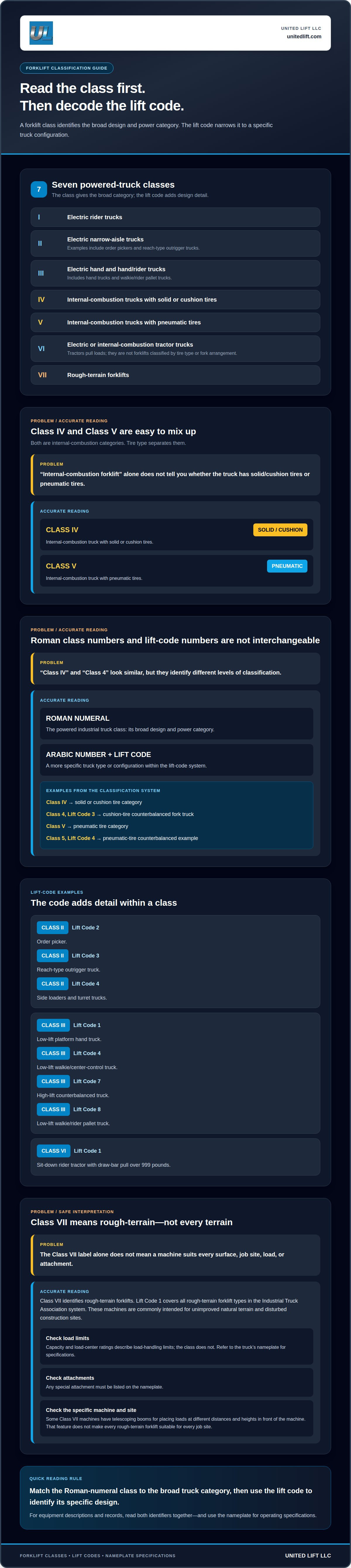
The seven commonly used powered industrial truck classes run from Class I through Class VII. A class identifies a truck’s broad design and power type; a lift code specifies its configuration.
Class VI Tractor Trucks
Class VI covers electric and internal-combustion engine tractors used to pull loads. These are tractors, not forklifts classified by tire type or fork arrangement.
Lift codes add detail within the class. In the Industrial Truck Association system, Class 6 Lift Code 1 identifies a sit-down rider tractor with draw-bar pull over 999 pounds. That distinction helps separate tractor trucks from lifting trucks in the same broader classification system. A Class VI label can apply to either an electric tractor or one powered by an internal combustion engine.
Class II Narrow-Aisle Trucks
Class II identifies electric motor narrow-aisle trucks, with lift codes distinguishing their designs. For example, Lift Code 2 covers order pickers, while Lift Code 3 identifies reach-type outrigger trucks.
Other Class II trucks can include designs with different lifting configurations. Side loaders and turret trucks fall under Lift Code 4. These distinctions matter when identifying a truck from its class alone: Class II establishes the narrow-aisle category, while the lift code points to its specific truck type. Check both identifiers when comparing descriptions or equipment records.
Class III Hand and Rider Trucks
Class III covers electric motor hand trucks and hand/rider trucks. Its lift codes distinguish configurations such as low-lift walkie pallet and platform trucks.
In the Industrial Truck Association system, Lift Code 1 is a low-lift platform hand truck, and Lift Code 4 is a low-lift walkie/center-control truck. Lift Code 7 identifies a high-lift counterbalanced truck, while Lift Code 8 denotes a low-lift walkie/rider pallet truck. Class III also includes tractors under Lift Code 3. These examples show why a class and its lift code should be read together.
As a quick reference, Class I means electric motor rider trucks, Class II means electric narrow-aisle trucks, and Class III means electric hand or hand/rider trucks. Classes IV and V cover internal-combustion trucks, while Class VII identifies rough-terrain forklifts. The class gives the broad category; the lift code adds detail about the truck’s design.
Internal combustion trucks with solid or cushion tires
Class IV identifies internal-combustion engine trucks with solid or cushion tires. This distinguishes them from pneumatic-tire models by both power source and tire category. A counterbalanced fork truck in this group is described more precisely by its lift code. The Roman numeral indicates the class, and the Arabic numeral identifies the truck type.
Class 4 Lift Code 3 identifies a cushion-tire counterbalanced fork truck in the Industrial Truck Association classification system. Here, “Class 4” is the lift-code system’s numbered class, not another way to write Class IV. The similar numerals can be confusing in equipment descriptions. Keep the labels together: Class IV refers to the powered industrial truck category, while Class 4, Lift Code 3 identifies a particular cushion-tire design.
Class V identifies internal combustion engine trucks with pneumatic tires. Pneumatic tires set this category apart from the solid or cushion tires associated with Class IV. Lift-code descriptions can provide more detail about a truck’s tire type and configuration. This paired code gives a more exact description than “Class V” alone. It also shows how a broad power-and-tire category connects to a specific truck configuration.
Use the distinction when reading a truck record, product description, or training material. First identify whether the class is written as a Roman numeral, such as IV or V. Then look for an Arabic-numbered lift code, such as Class 4 Lift Code 3 or Class 5 Lift Code 4. These labels describe different levels of classification, so don’t treat them as interchangeable. For example, a cushion-tire truck belongs to Class IV, while the specific counterbalanced model maps to Class 4 Lift Code 3. A pneumatic-tire truck is Class V, with its counterbalanced example mapped to Class 5 Lift Code 4. Matching both labels helps you identify the truck type accurately.
Class VII rough-terrain forklift types
Class VII identifies rough-terrain forklift trucks, with Lift Code 1 covering all rough-terrain forklift types in the Industrial Truck Association system. These machines are commonly intended for unimproved natural terrain and disturbed construction sites, but the class doesn’t mean every surface is suitable.
How do classifications differ from capacity and load-center ratings? A class identifies a truck’s broad design and power category; capacity and load-center ratings describe its load-handling limits. Refer to the truck’s nameplate for specifications, rather than treating its class as a capacity rating.
How do classifications affect workplace use, permitted surfaces, and attachments? The class helps identify the truck type, but it does not authorize operation on every surface. Operators need to follow the truck’s nameplate specifications, and any special attachment must be listed on the nameplate.
Class VII machines are often ruggedly built for outdoor work. Some have a telescoping boom that lets the operator place a load at different distances and heights in front of the machine. This reach can suit construction tasks that require flexible load placement, but it does not make every rough-terrain forklift appropriate for every job site.
What are common examples across the classes? Class I includes electric rider trucks, Class II includes order pickers, and Class III includes electric hand trucks. Class IV covers internal-combustion trucks with cushion tires, Class V pneumatic-tire trucks, Class VI tractors, and Class VII rough-terrain forklifts.
What risks and operating restrictions apply? A class alone does not establish a truck’s safe load or suitable operating surface. Operators must follow the nameplate specifications, and special attachments must be listed there. Operators are required to be certified for each truck class they operate.
Some portable, self-propelled Class VII forklifts travel to construction sites on carriers mounted behind trucks or trailers, where they can unload heavy items. Not every truck- or trailer-mounted forklift is a rough-terrain model, so identify the machine by its classification, not how it is transported.
Forklift classification codes
Forklift codes describe different things, so identify the system before interpreting a code. Truck classes describe design and power; U.S. customs codes classify goods for tariff purposes.
Classification Standards
The class and lift-code examples here follow the Industrial Truck Association classification system. They identify truck types, such as electric trucks and rough-terrain forklifts.
ANSI and ISO labels shouldn’t be assumed to match those class and lift-code examples. In the United States, regulatory agencies refer to Industrial Truck Association classifications to define powered industrial truck types. Customs uses a separate system: HTSUS heading 8427 covers forklift trucks and other works trucks fitted with lifting or handling equipment. Don’t treat a truck class as a customs tariff code.
For example, a Class V label describes an internal-combustion truck with pneumatic tires, while an HTSUS code addresses its trade classification. The machine’s configuration and purpose determine which description applies.
Data Plates and Manufacturer Specifications
A data plate provides truck-specific information, while manufacturer specifications describe the machine’s configuration. The forklift’s UL rating should be stamped on its data tag; a chassis decal may show that rating as well.
Those ratings are not the same as the truck’s class or lift code. Use manufacturer specifications to identify the truck type, and read any class and lift-code labels in their stated classification system. OSHA 1910.178 provides information about forklift ratings. A special attachment must be listed on the nameplate.
For customs classification, the details matter. In the United States, other self-propelled rider-type counterbalanced forklifts, such as internal-combustion machines, are classified under HTSUS code 8427.20.40.00, with a general duty rate of Free, according to the United States International Trade Commission. Electric self-propelled trucks fall under a different HTSUS subheading than other self-propelled trucks.
Start by identifying the code’s purpose: truck class, lift code, UL rating, or HTSUS tariff code. Then match the machine’s power source, tire type, and configuration to the relevant system. For help finding equipment by truck type, explore forklift options.
United Lift: Forklifts
United Lift LLC helps you move from classification details to equipment choices with forklifts suited to different material-handling needs. If your work calls for reaching elevated areas or handling loads across varied job sites, boom lifts, scissor lifts, and telehandlers are also available.
Use the truck class as a starting point, then match the equipment to your work environment, load-handling needs, and required configuration. United Lift LLC offers new and used forklifts to consider for your operation. The classification code narrows down the truck type, while the job itself helps determine which equipment category fits.
Contact United Lift LLC to explore forklift options for your operation.
Turn the Classification Into Your Next Equipment Decision
Use forklift classification codes as a starting point, then define what the machine needs to do. Consider the work area, travel surfaces, load-handling tasks, and equipment configuration together. This gives you a practical basis for narrowing your options instead of choosing by class label alone.
When you’re ready to explore equipment, United Lift LLC offers forklifts, boom lifts, and telehandlers. Share details about where the equipment will work and what tasks it needs to handle. This helps focus the next step on equipment suited to the job.
Contact United Lift LLC about your forklift needs and take the next step with confidence.
Frequently Asked Questions
What does each forklift class code mean for electric versus internal-combustion forklifts?
Classes I through III cover electric motor rider, narrow-aisle, and hand or hand/rider trucks. Class IV identifies internal-combustion trucks with solid or cushion tires, while Class V identifies those with pneumatic tires. Class VI covers electric and internal-combustion tractors, and Class VII identifies rough-terrain forklifts. Class VI is a useful reminder that the class numeral alone does not always indicate the power source.
What safety risks and operating restrictions apply to each forklift classification?
A class alone does not establish a truck’s safe load or suitable operating surface. Operators must follow the nameplate specifications, and any special attachment must be listed there. Class VII does not mean the truck is safe on every terrain, and operators must be certified for each class they operate.
- Tags: electric forklifts, forklift classification codes, forklift classifications, forklift tires, forklift types, internal combustion forklifts, lift truck codes, material handling, rough-terrain forklifts
