
Forklift Battery Types Compared by Cost and Key Tradeoffs
Posted by United Lift LLC on
The right forklift battery isn't chosen by chemistry alone; it must match the truck’s voltage and operating demands. The main options include lead-acid, lithium-ion, AGM, and TPPL batteries, while common nominal forklift voltages are 24V, 36V, 48V, and 80V. Here, forklift battery types are explained alongside the key rule: match a replacement battery’s voltage to the truck’s nameplate rating.
It’s easy to focus on a battery’s purchase cost, but charging time, maintenance, shift patterns, and equipment compatibility all matter. A lower upfront cost may mean more hands-on upkeep or a different charging routine.
This guide compares four battery options by cost considerations, maintenance, operating conditions, lifespan, and voltage compatibility. Learn when lead-acid batteries make sense, how lithium-ion changes daily charging, and what to consider with AGM and TPPL. Use the decision guide to narrow your options based on your equipment and work schedule.
Key Takeaways
- Compare battery options by expected service life and charging demands, not just the initial purchase decision.
- Lead-acid batteries can suit warehouse operations that can accommodate their charging and upkeep routines.
- Battery chemistry affects day-to-day maintenance, including whether regular watering is part of the routine.
- Match battery voltage to the forklift and its work demands to narrow down compatible options.
What Type of Battery Does a Forklift Use?
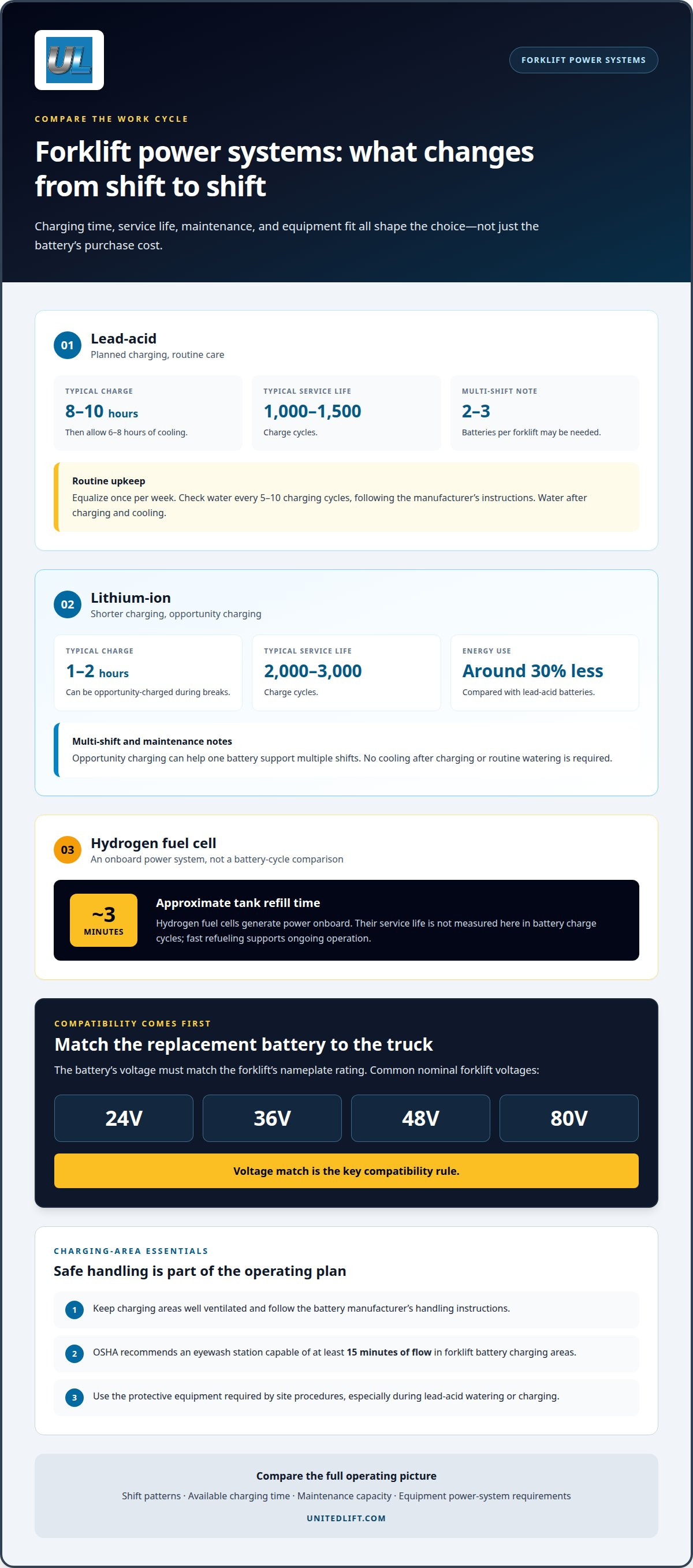
Forklifts commonly use lead-acid, lithium-ion, or hydrogen fuel-cell power systems. Lead-acid and lithium-ion batteries store electricity, while hydrogen fuel cells generate it onboard. Lead-acid batteries support scheduled charging, lithium-ion batteries allow opportunity charging, and hydrogen tanks can be refilled in about three minutes.
Lead-Acid Forklift Power Systems
A lead-acid system uses a rechargeable battery that needs planned charging and routine care. A typical charge takes 8-10 hours, followed by 6-8 hours of cooling. Equalize the battery once per week to balance cells, and check its water about every 10 charging cycles. Lead-acid batteries typically provide 1,000-1,500 charge cycles, so multi-shift warehouses may need 2-3 batteries per forklift.
Lithium-Ion Forklift Power Systems
Lithium-ion batteries typically provide 2,000-3,000 charge cycles and can charge in 1-2 hours. They support opportunity charging during breaks, which can help a forklift work multiple shifts with one battery. They also use around 30% less energy than lead-acid batteries. Unlike a lead-acid system, lithium-ion doesn’t require cooling after charging or routine watering.
| Power system | Typical service life | Charging or refueling | Multi-shift fit |
|---|---|---|---|
| Lead-acid | 1,000-1,500 cycles | 8-10 hours, plus cooling | May need 2-3 batteries per forklift |
| Lithium-ion | 2,000-3,000 cycles | 1-2 hours; opportunity charging | Can use one battery per forklift |
| Hydrogen fuel cell | Not measured here in battery cycles | Refill in about three minutes | Fast refueling supports ongoing operation |
Charging conditions matter as much as battery type. Keep charging areas well ventilated, and follow the battery manufacturer’s handling instructions. OSHA recommends an eyewash station capable of at least 15 minutes of flow in forklift battery charging areas. Use the protective equipment required by your site’s battery-handling procedures, especially during lead-acid watering or charging.
Choose based on shift patterns, available charging time, maintenance capacity, and the equipment’s power-system requirements.
What are lead-acid batteries?
A lead-acid forklift battery stores electrical energy through a reaction between lead plates and electrolyte. Its cells determine the truck’s voltage, while amp-hours (Ah) indicate capacity.
Flat-Plate Lead-Acid Batteries
Flat-plate batteries use broad, flat lead plates immersed in electrolyte. Their design is a common option for warehouse handling where equipment follows a planned charging routine. Each cell supplies 2 volts, so a 48-volt battery uses 24 cells. Compared with tubular designs, flat-plate batteries provide less capacity for a similar battery size, which can matter when trucks face demanding workloads.
Tubular Lead-Acid Batteries
Tubular batteries use lead plates held within tubular structures, offering a different balance of capacity and cost. They provide about 15% more capacity than comparable flat-plate batteries. That added capacity can suit a warehouse where forklifts need more operating time between charges. The tradeoff is a higher purchase cost than flat-plate designs, so workload and operating demands should guide the choice.
Both designs use electrolyte and lead plates to store and deliver power. Temperature and charging habits affect performance, so follow the battery manufacturer’s operating and maintenance instructions. For watering, use deionized or distilled water after charging and cooling. Add enough to cover the plates, helping protect them and support dependable operation.
Lead-acid batteries often have a lower upfront cost than lithium-ion options, but purchase price is only one part of ownership. The battery’s purchase cost represents about 30% of its total cost of ownership. Over five years, charging needs, maintenance, and replacement timing can influence the overall comparison. A single-shift warehouse with planned charging may weigh those factors differently from a facility running multiple shifts.
For equipment decisions involving battery fit, explore industrial batteries alongside your forklift’s capacity and work demands.
Battery maintenance and operating environment
Maintenance needs vary with battery type, charging pattern, and warehouse environment. A consistent routine helps preserve usable capacity and battery life. Lead-acid batteries need watering and cleaning; sealed lithium-ion batteries need neither watering nor acid checks. Opportunity charging also changes daily routines, so follow guidance suited to the battery and equipment.
For a lead-acid battery, add water only after charging and cooling. Use distilled or deionized water, and keep the water above the plates. Check water every 5-10 cycles, following the battery manufacturer’s instructions. Clean the battery once a month to remove chemical buildup. Regular checks help catch residue or low water before these conditions affect operation.
Equalization is another part of lead-acid care. It helps balance cells and address sulfation, so schedule it once per week. Charge in a well-ventilated area, and keep the battery cover open while charging to help heat disperse. OSHA recommends an eyewash station with at least 15 minutes of flow in a forklift battery charging area. These precautions support safer battery handling.
Sealed lithium-ion batteries need no watering or acid checks, reducing routine hands-on maintenance compared with flooded lead-acid models. Their opportunity-charging capability can suit electric forklifts working across multiple shifts. Follow the manufacturer’s charging guidance, though, and don’t treat every battery type alike. A charging plan for one chemistry may not preserve another’s capacity.
Battery depth of discharge matters, too. AGM batteries should discharge up to 50% of capacity during each charge cycle to help maintain performance and lifespan. For TPPL batteries, discharging below about 40% state of charge voids the warranty. Track charge levels and set operating practices around these limits. That helps keep the energy available for work while supporting the battery’s intended service life.
Temperature, ventilation, and charging frequency all shape the operating environment. For example, a warehouse using opportunity charging needs a routine built around breaks and shift changes, while lead-acid charging requires cooling time. Choose a process that suits the battery chemistry, not convenience alone.
Voltage and forklift equipment compatibility
An electric forklift battery must match the truck’s voltage rating. Common nominal voltages are 24V, 36V, 48V, and 80V. Capacity is measured in amp-hours (Ah), while runtime depends on the truck’s work and battery condition. A fully charged forklift battery is designed to last a full eight-hour shift before recharging.
Voltage helps narrow down which equipment a battery can power. A 24-volt battery suits some smaller electric equipment, including walkie pallet jacks and walkie stackers. A 36-volt battery is designed for mid-sized equipment, such as narrow-aisle and three-wheel sit-down forklifts. Larger counterbalanced forklifts commonly use 48-volt batteries, while heavy electric equipment may use 80 volts.
Capacity figures provide context, not a universal fit. For example, a lithium-ion forklift battery may have a capacity of 200 ampere-hours, while a lead-acid example is 600 ampere-hours. Those examples don’t establish equivalent runtime across trucks. Battery chemistry, equipment demands, and operating conditions affect how stored energy is used.
For runtime, use the full-shift design target as a starting point, then consider the work pattern. A forklift carrying demanding loads or operating continuously may use its available capacity differently from one with lighter duties. Multiple shifts also change charging needs. Lithium-ion batteries can be opportunity charged without reaching 100%, which can support shift operations between work periods.
Before you replace a battery, match its voltage exactly to the forklift’s nameplate rating. Then compare the battery’s physical fit, capacity, chemistry, and charging routine with the truck’s demands. A 48-volt battery, for example, isn’t a substitute for an 80-volt unit simply because both power electric forklifts. Voltage mismatch can make a replacement incompatible; the nameplate is the essential starting point.
Start with voltage to narrow equipment compatibility, then compare capacity and expected runtime with the actual shift pattern. This keeps battery selection aligned with both the truck and its daily work.
United Lift LLC: Forklifts
United Lift LLC offers forklifts for businesses matching equipment to warehouse work, load handling, and operating demands. Once you’ve clarified the battery requirements, the next step is choosing a truck suited to the job. United Lift LLC also offers boom lifts, telehandlers, and scissor lifts.
Consider the forklift’s intended tasks and the battery system it must accommodate. Start with the work, then account for operating conditions and compatibility. This keeps the equipment decision grounded in your operation’s practical needs.
Contact United Lift LLC to discuss forklift options for your operation.
Make the Next Equipment Decision Count
Now that forklift battery types are explained, use what you’ve learned to plan for your operation’s upcoming work. Consider whether changing demands could affect truck use, charging routines, or equipment needs. Treat battery selection as part of your broader equipment plan.
Gather the practical details that shape the job, including the forklift’s tasks, operating pattern, and battery requirements. They provide a clear basis for evaluating equipment options and keeping the decision focused on your operation.
For a next step, contact United Lift LLC about battery options and the equipment they need to support. Share what the forklift must do and how it fits your operation. Move forward with a decision grounded in the work ahead.
Frequently Asked Questions
What are lithium-ion batteries?
Lithium-ion batteries store energy in electrochemical cells, with lithium ions moving between electrodes during charging and use. Forklift packs include a battery management system (BMS) to monitor the cells. Lithium iron phosphate (LFP) is a popular lithium-ion chemistry in material handling. Unlike a hydrogen fuel cell, a lithium-ion pack stores electricity for later use.
What are the main types of forklift batteries?
The main options are lead-acid batteries, lithium-ion batteries, and hydrogen fuel-cell power systems. The forklift battery types explained here include flat-plate and tubular lead-acid designs, as well as AGM and TPPL batteries. Fuel cells differ from rechargeable batteries because they generate electricity onboard using hydrogen. To narrow your options, consider the truck’s power system, charging routine, and maintenance needs.
What are the pros and cons of lead-acid forklift batteries?
Lead-acid batteries generally cost less upfront than lithium-ion options and are more than 99% recyclable. Their tradeoffs include regular upkeep and a charging routine that can constrain equipment availability. Charging stations may also require specialized electrical wiring to meet battery voltage demands. They can suit a warehouse that plans charging around its work schedule and can manage battery care.
What are the pros and cons of lithium-ion forklift batteries?
Lithium-ion batteries reduce routine maintenance and can support opportunity charging, helping operations plan around demanding schedules. Their higher upfront cost is a key tradeoff. The pack also needs a battery management system to monitor its cells, and communication between the battery and truck matters. LFP is a common chemistry to consider for material-handling equipment.
How long do forklift batteries last, and what affects their lifespan?
Lead-acid forklift batteries typically last three to seven years, while well-maintained lithium-ion batteries can last seven to ten years with 300 workdays per year. The forklift battery types explained in this comparison don’t all age at the same rate. Service life depends on operating and maintenance conditions, including charging habits, workload, temperature, and regular care.
- Tags: AGM batteries, battery maintenance, forklift batteries, forklift battery types explained, lead-acid batteries, lithium-ion batteries, material handling, TPPL batteries, warehouse equipment
