
Choose Between Alternative Equipment and Leasing a Forklift
Posted by United Lift LLC on
A forklift isn’t the only way to move materials. Alternatives to buying a new forklift include manual or electric pallet jacks, electric stackers, and tow tractors. Choose based on whether you need to lift, stack, or tow loads.
If your current forklift feels oversized for the job, replacing it with another forklift may not be the best fit. The right choice depends on load weight, travel distance, stacking height, workload, and how often your operation needs equipment.
This guide compares alternative equipment with buying used or leasing a forklift. It covers typical applications, costs, maintenance, and trade-offs. You’ll also find a practical way to reassess your operation and choose equipment that matches the work, without paying for capacity or features you don’t need.
Key Takeaways
- Match the equipment to the task: towing, moving pallets, and stacking require different capabilities.
- Compare alternatives by application, capacity, operating demands, and total cost, not just the purchase price.
- Use daily hours, shifts, and throughput to decide whether a used or new forklift is a better fit.
- Consider leasing when preserving cash matters, and weigh its terms against the value of owning equipment.
- Include expected maintenance in your comparison, since upkeep can change the long-term cost of a used or new forklift.
Electric tuggers as a forklift alternative
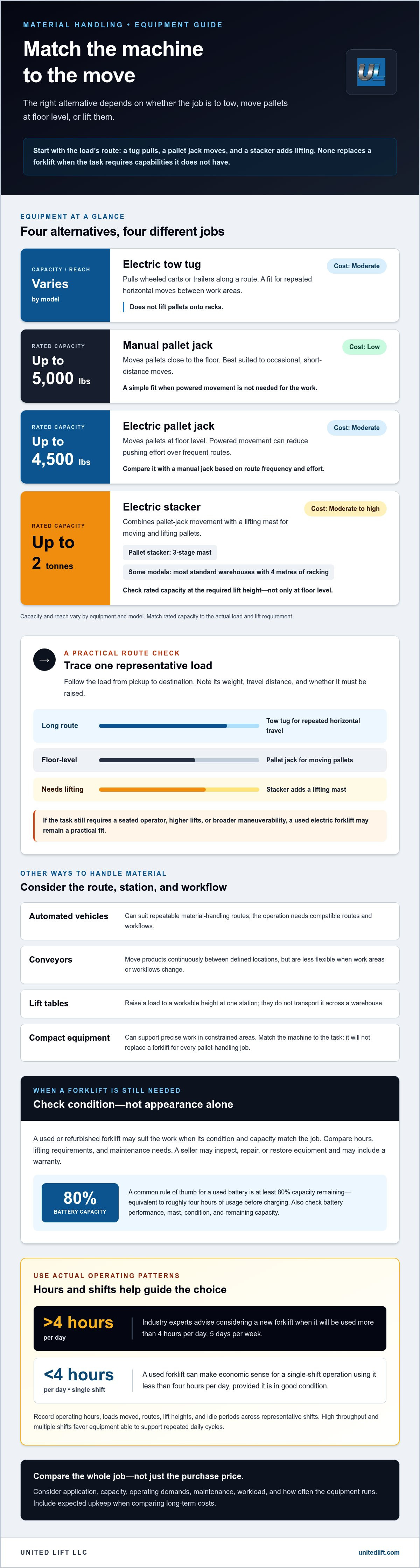
Start by mapping the load’s route. A forklift lifts and stacks; an electric tow tug pulls wheeled carts or trailers along a route. Tugs suit repeated horizontal moves between work areas, but don’t replace a forklift when pallets must be lifted onto racks. For example, a plant moving components on wheeled dollies could use a tug for the route and lifting equipment only at receiving.
For pallet moves close to the floor, compare manual and electric pallet jacks. The powered option can reduce pushing effort over frequent routes; the manual option may fit occasional, short-distance moves. According to the U.S. Department of Labor, the U.S. federal minimum wage is $7.25 per hour. Labor cost also depends on the time and staffing required to move each load, a detail that United Lift LLC often emphasizes when assessing total operational expenses.
Need to place pallets at height? An electric stacker combines pallet-jack movement with a lifting mast. A pallet stacker is described as an electric pallet jack with a 3-stage mast. Sit-on or stand-on models can place pallets in most standard warehouses with 4 metres of racking height. Compare the stacker’s rated capacity at the required lift height, not just its maximum capacity at floor level.
A used electric forklift remains an option when the job still requires a seated operator, higher lifts, or broader maneuverability. Its condition, battery performance, mast, and remaining capacity matter more than appearance alone. A used 5,000 lb. electric sit-down rider forklift has a market price range in the research data, but no specific price belongs in this comparison. Include a practical battery check: used batteries with at least 80% capacity remaining are a common rule of thumb, equivalent to roughly four hours of usage before charging.
| Option | Best fit | Capacity or reach | Typical cost |
|---|---|---|---|
| Electric tow tug | Pulling carts along routes | Varies by model | Moderate |
| Manual pallet jack | Occasional, short pallet moves | Up to 5,000 lbs | Low |
| Electric pallet jack | Frequent pallet movement | Up to 4,500 lbs | Moderate |
| Electric stacker | Moving and lifting pallets | Up to 2 tonnes | Moderate to high |
Trace a representative load from pickup to destination: note its weight, travel distance, and whether it must be raised. A tug suits long horizontal routes; a pallet jack suits floor-level moves; a stacker adds warehouse lifting. If those options don’t cover the work, an electric forklift may remain the practical fit. This comparison helps identify alternatives to buying a new forklift without paying for capacity your workflow doesn’t use.
Alternative equipment costs, applications, pros, and cons
A used or refurbished forklift can be a reliable alternative to buying new when its condition and capacity suit the work. A seller may inspect, repair, or restore used equipment and may include a warranty. Compare the machine’s condition, hours, lifting requirements, and maintenance needs rather than judging it by appearance alone.
Other equipment can reduce costs when a lift truck is handling tasks it doesn’t need to perform. Tow tractors and automated vehicles can suit repeatable material-handling routes. They can reduce manual transfers, but the operation must accommodate their routes and workflows.
Conveyors can move products continuously between defined locations, but offer less flexibility when work areas or workflows change. Lift tables raise a load to a workable height at a station, but don’t transport it across a warehouse.
Compact vehicles can also suit jobs where turning room and controlled movement matter. Neither replaces a forklift for every pallet-handling task, so match the machine to the load and route.
Use these figures as a starting point for budgeting, not as a complete ownership-cost comparison. Purchase price is only one factor. Consider how often the equipment runs, how much floor space it needs, and whether it can handle more than one task. A conveyor may suit steady movement between fixed stations, a lift table may work better at one loading point, and an automated vehicle may fit repeated travel between work areas.
- Automated vehicles: Best suited to repeatable routes; require compatible workflows.
- Conveyors: Move products along fixed paths; less adaptable to layout changes.
- Lift tables: Raise loads at a station; don’t move them between locations.
- Compact equipment: Can support precise work in constrained areas; match it to the task.
Used equipment can be quicker to put into operation: in some cases, a used forklift can be purchased and put to work in as little as a day or two. Reputable sellers may inspect, repair, or restore the machine, and may include a warranty. For a practical comparison, list the loads, routes, lift heights, and work frequency, then weigh each option’s flexibility against its upfront cost and application.
Reassessing forklift needs based on current operations
Outsourcing material handling or hiring an operator can be more cost-effective when forklift work is occasional, seasonal, or limited to a specific project. Compare paid support with equipment ownership, operator time, and the workload your operation can use consistently.
Track actual forklift use before choosing a replacement. Record operating hours, loads moved, travel routes, lift heights, and idle periods across representative shifts. Industry experts advise considering a new forklift when it will be used for more than 4 hours per day, 5 days per week. A used forklift can make economic sense for a single-shift operation using it less than four hours per day, provided it’s in good condition.
Workload matters as much as hours. High-throughput operations and multiple shifts favor a new forklift because the equipment must support repeated daily cycles. A machine running three shifts a day for five years can experience practical wear equivalent to a 15-year-old machine used one shift a day. That comparison shows why calendar age alone can mislead; intensity changes wear.
Check whether the current lift truck is oversized for its routine loads. Using a forklift to move loads weighing 4,000 pounds or less can mean using more power than necessary. In heavy plant manufacturing, industrial loads typically weigh between 4,400 lbs. and 44,000 lbs. A warehouse with 25-foot-tall racking may need a mast tall enough to reach its storage levels. Narrow aisles, turning space, and attachment needs also affect the right configuration.
Use this quick review to connect your equipment choice with operating demands:
- Hours: Compare daily use with the more than 4 hours per day guideline.
- Shifts: Identify whether one machine must serve multiple shifts or high throughput.
- Loads: Record typical and heaviest loads, not just the rated capacity of the current truck.
- Routes: Map travel distance, turning areas, and rack heights to spot wasted movement.
- Downtime: Note delays caused by breakdowns, charging, or waiting for equipment.
Then separate essential work from occasional tasks. For example, if a lift truck mainly moves light loads between nearby stations, another material-handling method may suit those trips. Reserve forklift capacity for loads that need its lifting height or handling capability. This can improve productivity without assigning every movement to the largest vehicle in the fleet.
Compare the full operating picture, not purchase price alone. Include usage, upkeep, downtime, and the impact of an idle machine on operations. A forklift replaced after 5 or 10 years may still suit light, occasional work if its condition is sound. For sustained use across multiple shifts, a new forklift may better match the workload. Reassess whenever product mix, routes, or shift patterns change.
Leasing a forklift to preserve cash
Leasing can spread equipment payments over time instead of tying up cash in a purchase. Compare it with buying or renting based on expected use, operating expenses, and equipment needs.
Buying Versus Renting or Leasing
Buying gives a business ownership and control over how long it keeps a forklift. Leasing spreads payments across an agreement, while renting generally suits a defined, temporary need. To compare total cost of ownership, add purchase or lease payments, operating costs, maintenance, and downtime over the period you expect to use the truck.
For example, a warehouse that needs lifting capacity throughout regular operations should compare a longer-term lease with ownership. A short project with a clear end date calls for a rental-cost comparison instead. Include the cost of idle equipment, so the budget reflects actual use rather than assuming the truck works continuously.
Forklift Rental and Lease Considerations
Forklift rental costs in the United States vary with capacity, power type, rental duration, delivery, and usage needs. Build an estimate around those factors and the project schedule rather than treating one rate as universal. Include OSHA-related safety considerations in the comparison: assess the truck’s condition, capacity for the planned load, operator practices, and workplace hazards.
Choosing to buy, rent, or lease doesn’t replace a practical safety review. Apply the same care to used equipment: inspect its condition and make sure it suits the material-handling task. Focus on safe use rather than assuming the acquisition method settles the issue.
Preserving cash is one reason businesses consider leasing. Market data reports that 80% of businesses in the United States lease equipment. That figure indicates leasing is a common equipment-financing choice, but it doesn’t show which arrangement costs less for an individual warehouse. Compare the payment schedule with your operating budget and expected forklift use.
Use this step-by-step comparison before deciding:
- Define the work period and the hours the forklift must be available.
- List the required capacity, lifting height, and workplace conditions.
- For buying, total the purchase outlay, maintenance, operating costs, and expected downtime.
- For leasing, total the scheduled payments and operating costs over the agreement.
- For renting, account for the rental period, delivery, and project-specific requirements.
Leasing can preserve cash for other operating needs, while ownership may suit equipment used steadily over a longer period. Renting can fit a temporary workload without a longer commitment. Look beyond the payment amount: a truck that doesn’t match the warehouse’s loads, routes, or lifting requirements can cause avoidable delays. Compare each option over the same work period and operating assumptions, then choose the arrangement that fits your equipment needs and budget.
Maintenance costs
Maintenance can change the long-term cost of forklift ownership. Use maintenance figures as a comparison point, then consider how condition, workload, and downtime affect your operation.
What maintenance, repair, insurance, and delivery costs should you compare? Add routine maintenance and repairs, insurance, delivery, and downtime to each option’s purchase or lease cost. For used machines, consider condition and service history. For delivery and insurance, account for the equipment and your operating needs.
Calculate maintenance costs against expected operating hours, not just the machine’s purchase price. For example, compare the expected hours for a used forklift and a new forklift over the same period. Then multiply each machine’s estimated hourly maintenance cost by those hours.
Build a practical review around the machine’s condition and the job:
- Service records: Review past maintenance and repairs to identify recurring issues.
- Operating condition: Inspect visible wear and test the machine’s functions before putting it into regular use.
- Battery and capacity: For an electric forklift, consider battery condition and whether its capacity suits the loads and shifts.
- Work environment: Account for routes, floor conditions, and pedestrian traffic that could affect use and downtime.
- Delivery and insurance: Include both in the total cost for each equipment option.
Repair spending also affects throughput. If a machine is unavailable, loads may wait, operators may lose time, and other equipment may need to cover the work. For example, a warehouse relying on one forklift for receiving and dispatch should consider how downtime affects both tasks. Compare that impact with maintenance costs, rather than treating them separately.
Maintenance needs also depend on how equipment is used. Frequent lifting, demanding routes, and long operating periods make condition and service history especially important. A used truck with a lower purchase cost may need more upkeep; a new truck may have lower hourly maintenance costs but a higher purchase price. Compare both across the same expected workload.
Before choosing, write down the expected hours, load capacity, maintenance cost, insurance, delivery, and likely downtime for each option. Use the same work period and operating assumptions. If you’re comparing forklift options, include maintenance and operating fit alongside the equipment choice.
United Lift: Forklifts
United Lift LLC offers forklifts for businesses comparing new and used equipment with other options. If your operation still needs lifting capacity, travel between work areas, or regular pallet handling, comparing forklift options can help narrow the choice to equipment that fits the job. Consider load requirements, lift height, daily use, and maintenance alongside the purchase decision.
United Lift LLC also offers boom lifts, telehandlers, and scissor lifts for other material-handling and access needs. These equipment categories serve different applications, so start with the task your operation needs to complete and choose accordingly.
Ready to explore forklift options for your operation? Contact United Lift LLC to discuss your equipment needs.
Make your next equipment decision with confidence
Your material-handling setup doesn’t have to be permanent. As workflows change, revisit your equipment mix and whether each machine still suits its tasks. The best alternatives to buying a new forklift are the ones that fit your operation now and can adapt as your needs change.
United Lift LLC offers forklifts, boom lifts, and telehandlers for different equipment needs. Consider which type of machine suits your work, then compare the options with your application and operating priorities. A focused conversation can help turn general research into a clearer equipment choice.
Contact United Lift LLC about your options and take the next step toward equipment that fits your operation. A practical decision today can make your material-handling plan easier to manage as work evolves.
Frequently Asked Questions
What Can I Use Instead of a Forklift?
Use pallet jacks for floor-level pallet moves, stackers when pallets also need raising, and tow tractors for pulling loads along set routes. The right choice depends on what the load needs to do, not simply its weight. For example, a production line moving wheeled carts between stations may suit a tow tractor, while rack placement requires lifting equipment with appropriate reach.
What about used electric forklifts?
A used electric forklift can suit a warehouse that needs powered lifting without buying new equipment. Assess battery condition, charger compatibility, mast operation, and whether the machine can handle your daily workload. Check that it can lift the required load to the height you need, since rated capacity can change with configuration. These checks help distinguish a suitable machine from one that only appears to fit.
What are the pros and cons of renting a forklift instead of buying one?
Renting can match equipment use to a temporary project, seasonal workload, or short evaluation period without a long-term purchase. The trade-off is that repeated rental periods may be less economical than owning equipment used consistently. Before choosing, map the expected work period, delivery needs, operating schedule, and required capacity. Renting also means you won’t own the machine after the agreed period ends.
Can businesses lease a forklift, and what are typical lease terms and costs?
Businesses can lease forklifts. Lease terms and costs depend on the agreement, equipment configuration, payment structure, and how long the machine is needed. Compare the full payments over the intended use period with ownership costs, including maintenance and downtime. Understand the agreement’s end-of-term options and responsibilities, too. This comparison shows whether preserving cash now makes sense for your equipment plan.
How much do used forklifts cost by type, capacity, and age?
Market estimates for a used 5,000 lb. Condition, operating history, configuration, and age affect where a machine falls within a range. Compare like with like: match power type and capacity, then assess the machine’s condition and expected workload.
What forklift types and capacities are available for short-term rental or lease?
Rental and lease options can include different forklift power types, configurations, and load capacities. Availability depends on the equipment offered through the particular arrangement. Start by identifying the heaviest load, required lift height, operating environment, and aisle constraints. Then match capacity to the actual job, including any attachment that changes how the load is carried. These details help define the right equipment class and agreement duration.
Can forklift dealers or manufacturers offer trade-in, demo, or certified pre-owned options?
Dealers may offer trade-in, demonstration, or certified pre-owned programs, but these are distinct options. A trade-in applies the value of existing equipment toward another purchase; a demo machine has been used for demonstrations. Certified pre-owned equipment should have a defined inspection and reconditioning process. Ask what the certification covers and review the machine’s condition, service history, and warranty terms before comparing it with other used equipment.
- Tags: alternatives to buying a new forklift, electric stackers, forklift leasing, forklifts, material handling, pallet jacks, tow tractors, warehouse equipment, warehouse operations
