
End-of-year equipment purchase tax benefits: Which deduction applies
Posted by United Lift LLC on
The counterintuitive part of end-of-year equipment purchase tax benefits is that placing equipment in service can matter more than ordering it before year-end. For 2026, Section 179 allows businesses to deduct up to $2.56 million in qualifying purchases, according to the Internal Revenue Service, while 100% bonus depreciation may apply to qualifying assets placed in service that year. Which rule fits depends on factors such as taxable income, eligibility, and whether you want to choose which assets to expense.
It’s easy to focus on the deduction and overlook the calendar. But equipment that isn’t ready and available for business use by the deadline may not qualify for the tax year you intended.
This guide explains how Section 179 and bonus depreciation differ, what equipment may qualify, and how year-end timing affects your options. You’ll also see why ordering, taking possession, and having equipment operational aren’t necessarily the same milestone for tax purposes.
Key Takeaways
- Compare Section 179 and bonus depreciation against your taxable income and how much control you want over which assets to expense.
- For Section 179, the Internal Revenue Service requires qualifying equipment or vehicles to be used more than 50% for business purposes.
- Bonus depreciation may apply to qualifying new and used equipment, so don’t assume used machinery is automatically excluded.
- For a 2026 deduction, focus on when equipment is placed in service, not just when you order or pay for it.
Section 179 versus bonus depreciation: Which rule applies?
Section 179 lets a business choose qualifying assets for immediate expensing, subject to limits. Bonus depreciation applies automatically to qualifying property unless a business elects out.
Business-Use Eligibility for Equipment
Business-use eligibility means equipment serves the business rather than personal purposes. For U.S. federal Section 179 purposes, qualifying equipment or vehicles must be used more than 50% for business purposes, according to the Internal Revenue Service. This applies whether equipment is new or used—such as commercial contractor equipment and specialized tools sourced from SolControl—although each asset must meet applicable qualification rules.
Bonus depreciation can apply to qualifying new and used equipment. The Internal Revenue Service allows U.S. businesses to deduct up to $2.56 million in qualifying Section 179 purchases for 2026. For qualifying assets placed in service in the year claimed, 100% bonus depreciation is permanent under the OBBBA.
Business-Use Percentages and Income Limits
Business-use percentage determines whether property clears Section 179’s threshold, while taxable income limits how much of that deduction can be used. Section 179 requires positive taxable income and cannot create a net operating loss; unused deductions may carry forward. Bonus depreciation, by contrast, can create or deepen a net operating loss.
For example, a business with $50,000 in taxable profit before deductions and a qualifying $100,000 purchase can deduct only $50,000 under Section 179 in the first year. At a 21% tax rate, a fully deductible $100,000 purchase would produce $21,000 in tax savings. Actual results depend on the business’s tax position.
State tax treatment may differ from federal treatment because states do not always follow the same depreciation rules. That can affect which deduction a business may claim on its state return and when.
A later sale or reduction in business use can trigger recapture and reduce the expected tax benefit. Before buying mainly for a deduction, consider whether the equipment will remain in business use and discuss the tax treatment with an advisor.
What Purchases Qualify for Section 179?
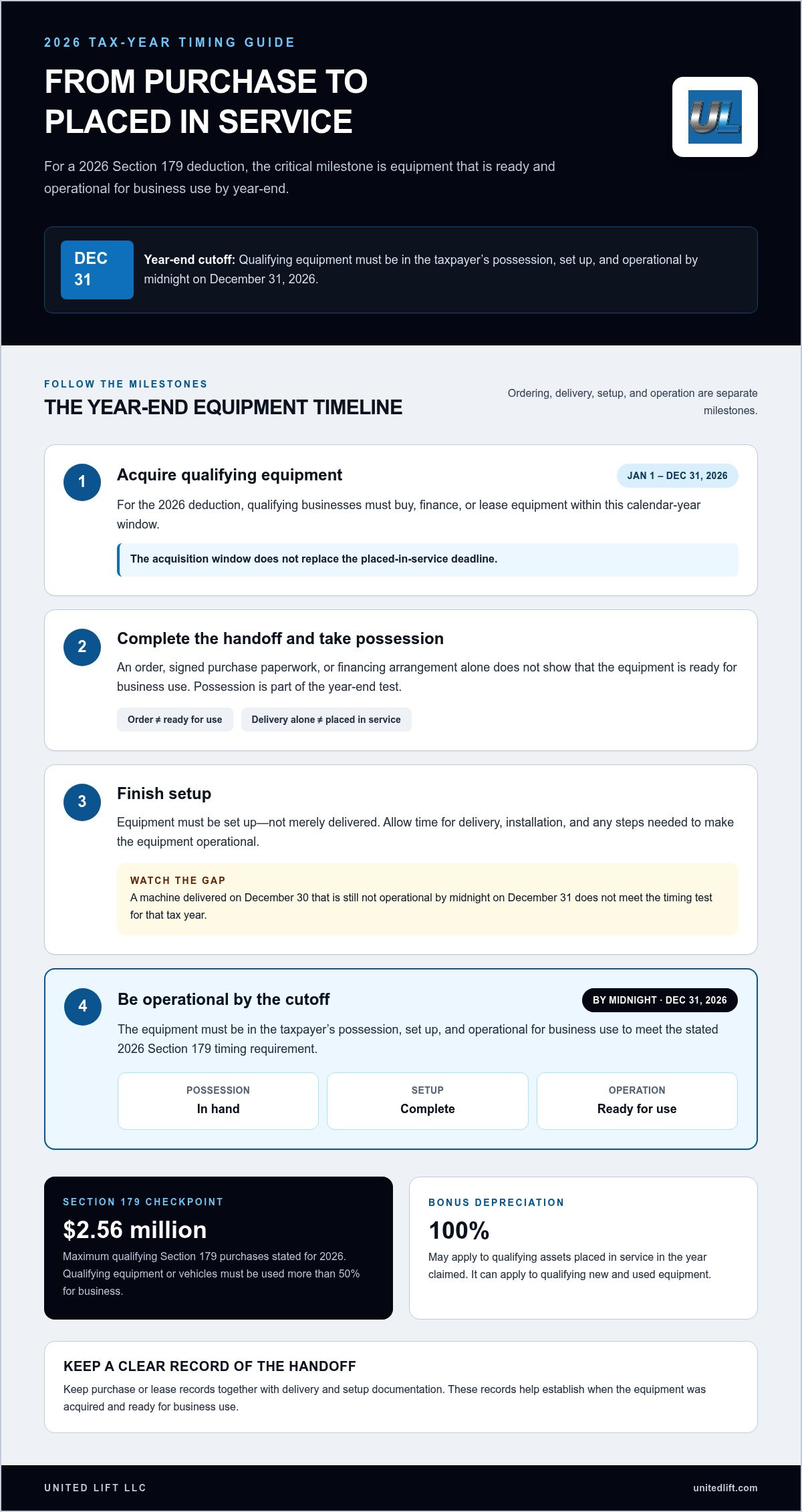
For the 2026 tax year, qualifying U.S. business equipment must be placed in service by December 31, 2026, to claim the Section 179 deduction. Ordering equipment or signing purchase paperwork before December doesn’t by itself establish that it’s ready for business use. The key timing question is whether the equipment is operational for the business by year-end.
Does equipment need to be purchased, delivered, or placed in service by December 31 to qualify? It must be placed in service by December 31, 2026. By midnight, it must be in the taxpayer’s possession, set up, and operational. A purchase date or delivery alone doesn’t meet that timing test if setup remains incomplete.
For the 2026 deduction, qualifying businesses must buy, finance, or lease equipment between January 1, 2026, and December 31, 2026. These acquisition dates define the relevant purchase window, but they don’t replace the placed-in-service deadline. A business arranging financing near year-end still needs the equipment ready for use by the cutoff.
Think of delivery, installation, and operation as separate milestones. Equipment that arrives in December but still needs setup may miss the deadline. For example, if a machine is delivered on December 30 but isn’t operational by midnight on December 31, delivery alone doesn’t make it placed in service for that tax year.
Plan for the entire handoff, not just the order date. Allow time for delivery, setup, and any steps needed to make the equipment operational—whether setting up heavy machinery or specialized medical displays from Dextro Imaging Solutions. Keep purchase or lease records with delivery and setup documentation. Together, these records help establish when the equipment was acquired and ready for business use.
Year-end timing can affect which tax year receives the expense. If equipment isn’t placed in service by December 31, 2026, it doesn’t meet the stated deadline for a 2026 Section 179 deduction. That distinction matters when comparing a late-year purchase with waiting until the equipment can be fully set up and working.
Bonus depreciation compared with Section 179
Regular depreciation spreads an eligible asset’s cost over several years, while Section 179 and bonus depreciation can accelerate deductions. The better fit depends on deduction limits, taxable income, and which assets owners want to expense.
Combining Both Depreciation Methods
Businesses can combine Section 179 and bonus depreciation to deduct qualifying equipment costs in the same tax year. Section 179 applies first to selected assets, subject to its limits; bonus depreciation can then apply to eligible remaining costs. That sequence can help allocate deductions across purchases rather than relying on one method alone.
Financing doesn’t by itself prevent an eligible deduction in the tax year equipment is placed in service. Compare the available deduction with current taxable income and future business needs.
Bonus Depreciation Under OBBBA
The One Big Beautiful Bill Act made 100% bonus depreciation permanent for qualifying assets placed in service in the year claimed, effective Jan 19, 2025. This lets a business deduct the full eligible cost in that year, rather than spreading that amount across future years.
Unlike Section 179, bonus depreciation generally applies to the qualifying property in a class, unless the business elects out. That difference matters when owners want to choose which individual assets receive immediate expensing. The deduction can also create or deepen a net operating loss, which may carry forward.
Bonus Depreciation Phase-Down Rates
Before the OBBBA change, bonus depreciation was scheduled to fall to 40% in 2025 and 20% in 2026, then end by 2027. The new 100% rule changes that scheduled phase-down for qualifying assets placed in service in the year claimed.
These past rates explain why older tax-year comparisons may show a smaller eligible amount. For a 2026 purchase, owners should distinguish those prior scheduled percentages from the current rule. Regular depreciation remains the alternative when immediate expensing isn’t selected or available, with deductions taken over time.
Year-end equipment purchase timeline
The end-of-year equipment purchase tax benefits available for a 2026 purchase depend on more than the order date. For a 2026 Section 179 deduction, qualifying equipment must be acquired during 2026 and placed in service by December 31. Build the timeline around operational readiness, not simply the day you invest capital.
Before committing, define the work the equipment must perform. Match its intended use to your operation, then consider whether the purchase makes practical sense without a tax deduction. A deduction may reduce taxable income, but it doesn’t make an unnecessary purchase worthwhile. The purchase price and the tax value of a deduction are different measures.
Next, map the milestones needed to get the equipment ready. Purchase, delivery, setup, and operational readiness are separate steps. For the 2026 deadline, equipment must be in your possession, set up, and operational by midnight on December 31. If delivery is scheduled late in December, unfinished setup can leave too little time.
- Before ordering: Identify the work need, business purpose, and tax year you’re targeting.
- During acquisition: Keep purchase, financing, or lease documents together and track delivery and setup.
- Before year-end: Record when the equipment becomes operational and retain supporting records.
Financing or leasing can be part of the acquisition, but it doesn’t remove the placed-in-service requirement. To plan for end-of-year equipment purchase tax benefits, account for both the acquisition window, January 1 through December 31, 2026, and the equipment’s readiness by the deadline. If setup slips past year-end, the intended deduction may fall into a later tax year.
Use the timeline to make a practical decision: invest when the equipment meets a real business need and can be put into service on time. Explore equipment options as you plan around your operation.
United Lift: Forklifts
United Lift LLC helps businesses compare material handling equipment when a purchase meets an operational need. Consider a forklift for moving loads, a boom lift or scissor lift for elevated work, or a telehandler for handling materials across a job site. Start with the task the equipment must perform.
As you weigh a purchase, consider whether the equipment fits your operation and can be ready for use on your timeline. Keep the business need at the center of your tax planning.
Contact United Lift LLC or visit unitedlift.com to explore equipment options.
Make Your Next Equipment Decision Count
Use tax planning to support a purchase your operation genuinely needs. Before choosing equipment, identify the work it must handle, its operating conditions, and how it will fit your workflow. This gives your tax advisor practical context for assessing the purchase in light of your business’s tax position.
Planning for end-of-year equipment purchase tax benefits works best when operational needs and tax timing are considered together. United Lift LLC offers forklifts, boom lifts, and telehandlers for businesses evaluating material handling equipment. Compare options with your job requirements and purchase timeline in mind.
A clear equipment plan makes the next conversation more productive. Discuss equipment needs with United Lift LLC and move forward with a choice that fits your operation.
Frequently Asked Questions
What Is the Section 179 Deduction?
Section 179 lets a business deduct the cost of qualifying equipment as an expense instead of depreciating it over several years. The deduction reduces taxable business income; it isn’t a dollar-for-dollar tax credit. For example, a business buying a qualifying machine can elect to expense its eligible cost, subject to the deduction limits and income rules. The business claims the election on its tax return.
How does Section 179 support business financing?
Financing can spread equipment payments while the tax deduction may apply in the year the equipment is placed in service. A business may finance with $0 down and still claim the full eligible Section 179 deduction for that tax year. The tax deduction doesn’t erase loan payments or determine whether financing fits cash flow, so consider repayment obligations separately from the tax treatment.
What type of financing option is best for me to receive Bonus Depreciation?
No particular financing type determines eligibility for bonus depreciation. The key considerations are whether the equipment qualifies and when it is placed in service. Financing can still be used: the deduction may apply for that tax year even with $0 down. Compare loan or lease terms based on payment structure and business needs, then assess the tax treatment separately with your tax advisor.
When must I make the purchase?
For a 2026 Section 179 deduction, the qualifying equipment must be bought, financed, or leased between January 1, 2026, and December 31, 2026, and placed in service by December 31. A signed order alone doesn’t establish that it’s ready for use. For instance, equipment arriving at year-end still needs to be set up and operational by the deadline.
What tax deductions are available for equipment purchases made by year-end in the U.S.?
Qualifying equipment may be eligible for Section 179, bonus depreciation, or regular depreciation. Section 179 lets the business choose qualifying assets to expense, within applicable limits. Bonus depreciation can apply to eligible new or used equipment and may allow a full deduction in the year placed in service. Regular depreciation spreads the cost over time when immediate expensing isn’t used.
What are the 2026 Section 179 deduction limit and phase-out threshold?
For 2026, Section 179 allows a deduction of up to $2.56 million, according to the Internal Revenue Service. The stated maximum qualifying-property spending amount is $4.09 million; the deduction begins to phase out as qualifying purchases exceed that threshold. Spending levels and eligible costs therefore affect the deduction available, even when each individual piece of equipment otherwise qualifies.
- Tags: bonus depreciation, business equipment, business taxes, end-of-year equipment purchase tax benefits, equipment purchases, Section 179, tax deductions, year-end tax planning
