
Explosion proof forklift standards for international operations
Posted by United Lift LLC on
Explosion proof forklift standards aren’t a one-size-fits-all checklist. Choose equipment for the specific gas or dust hazard, the truck’s power system, and the requirements of the country where it will operate. A designation suitable for one environment or market may not fit another.
A forklift’s general rating is only part of the picture. Hazard zones, temperature classes, and protective features all inform a safe selection. This guide explains how NRTL approval factors into the decision, what diesel safeguards and electrical protections can involve, and how European and international standards affect cross-border operations.
You’ll also learn what to look for on a forklift’s certification plate and why its configuration matters when conditions change. Use these points to build a practical shortlist based on your operating environment and destination market.
Key Takeaways
- Match the forklift’s approval and certification details to the hazardous area and destination market, and treat modifications as a manufacturer-controlled decision.
- For diesel equipment, understand how exhaust cooling, flame and spark arrestors, air shut-off valves, and automatic shutdown can reduce ignition risks.
- Review electrical protection as part of the complete truck configuration, not as a standalone component choice.
- Compare regional standards by hazard zone and temperature class so equipment requirements align with the materials and conditions at your site.
Nationally Recognized Testing Laboratory approval
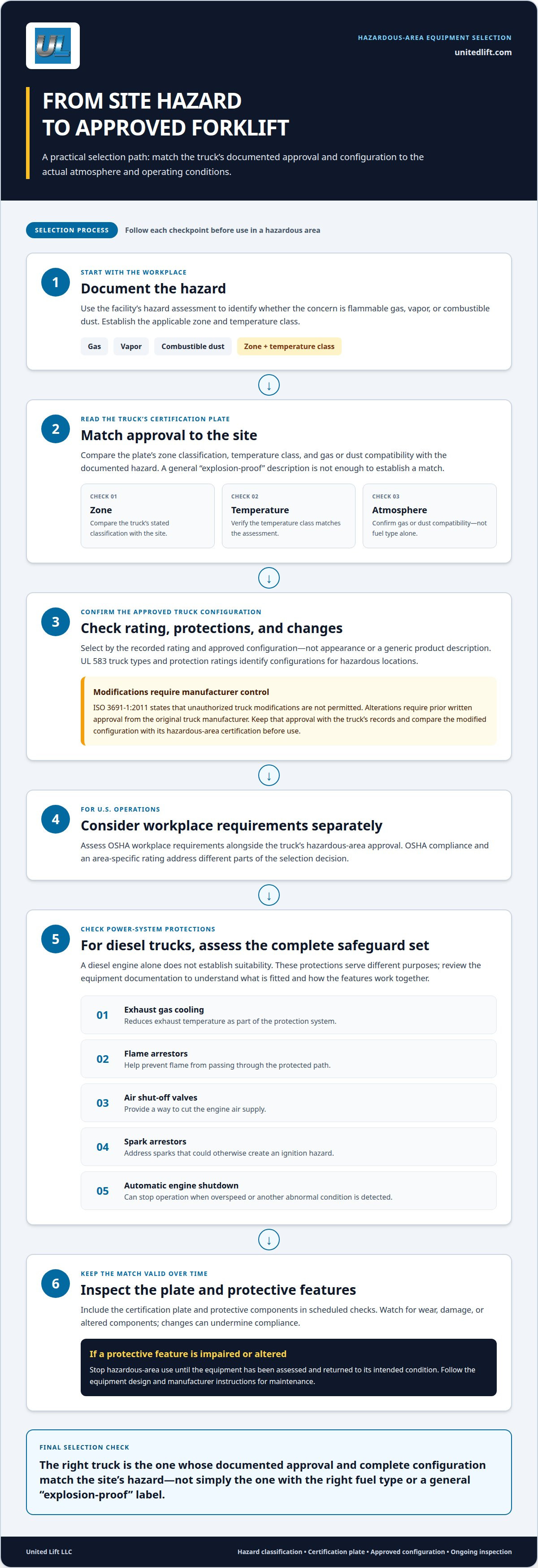
For U.S. operations, assess OSHA workplace requirements alongside the truck’s hazardous-area approval. OSHA compliance and an area-specific rating address different parts of the selection decision.
Use the site’s documented hazard classification to guide your choice. A forklift certification plate can identify the zone classification, temperature class, and gas or dust compatibility. These details help match equipment to the actual atmosphere instead of relying on a general “explosion-proof” description.
Manufacturer Approval and Truck Modifications
ISO 3691-1:2011 states that unauthorized truck modifications are not permitted. Alterations require prior written approval from the original truck manufacturer. Treat additions or component substitutions as changes to the approved configuration, not routine upgrades. Keep the manufacturer’s written approval with the truck’s records, then compare the modified configuration with its hazardous-area certification before use.
UL 583 Truck Types and Protection Ratings
UL 583 truck types and protection ratings identify equipment configurations for hazardous locations. Select by the truck’s recorded rating, not by appearance or a generic product description. Compare its certification plate with the site’s zone, temperature class, and gas or dust compatibility. If a listing does not match those conditions, that truck is not the right selection for that area.
Selecting a Forklift Rating
Start with the facility’s hazard assessment. Identify whether the concern is flammable gas, vapor, or combustible dust, then establish the applicable zone and temperature class. Compare those conditions with the certification plate and the truck’s approved configuration. Gas or dust compatibility matters as much as the zone designation. Don’t choose based on fuel type alone.
Inspection and maintenance should preserve the certified configuration. Include the plate and protective components in scheduled checks, and look for signs of wear. Damage or unauthorized changes can undermine compliance. Cost depends on the truck configuration, protection requirements, power system, and selected equipment. Noncompliance can expose workers to ignition hazards and lead to enforcement consequences under applicable workplace rules.
Diesel engine safeguards
Diesel forklifts used in hazardous areas need safeguards that address potential ignition sources. Protection can combine exhaust gas cooling, flame arrestors, air shut-off valves, spark arrestors, and automatic engine shutdown. These measures serve different purposes, so assess the complete configuration rather than assuming one component is sufficient.
Start with the hazard assessment and the truck’s certification details. Identify the atmosphere the forklift will encounter, then compare the truck’s approved equipment and safeguards with those conditions. A diesel engine alone doesn’t establish suitability. The exhaust system, air intake, shutdown controls, and other protective features must work together in the intended configuration.
- Exhaust gas cooling reduces exhaust temperature as part of the protection system.
- Flame arrestors help prevent flame from passing through the protected path.
- Air shut-off valves provide a way to cut engine air supply.
- Spark arrestors address sparks that could otherwise create an ignition hazard.
- Automatic engine shutdown can stop operation when overspeed or another abnormal condition is detected.
These safeguards aren’t interchangeable. An air shut-off valve and an automatic shutdown function, for example, address different conditions. Review the equipment documentation to understand which protections are fitted and how they work together. Keep the truck in its approved configuration, since component changes can affect whether its hazardous-area protection remains valid.
Inspection matters throughout the forklift’s working life. Include the listed safeguards in routine checks, and watch for damage, wear, or altered components. If a protective feature is impaired, remove the truck from hazardous-area work until it has been assessed and returned to its intended condition. The appropriate maintenance process depends on the equipment’s design and manufacturer instructions.
Choosing a diesel truck? Compare the work environment and required protection with suitable forklift equipment options before deciding.
Assess how each measure fits the specific truck and its approved configuration; don’t assume a single safeguard establishes suitability. Diesel forklift explosion-protection measures can include exhaust gas cooling, flame arrestors, air shut-off valves, spark arrestors, and automatic engine shutdown when overspeed or other abnormal conditions are detected.
Documentation helps confirm which protections are fitted and how they work together. Preserve the intended configuration and include safeguards in routine checks. If a feature is impaired or altered, stop hazardous-area use until the equipment is assessed and restored.
Electrical component protection
Electrical protection is intended to prevent forklift components from becoming ignition sources in the surrounding atmosphere. The right design depends on the site hazard and the truck’s approved configuration. Check the certification plate for its stated zone and gas or dust compatibility, then compare those markings with the facility’s hazard assessment.
Explosion-proof equipment is designed to contain an internal ignition and limit its ability to ignite the surrounding atmosphere. Spark-resistant designs focus on reducing sparks from specified parts or operating conditions. Nonincendive electrical equipment is designed so its circuits won’t ignite a particular hazardous atmosphere under specified conditions. These are distinct protection approaches, not interchangeable approvals.
Review the electrical system as a set of connected components. Motors, switches, wiring, connectors, and enclosures can all affect suitability. A protected motor, for example, doesn’t make an altered connector or replacement switch suitable for the same area. Compare each component with the truck’s documentation, and keep the full configuration aligned with its certification.
- Check the plate: Match its zone and gas or dust compatibility markings to the assessed work area.
- Review components: Identify how motors, switches, wiring, and enclosures are covered by the truck’s approval.
- Control changes: Don’t substitute electrical parts or reroute wiring without manufacturer approval.
- Inspect condition: Look for damaged enclosures, loose connectors, exposed wiring, and signs of wear.
A forklift assigned to an area with combustible dust needs protection compatible with that hazard. A gas-rated marking alone doesn’t establish dust compatibility. The site’s zone, atmosphere, and temperature class also guide selection, so read the complete plate rather than relying on one label or a sales description.
Document the rating and fitted electrical components during equipment reviews. In routine inspections, record damage or component changes and remove affected equipment from hazardous-area use until its approved condition is restored. This keeps the electrical protection aligned with the actual truck and operating environment.
For conversions of explosion-protected equipment, GB19854-2005 is named as a relevant Chinese local safety regulation. Include that regulation in conversion reviews, and verify applicable requirements before returning converted equipment to hazardous-area service.
European and international standards
Cross-border forklift selection means comparing the destination market’s standards with the site’s hazard classification. European documents use zones and temperature classes to describe explosive atmospheres and equipment limits. When planning international operations, compare explosion proof forklift standards with the requirements of each site rather than treating them as universal approval.
NFPA 70 hazardous locations use Class, Division, and Zone classifications. Use the facility’s documented classification to guide selection; a zone marking doesn’t automatically substitute for a Class or Division designation.
Zone numbers distinguish how often an explosive atmosphere may be present. Zone 0 describes continuously present explosive gases or vapors, while Zone 1 means gases are likely during normal operations. Zone 2 covers gases that may occur under abnormal conditions. For dust, Zone 20 means explosive dust is continuously present, Zone 21 means it is likely during normal operations, and Zone 22 covers abnormal conditions.
Temperature classes set maximum equipment surface temperatures. The listed limits are:
- T1: 450°C maximum surface temperature.
- T2: 300°C maximum surface temperature.
- T3: 200°C maximum surface temperature.
- T4: 135°C maximum surface temperature.
- T5: 100°C maximum surface temperature.
- T6: 85°C maximum surface temperature.
Compare the site’s gas or dust hazard and required temperature class with the forklift’s certification plate. Compatibility details matter alongside the zone marking. Use the site assessment to determine the appropriate class and protection.
For European operations involving ignitable powders or dusts, EN1755:2015 is identified as a relevant forklift standard. ISO 3691-1:2011 was transposed into European standards in 2012. These references don’t replace matching the equipment’s specific marking to the operating area.
Compare explosion proof forklift standards across destination markets before assigning trucks to international sites. Record each facility’s classification alongside the forklift’s plate details. This gives your team a practical basis for assessing whether the documented protection aligns with the destination facility.
United Lift: Forklifts
United Lift LLC offers forklifts for material handling operations. After identifying your site’s hazards and equipment requirements, compare truck capacity, power type, and intended work with your operation’s needs. Keep hazardous-area certification and destination-market standards central to the decision.
United Lift LLC also offers boom lifts, telehandlers, and scissor lifts for other material handling and access needs. Match each equipment category to the task. In hazardous locations, use the truck’s certification details and the site classification to guide your selection.
Have your operating requirements ready? Contact United Lift LLC to discuss forklift options, or visit unitedlift.com.
Turn your standards review into a clear equipment decision
Use explosion proof forklift standards to document each operating site’s requirements. Record the intended work, destination market, and applicable hazard classification together. This gives your team a consistent basis for comparing forklift options across locations.
Keep the review specific to the operation. A truck’s suitability depends on its documented configuration and the conditions where it will work. A clear requirements list makes equipment discussions more practical and focused on your facility’s needs.
United Lift LLC offers forklifts, boom lifts, and telehandlers. To discuss equipment for your operation, contact United Lift LLC about forklift standards. A well-organized review is a useful starting point for moving forward with confidence.
Frequently Asked Questions
What U.S. standards apply to explosion-proof forklifts?
In the United States, selection involves workplace requirements and equipment approval matched to the hazardous location. NRTL approval and UL 583 classifications are relevant references for evaluating the truck. Treat them as part of a site-specific review, not as a substitute for the facility’s hazard assessment. For example, a forklift approved for one atmosphere may not suit a different gas or dust hazard.
How are forklifts certified for Class I, II, or III hazardous locations?
Certification identifies the hazardous-location conditions a forklift’s approved configuration is designed to address. Class I relates to gas or vapor hazards, Class II to combustible dust, and Class III to ignitable fibers or flyings. Use the truck’s marking and certification records to match its approval with the facility’s classification. A Class rating alone may not capture every condition, so review the full marking.
- Tags: diesel safeguards, electrical protection, explosion proof forklift standards, explosion proof forklifts, forklift certifications, forklift safety, hazardous areas, international standards, NRTL approval
