
Forklift for Recycling Facility: Match Capacity, Fuel and Safety
Posted by United Lift LLC on
The biggest forklift isn’t always the right one. A forklift for a recycling facility commonly has a capacity between 6,000 and 10,000 pounds, but the right match depends on the heaviest load, its shape, and the ground it must cross. For heavier or uneven outdoor work, a rough-terrain or high-capacity model may be a better fit.
Choosing a forklift for a recycling facility takes more than comparing capacity ratings. Consider whether it will operate indoors or outdoors, which power type suits the work, and how operators can move loads safely around people and debris. Assess load requirements, compare electric and internal-combustion options, and match attachments to the materials handled. Balanced loads, clear communication, and trained operators are also essential to safe, efficient work.
Key Takeaways
- Match rated capacity to the heaviest load and account for how its shape and shifting contents affect handling.
- Compare power options against where the forklift works and the facility’s priorities for emissions, noise, and performance.
- Build safer material movement around operator training, load control, equipment inspections, and clear communication.
- Choose attachments for the materials being moved, from baled recyclables to loose scrap and bins.
Forklift capacities for recycling operations
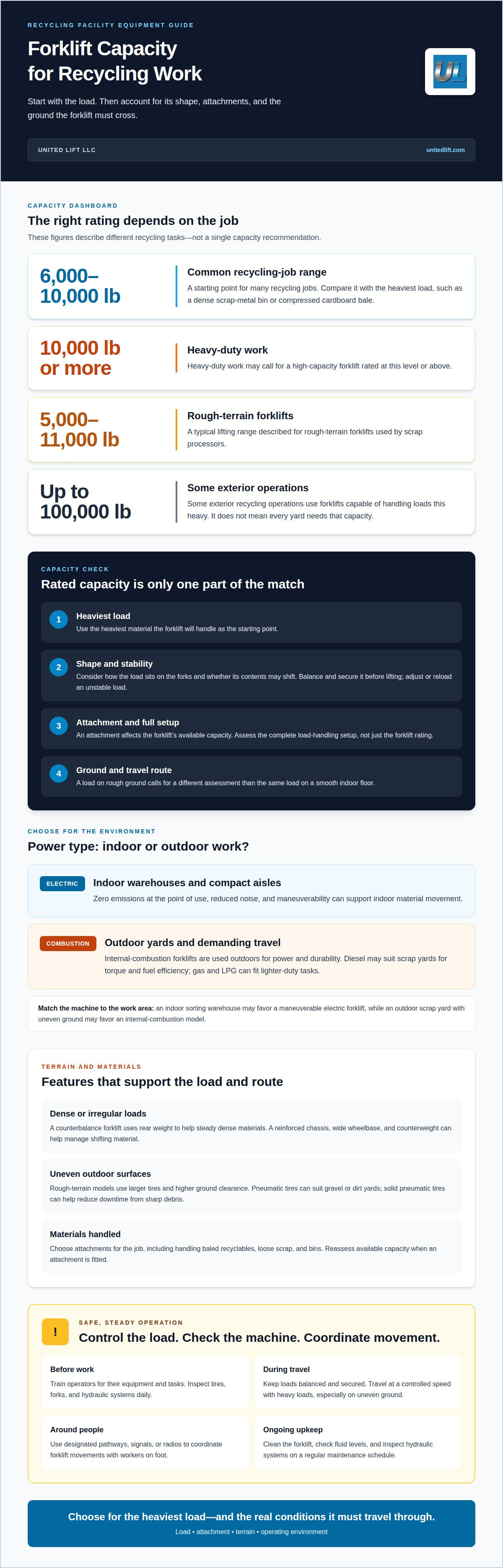
For many recycling jobs, forklift capacity falls between 6,000 and 10,000 pounds. That range is a starting point, not a universal target. Compare it with the heaviest load the machine will handle, such as a dense scrap metal bin or a compressed cardboard bale. Include the load’s shape and how securely it sits on the forks. An attachment also affects the machine’s available capacity, so consider the complete load-handling setup rather than the forklift itself.
Heavy-duty work may call for a high-capacity forklift rated for 10,000 pounds or more. Rough-terrain forklifts used by scrap processors typically lift 5,000 to 11,000 pounds. Some exterior recycling operations use forklifts capable of handling loads up to 100,000 pounds, but that figure doesn’t mean every yard needs that capacity. Match the machine to the actual material and work area. A battery-powered indoor machine and an outdoor forklift may serve different jobs, even when their rated capacities appear similar.
Stability matters as much as rated capacity. A counterbalance forklift uses rear weight to help steady dense materials such as scrap or compressed cardboard. For heavy or irregular loads, a reinforced chassis, wide wheelbase, and counterweight can help manage shifting material. Rough-terrain models use larger tires and higher ground clearance to cross uneven surfaces. Pneumatic tires can suit gravel or dirt yards, while solid pneumatic tires can help reduce downtime from sharp debris. Balance and secure each load before lifting. If it is unstable, adjust or reload it.
How should forklifts be maintained in a recycling facility? Set a regular maintenance schedule that includes cleaning the forklift, checking fluid levels, and inspecting hydraulic systems. Frequent checks can catch buildup or wear that could affect lifting or travel over debris-covered ground.
Use the rated capacity as a boundary, then account for the load, attachment, and terrain together. For example, a 6,000-pound load on rough ground calls for a different assessment than the same load on a smooth indoor floor.
Fuel, emissions, and operational efficiency
Match the power type to the work area. Electric forklifts suit indoor recycling warehouses, where zero emissions at the point of use, reduced noise, and maneuverability can support material movement. Internal-combustion forklifts are used outdoors for power and durability. Diesel may suit scrap yards because of its torque and fuel efficiency, while gas and LPG can fit lighter-duty tasks.
An indoor sorting warehouse with compact aisles may benefit from a maneuverable electric forklift. An outdoor scrap yard with uneven ground may favor an internal-combustion model. The choice affects more than fuel: the operating environment also determines how emissions, noise, and maneuverability fit into daily work.
Should a recycling facility buy, lease, or rent a forklift? Buying can suit steady, long-term use; leasing can fit operations seeking a different ownership arrangement; renting can address temporary demand. Compare expected use with the value of having equipment available, and weigh that against each option’s financial commitment.
How much does a new or used recycling facility forklift cost? Price depends on capacity, power type, condition, and attachments, so there is no single figure that applies to every facility. Compare the full operating picture, including maintenance needs and the productive work the forklift can support.
Cost efficiency also depends on output. A forklift may be due for replacement when its running costs exceed the value of the work it provides. Telematics can help managers monitor equipment use, track impacts, and identify maintenance needs. These insights can reveal underused machines or recurring problems that interrupt material handling.
Improve warehouse space efficiency by matching the forklift to the layout and task. A maneuverable electric model can suit indoor aisles, while outdoor equipment can be selected for yard travel. Keep high-volume materials near the stages they serve, such as sorting or compacting, to reduce unnecessary trips. A practical layout and effective equipment use can help control operating effort without expanding the fleet.
Safe load handling and operator training
Safe material handling depends on trained operators, clear traffic practices, and equipment suited to the work environment. Landfills, composting sites, and indoor sorting areas each present different hazards.
Forklift Rules for Recycling Facilities
OSHA’s powered-industrial-truck requirements provide a framework for operator training and safe forklift operation. Put that framework into practice with procedures tailored to the facility: train operators for their equipment and tasks, inspect tires, forks, and hydraulic systems daily, and establish clear routes for moving loads.
Landfill and composting work bring additional task-specific demands. Composting sites use forklifts to mix yard trimmings and food scraps, while transfer stations move waste between collection vehicles and larger hauling trucks. Operators need to understand the materials and routes they handle, especially where waste containers may contain hazardous or non-recyclable contents.
Common Safety Risks and Risk Reduction
Unstable loads, uneven surfaces, debris, and nearby ground workers can create collision or tip-over risks. Keep loads balanced and secured. If a load shifts, adjust or reload it before lifting. Travel at a controlled speed with heavy loads, particularly on uneven ground. Use designated pathways, signals, or radios to coordinate forklift movements with workers on foot.
Daily checks of tires, forks, and hydraulic systems can catch problems before work begins. Collision-avoidance systems can alert operators to nearby people or objects, providing an additional warning in busy work zones.
For dusty, wet, or corrosive areas, choose equipment suited to the facility’s conditions and inspect exposed electrical and hydraulic components regularly. No single feature suits every exposure, so match protective features and maintenance practices to the materials and environment. An electric forklift may fit indoor work, but operating conditions still guide equipment selection.
Recycling and waste-management facilities use forklifts to transport waste containers, including those that may hold non-recyclable or hazardous waste. Operators should coordinate each move and confirm its destination. Collision-avoidance systems can detect nearby objects or workers and alert operators to potential hazards, supporting attentive driving and clear communication in active work areas.
What forklift attachments are useful for handling recyclables and scrap?
Choose an attachment that matches the material’s shape and how it needs to be moved. Baled paper, loose metal, and mixed recycling each require a different way to grip, lift, or tip the load.
- Bale clamps: Grip compressed cardboard, paper, and plastic without requiring pallets. They’re useful where bales move from sorting areas to storage or compacting zones.
- Rotators: Pick up, turn, and dump bins of recyclables or waste. For example, an operator can rotate a collection bin over a designated sorting point.
- Fork positioners: Adjust fork spacing from the operator’s seat. This helps adapt to irregular scrap loads with different widths, without leaving the cab to reposition the forks manually.
- Magnets: Lift metal materials during recycling operations. They can support scrap handling where ferrous material needs to be moved separately from other recyclables.
Clamps can help stack recyclable items or waste materials, making better use of vertical storage space. This can be valuable when floor area is limited and materials need to stay organized. Choose an attachment based on the load and its destination: a bale clamp suits compressed paper, while a rotator suits bins that must be emptied.
Consider the full route, not just the pickup. A bin that needs to be tipped requires a different attachment from a bale that must remain intact. Scrap that varies in size may benefit from adjustable fork spacing, while separated metal may call for a magnet. Choose the tool for the specific task rather than relying on one attachment for every material.
Attachment selection should also suit the forklift and the work sequence. Consider the material, how it is collected, and where it needs to go next. A well-matched tool can simplify repeated movements, but operators still need a clear view and a stable load during pickup, travel, and placement.
Browse forklift equipment attachments to find options suited to recycling and scrap-handling tasks.
United Lift: Forklifts
United Lift LLC offers new and used forklifts for recycling operations with different material-handling needs. Narrow your options by work area, load requirements, and equipment type to find a forklift suited to the task.
When discussing options, describe the loads you handle, where the forklift will operate, and which attachments the work requires. United Lift LLC also offers equipment attachments, boom lifts, telehandlers, and scissor lifts for other material-handling and access needs.
Ready to discuss forklift options for your recycling facility? Contact United Lift LLC.
Plan Your Next Equipment Decision
Turn your facility’s work patterns into a clear equipment brief. Consider which materials move most often, where they travel, and whether the operation expects changes in volume or layout. This context helps focus the choice of a forklift for a recycling facility on the work it needs to support.
Keep future flexibility in mind. Sorting processes, storage needs, and site demands can evolve, changing how equipment is used. Account for those priorities when choosing equipment so your team has a practical basis for its next decision.
Ready to discuss the right fit for your operation? Talk through your forklift needs with United Lift LLC and take the next step with confidence.
Frequently Asked Questions
What types of forklifts are best for recycling facilities?
The right forklift depends on where it works and what it moves. Electric forklifts can suit indoor sorting buildings, while internal-combustion machines are used for outdoor waste-handling work. For a forklift for a recycling facility with rough surfaces, consider a rough-terrain design; for dense materials, a counterbalance forklift may suit the task. Match tire type, maneuverability, and attachment to the route and load.
How do I choose forklift capacity and lift height for a recycling facility?
Start with the heaviest load and the highest point where it must be placed. Include the load’s dimensions and the attachment, since both affect handling and available capacity. Then consider storage racks, truck-loading points, and clearance limits. For example, a forklift for a recycling facility that places bales on elevated storage needs a different lift height from one moving them at floor level.
Are electric, propane, or diesel forklifts better for recycling operations?
Electric forklifts can work well indoors, where zero emissions at the point of use, lower noise, and maneuverability are useful. Diesel may suit outdoor scrap-yard work that calls for torque and fuel efficiency. Gas or LPG forklifts can suit lighter-duty tasks. Compare the work location, duty cycle, ventilation, and load demands. A facility with indoor sorting and outdoor scrap handling may need different power types for each area.
Which forklift brands and models are popular for recycling facilities?
United Lift LLC’s equipment lineup includes Hyster, Yale, Toyota, and Caterpillar. Choose a model based on capacity, power type, tires, and attachment, not brand name alone. Match it to the facility’s loads and working conditions. United Lift LLC offers new and used forklifts to suit different equipment needs.
- Tags: forklift for recycling facility, forklift safety, forklifts, material handling, recycling equipment, recycling operations, rough-terrain forklifts, warehouse equipment
