
Forklift Battery Charging Best Practices: A Safe, Practical Guide
Posted by United Lift LLC on
What charging routine keeps a forklift ready for work without putting battery life or worker safety at risk? The answer depends on the battery. Forklift battery charging best practices aren’t one-size-fits-all: lead-acid and lithium-ion batteries have different charging needs, and the right routine must also fit the truck’s duty cycle.
It can be hard to know when to plug in, when to disconnect, and whether a quick top-up is suitable. A consistent process reduces guesswork and helps operators prepare equipment for the next shift. Follow the battery and charger manufacturer’s instructions, and don’t assume a habit that suits one chemistry applies to another.
This guide explains how to build a repeatable charging routine, distinguish full-cycle charging from opportunity charging, and recognize when a battery or charging setup needs attention. It also covers how to match a battery to forklift demands. United Lift offers forklifts and industrial batteries, making battery fit an important part of planning material-handling operations.
Key Takeaways
- Use forklift battery charging best practices that match the battery chemistry, forklift demands, and manufacturer instructions.
- Follow a clear routine from pre-charge inspection through reconnection to service, adjusting steps for the battery and equipment.
- Choose planned charging or opportunity charging based on battery suitability, charger design, and the work schedule.
- Watch for visible warning signs, document charging issues, and report concerns instead of attempting unqualified repairs.
- Build a team checklist for battery identification, compatible equipment, shift handoffs, and issue reporting.
Forklift Battery Charging Best Practices Start With Battery Type
Good forklift battery charging means following a repeatable, battery-specific routine that supports safe operation and keeps the truck ready for its work demands. Start by identifying the battery, then match charging habits to its chemistry, compatible charger, and shift pattern. A rule that suits one battery may not suit another.
Forklifts use traction batteries to power electric operation. The Traction battery overview provides background on these batteries and their applications. For everyday charging, rely on the instructions for the specific battery and charger. Their documentation sets the operating limits and steps. There’s no universal charge level, duration, or connection procedure that safely applies to every model.
How battery chemistry changes charging habits
Lead-acid and lithium-ion batteries store and deliver energy differently, so their charging routines aren’t interchangeable. Lead-acid batteries typically require a planned charging cycle and may have chemistry-specific care steps. Some lithium-ion systems can support opportunity charging, but only when the battery and charger instructions allow it. Don’t assume a charging method is suitable based on appearance or battery type alone.
Charging instructions can vary between battery and charger models, including what to do before, during, and after charging. Check both manuals and confirm the charger is intended for that battery. If the documents give different directions, don’t guess or combine steps. Resolve the conflict using manufacturer guidance before establishing a routine.
What to check before setting a routine
Start with four details: battery type, charger compatibility, shift length, and daily operating demand. Then map the schedule. Does the forklift run one shift, multiple shifts, or intermittent jobs with periods of downtime? A single-shift operation may have different charging windows from a truck expected to return to work quickly across shifts.
Use those details to create a practical routine, not to invent a target. Don’t prescribe a universal charge level or time without model-specific evidence. Keep the applicable instructions where operators can access them, and make handoffs account for the battery’s actual status. This gives the team clear expectations without treating every truck or workday the same.
Battery choice also affects how well a charging routine fits the operation. Match the battery to the forklift and its workload, then pair it with compatible charging equipment. United Lift offers forklifts and industrial batteries as part of its material-handling equipment lineup. The next step is to turn the manufacturer’s guidance into a consistent process operators can follow.
How to Charge a Forklift Battery Safely: A Step-by-Step Routine
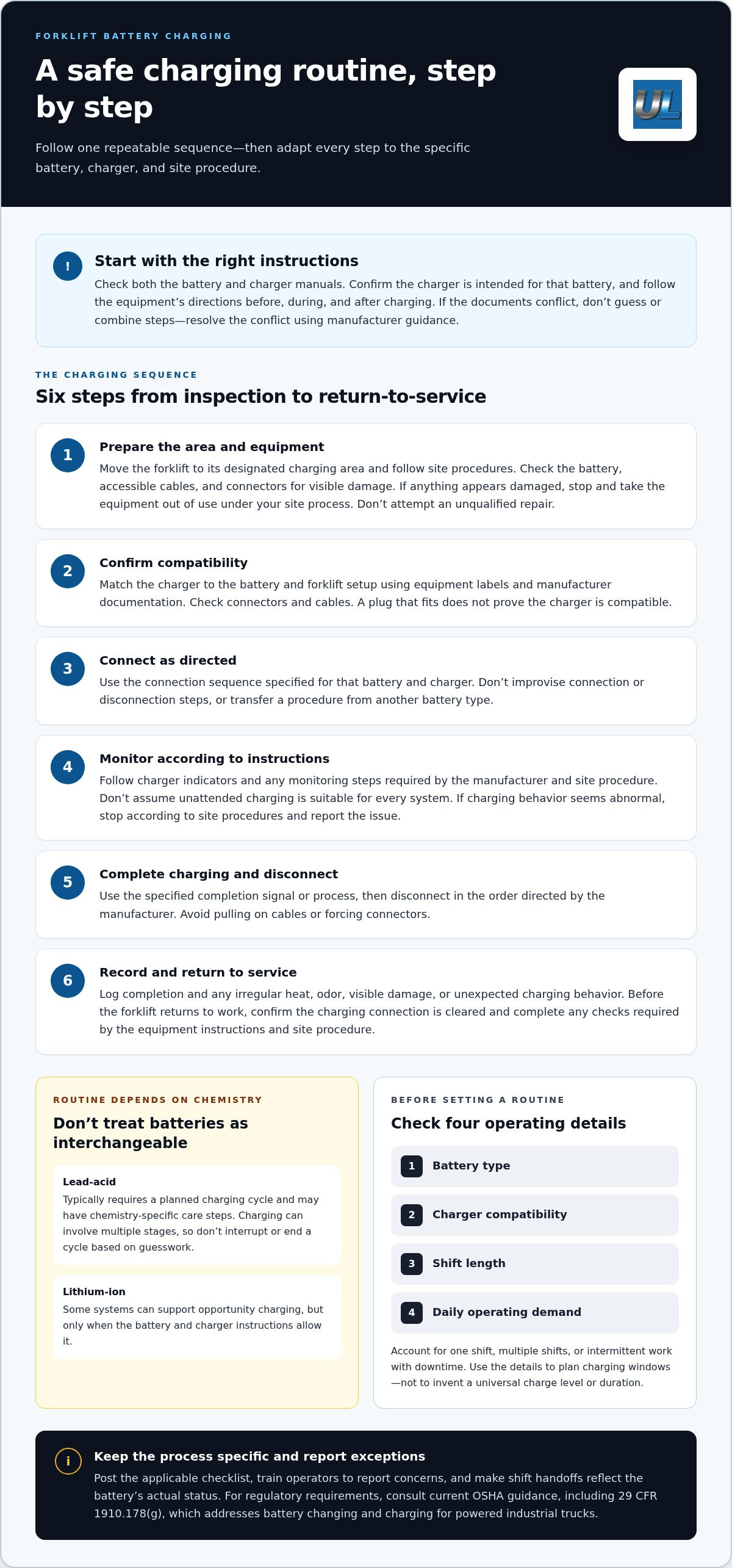
Use a consistent sequence, adapting every step to the battery and charger manuals. Lead-acid and lithium-ion systems may have different connection, monitoring, and completion instructions. Site procedures also matter. For regulatory requirements, consult current OSHA guidance, including 29 CFR 1910.178(g), which addresses battery changing and charging for powered industrial trucks.
A repeatable charging sequence
- Prepare the area and equipment. Move the forklift to its designated charging area and follow site procedures. Check the battery, accessible cables, and connectors for visible damage before handling them. If anything appears damaged, stop and take the equipment out of use under your site process. Don’t attempt an unqualified repair.
- Confirm compatibility. Match the charger to the battery and forklift setup using equipment labels and manufacturer documentation. Check that connectors and cables are in suitable condition. A plug that fits does not prove the charger is compatible.
- Connect as directed. Follow the manufacturer’s connection sequence for that battery and charger. Don’t improvise connection or disconnection steps or apply a procedure from another battery type.
- Monitor according to instructions. Follow the charger indicators and any monitoring steps specified by the manufacturer and site procedure. Don’t assume unattended charging is appropriate for every system. If charging behavior seems abnormal, stop according to site procedures and report the issue.
- Complete charging and disconnect. Use the specified completion signal or process, then disconnect in the order directed by the manufacturer. Avoid pulling on cables or forcing connectors.
- Record and return to service. Log completion and any irregular heat, odor, visible damage, or unexpected charging behavior. Before the forklift returns to work, confirm the charging connection is cleared and complete any checks required by the equipment instructions and site procedure.
Lead-acid charging can involve multiple stages, so don’t interrupt or end a cycle based on guesswork. Battery University’s overview of charging lead-acid batteries explains why charging behavior changes across a cycle. Use it as background, not as a substitute for the specific battery and charger manuals.
Turn the sequence into a posted checklist, then train operators to report exceptions rather than work around them. These forklift battery charging best practices make shift handoffs clearer while keeping the process grounded in the equipment’s instructions. If you’re reviewing equipment fit alongside your charging routine, explore United Lift’s forklifts and industrial batteries.
Opportunity Charging or Full-Cycle Charging: Which Routine Fits?
Charging during every pause may sound like an easy way to keep a forklift ready, but the right schedule depends on the battery, the charger, the manufacturer’s instructions, and how the truck is used. There’s no single charging schedule that fits every forklift battery.
A planned charging window groups charging into designated periods, while opportunity charging uses suitable breaks between work periods. Neither approach is automatically right or wrong. Use the comparison below to identify a routine that may fit your operation, then follow the instructions for the specific battery and charger.
- Planned charging periods: May suit predictable shifts with a designated time for charging. Supervisors can plan equipment availability around that window and coordinate handoffs.
- Opportunity charging: Adds charging during suitable pauses in equipment use. It may help support uptime, but only when the battery and charger manufacturers approve this practice for that system.
- Unplanned top-ups: Plugging in whenever a truck stops, without checking its instructions, is not a reliable charging strategy. A pause alone doesn’t mean the battery should be charged.
When a planned charging window may fit
A scheduled window can simplify coordination when work follows a consistent shift pattern and forklifts can be taken out of service at predictable times. For example, a supervisor can plan charging around a shift handoff instead of waiting until a battery becomes a readiness concern. Set the timing and completion process using the battery and charger manuals. Don’t assume a universal frequency or minimum downtime.
When opportunity charging may be appropriate
Opportunity charging means connecting a battery to a compatible charger during a suitable pause in equipment use, rather than relying only on one planned charging period. Some lithium-ion systems are designed to support this approach, but permission depends on the specific battery, charger, and manufacturer instructions. Don’t apply the routine to a lead-acid battery or another system unless its documentation says it’s appropriate.
For lead-acid equipment, follow the charging routine specified by its manufacturer rather than treating every break as a charging opportunity. A planned schedule can help teams follow the intended process. Frequent top-ups outside that process can create confusion about when a battery is ready for use.
To choose a routine, map actual work patterns first. Note whether trucks run one shift, multiple shifts, or intermittent jobs, then identify when equipment can be unavailable without disrupting operations. Compare that schedule with the battery and charger instructions. These forklift battery charging best practices help balance readiness with correct charging, without turning every convenient pause into an automatic plug-in cue.
Common Forklift Battery Charging Mistakes and How to Prevent Them
Charging problems often start with small workarounds: using whatever charger is nearby, skipping a visual check, or failing to tell the next shift that a charge was interrupted. A clear process helps prevent these habits from becoming routine. Use manufacturer instructions and site procedures as the reference, not assumptions based on another forklift or battery.
| Common mistake | Why it matters | Prevention |
|---|---|---|
| Using incompatible charging equipment | A matching connector alone doesn’t establish that a charger is suitable for the battery. | Check the battery and charger identification and follow their documentation. |
| Skipping visible inspections | Damage to a cable, connector, or battery surface may go unnoticed before charging. | Inspect accessible parts before use. Take damaged equipment out of use under site procedures. |
| Ignoring charging-area procedures | Disorganized work areas and missed site steps can make charging less consistent. | Use the designated area and follow posted site procedures for each charging task. |
| Applying one routine to every battery | Charging methods aren’t interchangeable across battery types and models. | Match the routine to the battery, charger, and manufacturer instructions. |
| Leaving exceptions undocumented | The next operator may not know a charge stopped early or behaved unexpectedly. | Record interruptions and report irregular behavior during the shift handoff. |
Responding to unusual charging behavior
Operators should report what they observe, not try to diagnose the cause. Examples include unusual heat or odor, visible damage, a connector that appears damaged, or charging that repeatedly stops or behaves differently than expected. Pause use when site procedures call for it, keep the equipment out of service as directed, and report the issue through the designated process. Don’t open, alter, or attempt to repair battery or charger components unless that work is specifically authorized and performed by qualified personnel.
Make the report useful. Note the forklift or battery identification, the time, what happened, any charger indication shown, and whether the issue has occurred before. Keep the details factual. A recurring interruption may need follow-up, but an operator’s observation alone doesn’t establish a fault or its cause.
Strong forklift battery charging best practices depend on compatible equipment, consistent inspections, and clear records. Review United Lift’s forklift and industrial battery options at United Lift as you plan equipment and battery choices around operating demands.
Build a Forklift Battery Charging Routine That Supports Readiness
A dependable routine should be simple enough to follow during a busy shift and clear enough to survive an operator handoff. Use this checklist as a starting point, then adapt it to your site procedures and the instructions for each battery, charger, and forklift.
- Identify the battery. Confirm its type and match it to the forklift and charger it’s assigned to.
- Check before charging. Follow the approved procedure and look for visible damage or unusual conditions. Report concerns through your site process.
- Follow the right instructions. Keep battery, charger, and forklift manuals accessible to the staff who need them.
- Record charging status. Log completion and note interruptions or unexpected behavior so the next operator knows what happened.
- Make the handoff clear. Share the battery’s status and any reported issue before the forklift returns to work or changes shifts.
A practical routine for operators and supervisors
Assign responsibility for following the approved charging procedure and documenting exceptions. Operators need to know where instructions are kept and how to report issues. Supervisors need a consistent way to review those records. If downtime or charging interruptions keep recurring, look for patterns before changing the routine. Recording which forklift, battery, and charger were involved can make that review more useful.
Keep the checklist focused on actions, not diagnosis. Staff should report what they observed and follow site procedures for equipment that may be damaged or behaving unusually. Don’t rely on memory alone, especially when batteries move between operators or work periods.
Match future battery decisions to operating demands
Use routine records to inform future equipment planning. Consider battery type, forklift compatibility, shift pattern, charging opportunities, and actual work demand together. For example, a multi-shift operation with limited downtime has different planning needs from intermittent work with predictable charging windows. These details can help guide battery and forklift selection without assuming one setup suits every operation.
For broader equipment-planning considerations, read the Ultimate Forklift Buying Guide for Industrial Success in 2026. United Lift offers forklifts and industrial batteries, so you can explore those options as you assess what fits your operation. The goal is a practical match between equipment, battery, and daily demands.
Use forklift battery charging best practices as a working process: make instructions easy to find, keep handoffs specific, and record exceptions. A routine staff can follow consistently gives supervisors a clearer picture of readiness and recurring needs.
Put a Consistent Charging Routine to Work
Reliable forklift charging starts with the right match: battery chemistry, compatible charger, manufacturer instructions, and the demands of the shift. A repeatable process helps operators prepare, charge, record completion, and report unusual behavior. Clear handoffs help the next shift understand whether equipment is ready.
Build your routine around the actual work pattern. Don’t assume every battery should follow the same schedule or be charged whenever a forklift pauses. The best forklift battery charging best practices are the ones your team can follow consistently while respecting the instructions for each battery and charger.
As you plan equipment needs, consider battery and forklift compatibility alongside workload and charging opportunities. United Lift offers new and pre-owned material-handling equipment, including forklifts and industrial batteries. Explore United Lift’s forklift and industrial battery options as you plan for your operation.
Start with clear instructions, make the handoff simple, and review charging issues before changing the process. Small, consistent steps can help your team build a safer routine and keep work moving.
Frequently Asked Questions
How often should you charge a forklift battery?
Charge it according to the battery and charger instructions, the battery’s condition, and the forklift’s work schedule. There isn’t one schedule that suits every battery or operation. A truck used across multiple shifts may need a different charging plan from one used intermittently. Set the routine around manufacturer guidance and operating demand, then record interruptions or unexpected charging behavior so supervisors can review recurring issues.
Can you charge a forklift battery during breaks?
Yes, if the battery and charger manufacturers permit opportunity charging for that system. A suitable pause may provide a charging window, but don’t assume every break is an invitation to plug in. Charging habits differ by chemistry and model. Check the instructions before adding short charging periods to the routine, and make sure operators know which batteries are approved for that approach.
Should forklift batteries be fully charged before use?
Follow the battery and forklift instructions for the required charge status before operation. Don’t assume every battery must be fully charged before every use, or that a partially charged battery is always ready for work. The appropriate level depends on the battery design, charging routine, and operating demands. Use the charger’s specified completion indication and site procedures to determine when the equipment can return to service.
Is it safe to leave a forklift battery charging overnight?
Follow overnight charging practices only if the battery and charger instructions and your site procedures allow them. Don’t treat unattended or overnight charging as safe for every battery or setup. Check the designated charging-area requirements, use compatible equipment, and follow any monitoring directions. If the charger behaves unusually or the battery shows visible damage, follow site reporting procedures rather than leaving the issue for the next shift.
What happens if you use the wrong charger for a forklift battery?
An incompatible charger may not follow the battery’s required charging limits or process, which can create charging problems, damage equipment, or introduce safety concerns. A connector that fits doesn’t prove compatibility. Match the charger to the battery using equipment identification and manufacturer documentation. If the charger is uncertain or charging behavior seems unusual, stop and follow site procedures instead of trying different chargers.
How do you know when a forklift battery is fully charged?
Use the completion indicator or procedure specified by the charger and battery manufacturer. Don’t rely on a universal charging time, sound, or appearance to judge completion. Charger displays and instructions can differ by model and battery type. Record the charging status as your site process requires. If the charger doesn’t show the expected completion signal or repeatedly stops early, report the behavior and avoid guessing at the battery’s condition.
Do lead-acid and lithium-ion forklift batteries charge the same way?
No. Lead-acid and lithium-ion batteries have different charging requirements, and their routines aren’t interchangeable. Some lithium-ion systems may support opportunity charging, while other batteries require a different schedule. The correct approach depends on the specific battery and charger instructions, not chemistry alone. These forklift battery charging best practices start with identifying the battery, confirming charger compatibility, and following the applicable manufacturer guidance.
- Tags: forklift battery charging, forklift battery charging best practices, forklift maintenance, industrial batteries, lead-acid batteries, lithium-ion batteries, material handling, opportunity charging, warehouse safety
