
Forklift Battery Replacement: Complete Industrial Power & Sizing Guide (2026)
Posted by United Lift LLC on
Your forklift battery isn't just an electrical fuel tank; it's a structural counterweight engineered to keep your entire machine stable under heavy loads. Treating a forklift battery replacement as a routine swap can quickly compromise truck balance, trigger unexpected downtime, and disrupt daily warehouse throughput. If you're struggling with sluggish lift speeds, fading shifts, or confusion over tray dimensions and amp-hour ratings, you're facing a challenge shared across busy material handling operations nationwide.
You don't have to guess your way through technical spec sheets or worry about getting the wrong fit. You'll master industrial battery replacement by accurately diagnosing cell wear, matching exact voltages and compartment dimensions, comparing lithium-ion against traditional lead-acid chemistries, and safely executing the changeout. Here is your complete sizing and industrial power roadmap to keep your electric fleet running at full capacity.
Key Takeaways
- Recognize physical sulfation, voltage drops under load, and cycle life limits before battery failure halts warehouse operations.
- Spec your forklift battery replacement accurately by cross-referencing truck data plates for voltage, amp-hour capacity, and minimum counterweight requirements.
- Compare sealed lithium-ion systems against traditional lead-acid chemistries to determine which power source fits your shift schedules and charging infrastructure.
- Follow strict safety protocols, PPE mandates, and approved lifting equipment practices during heavy industrial battery swaps.
- Protect your operational budget by utilizing flexible capital leasing and direct equipment financing to upgrade your fleet power.
Signs Your Forklift Battery Needs Replacement
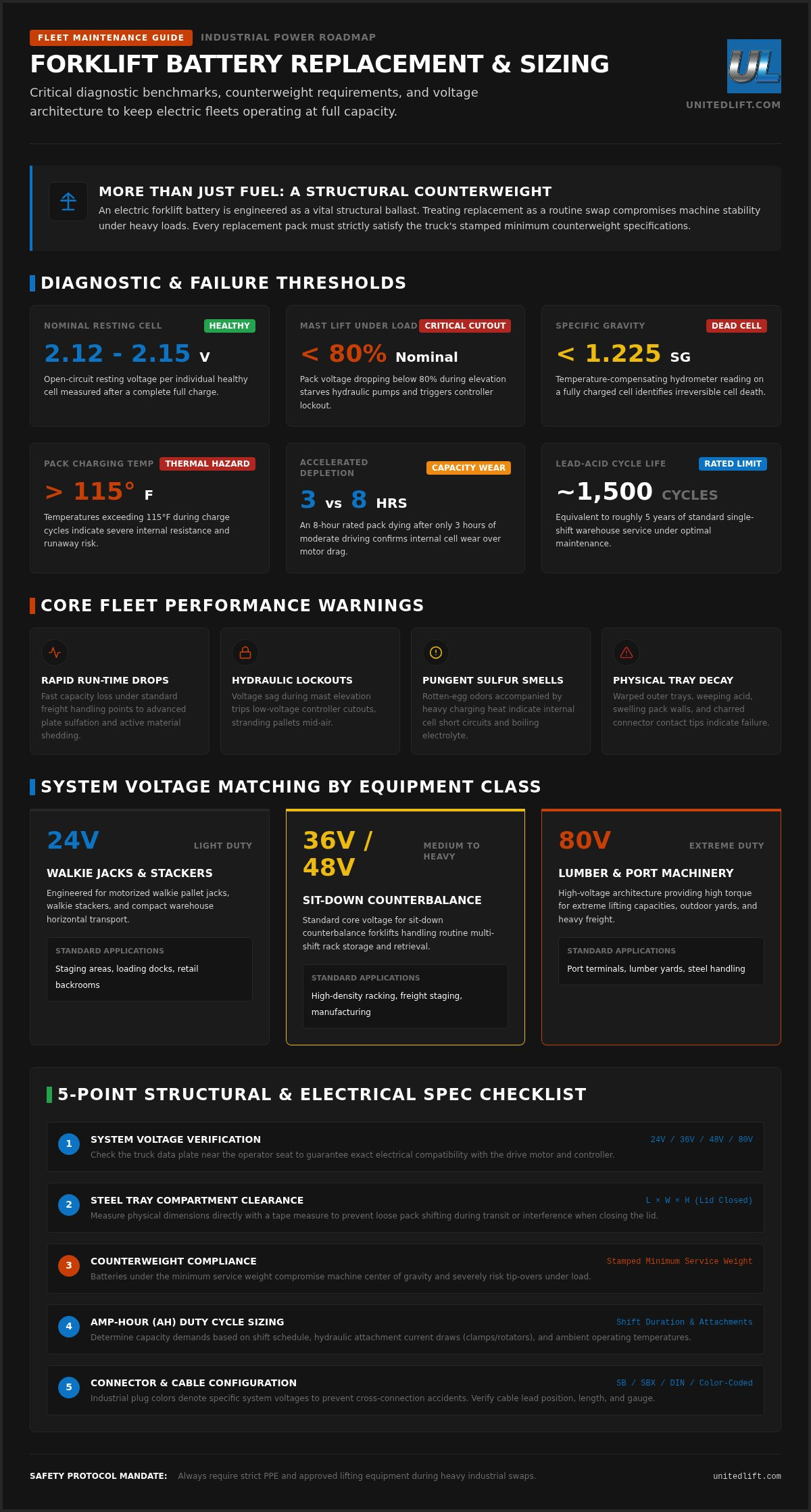
Standard lead-acid industrial batteries deliver approximately 1,500 charging cycles under optimal care. In a standard single-shift warehouse, that equals roughly five years of reliable service. Pushing a battery past this threshold often leads to sharp performance drops, unpredictable downtime, and costly disruptions to your warehouse throughput. Knowing when to plan a forklift battery replacement keeps your operators moving freight instead of waiting on sluggish trucks.
Watch for these core performance warnings across your fleet:
- Sudden run-time drop-offs: Rapid capacity loss under standard loads indicates advanced lead plate sulfation and active material shedding.
- Lift hydraulic lockouts: Severe voltage sag during mast lift triggers low-voltage controller cutouts, stranding loads mid-air.
- Pungent sulfur smells: Rotten-egg odors paired with high heat during charging signal internal short circuits and boiling electrolyte.
- Severe case corrosion: Weeping acid, crusty terminal crystallization, and degraded steel trays show irreversible physical decay.
Electrical Symptoms and Runtime Loss
Start your diagnosis with basic electrical testing. Measure the open-circuit resting voltage across the pack after a full charge. A healthy cell reads about 2.12 to 2.15 volts open-circuit. Next, measure pack voltage while the operator elevates the mast under full load. If the pack drops below 80 percent of its nominal rating during elevation, your capacity is compromised. Electric forklifts demand steady voltage to power hydraulic pumps; voltage sag here starves the motor and triggers premature battery discharge indicators.
Use a temperature-compensating hydrometer to verify individual cell chemistry. Specific gravity readings below 1.225 on a fully charged cell identify dead or failing cells. If two or three cells lag behind the rest, the weak cells drag down the entire series string. Track daily operating hours as well. If an eight-hour battery dies after three hours of moderate driving, run-time loss points to battery wear rather than drive-motor drag.
Physical Degradation and Thermal Warnings
Inspect the steel tray and cell covers during your pre-shift walkarounds. Warped outer steel trays, swelling pack walls, and cracked plastic covers mean the internal plates have expanded from severe sulfation. Thermal damage is equally dangerous. Use an infrared thermometer to measure pack temperatures during charging cycles. Temperatures exceeding 115 degrees Fahrenheit signal severe internal resistance and thermal runaway risks.
Examine the charging leads and connectors closely. Charred lead cable heads, brittle or cracked insulation, and pitted contact tips create heavy electrical resistance. This burns extra power and generates heat at the connection point. When physical and electrical symptoms appear together, sourcing a complete forklift battery replacement is the safest, most cost-effective path to restoring fleet productivity.
How to Choose the Right Industrial Battery Replacement
Selecting the wrong battery can shut down a truck before it even starts a shift. Every machine requires a specific physical and electrical match. Start your search by reading the forklift data plate near the operator seat. This metal tag lists the system voltage, compartment size limitations, and the exact weight range required for safe operation. Take a tape measure to the physical battery compartment, checking length, width, and height clearances with the lid closed. Don't forget connector compatibility. Verify cable lead position, length, gauge, and connector color, because industrial plug colors represent specific voltages to prevent cross-connection accidents.
When planning your next forklift battery replacement, cross-check these five structural and electrical points:
- System voltage: Identify whether the machine runs on a 24V, 36V, 48V, or 80V electrical system.
- Tray dimensions: Measure the steel compartment to allow proper clearance without loose shifting during transit.
- Counterweight compliance: Match the truck's stamped minimum service weight to protect load capacity.
- Amp-hour rating: Select capacity based on shift length, attachment draws, and ambient warehouse temperature.
- Connector configuration: Confirm lead length and plug type (such as SB, SBX, or DIN plugs) match your charging infrastructure.
Matching Voltage and Capacity to Duty Cycles
Voltage dictates power delivery. Walkie pallet jacks and small stackers generally operate on 24V systems. Standard sit-down counterbalance forklifts utilize 36V or 48V power, while heavy-duty lumber or port machinery steps up to 80V architectures. Amp-hour (Ah) ratings determine your run time. Light, single-shift dock work runs smoothly on moderate Ah packs. Demanding operations, such as cold-storage facilities or continuous high-mast lifting with carton clamps, require high-capacity Ah units to sustain throughput. Always match your battery's Ah rating with charger output profiles to prevent plate overheating and chronic undercharging.
The Critical Role of Battery Counterweight
Electric lift trucks rely on battery mass to stabilize elevated loads. The battery serves as part of the vehicle's functional counterweight system. If you install an underweight pack, the forklift's center of gravity shifts forward under load, dramatically increasing the risk of forward tip-overs. Adhering to OSHA safety standards requires keeping industrial equipment within rated manufacturer specifications. Always review the truck data plate for the stamped minimum battery weight. If your replacement unit is lighter than required, you must install approved steel counterweight trays to bring the mass back into legal operating tolerance. If you need help finding exact-fit options for your machinery, explore our nationwide inventory of industrial batteries and electric lift trucks.
Lithium-Ion vs. Lead-Acid Forklift Batteries: Fleet Comparison
Choosing between lithium-ion and lead-acid chemistries defines your warehouse productivity for years. Traditional lead-acid units remain common across material handling, but they carry rigid operating demands. They require scheduled watering routines, regular equalization charging, and dedicated charging rooms with active exhaust ventilation. In contrast, lithium-ion packs offer fully sealed, zero-maintenance operation. Their integrated battery management systems constantly monitor cell voltages, state of charge, and temperatures to maximize efficiency.
Reviewing capital equipment options from United Lift LLC helps fleets transition efficiently between these power platforms. Consider how the two chemistries compare across key operational metrics:
- Daily maintenance: Lead-acid demands weekly distilled water replenishment and acid neutralizer washes; lithium requires zero fluid checks.
- Charging flexibility: Lithium supports rapid opportunity charging during breaks; lead-acid requires uninterrupted eight-hour charging cycles.
- Cycle life: Lead-acid yields around 1,500 charging cycles; lithium units deliver 3,500 or more cycles before retirement.
- Floor footprint: Lead-acid setups consume warehouse square footage for changing hoists; lithium stays inside the truck.
Operating Cost and Maintenance Requirements
Factor labor into your power equation. Managing lead-acid batteries involves watering schedules, acid spill containment kits, and periodic eye-wash station inspections. Swapping discharged batteries between shifts also ties up warehouse personnel. Opportunity charging changes the entire routine. Operators plug lithium-powered trucks directly into fast chargers during 15-minute breaks or lunch periods. This practice eliminates spare battery inventory and heavy swapping equipment. Check your facility's electrical distribution panel first. Fast chargers draw high amp loads, so verify your transformer capacity before installing high-rate charging banks across the warehouse floor.
Lifecycle Longevity and Multi-Shift Operations
Calculate your operating hours to see where each chemistry fits best. For single-shift warehouses running five hours a day, a lead-acid forklift battery replacement often meets operational targets effectively. Heavy 24/7 multi-shift logistics hubs tell a different story. In multi-shift applications, lithium-ion eliminates two to three battery swaps per truck every single day. A lithium unit can easily outlast the forklift chassis itself, allowing you to transfer that power pack into a newer machine later. Consult The Ultimate Forklift Buying Guide for Industrial Success in 2026 for deeper insights into fleet power strategies and machinery lifecycles.
Safe Forklift Battery Replacement and Installation Procedure
Handling industrial power units demands strict operational discipline. These units weigh several thousand pounds and contain concentrated chemical energy. Before initiating a forklift battery replacement, park the lift truck on smooth, level concrete. Lower the mast and carriage until the forks rest flat on the floor. Apply the parking brake, shut off the ignition, and pull the emergency battery disconnect lever to cut all live circuits across the machine.
Every technician involved in the changeout must suit up in appropriate personal protective equipment (PPE). Put on heavy acid-resistant neoprene gloves, a chemical splash apron, and a full-face safety shield paired with impact goggles. Remove all wristwatches, rings, and metal jewelry to eliminate electrical arc hazards around high-amperage terminals.
Follow this systematic procedure for every pack extraction and installation:
- Rigging setup: Connect a non-conductive lifting beam or approved spreader bar rated above the battery's maximum gross weight.
- Vertical extraction: Lift the spent battery straight up until the bottom plate clears the chassis lip, keeping the load steady and level.
- Roller extraction: For side-extract models, align the transfer cart rollers precisely with the compartment deck and unlock the retention latches.
- Cable clearance: Guide the battery cables clear of the compartment rim during movement to avoid shearing insulation or pinching copper strands.
- Pack seating: Lower the fresh unit squarely into the compartment tray, ensuring it rests evenly on the internal chassis stops.
- Retention lock: Reinstall side gates, spacer blocks, and heavy retention brackets to lock the pack securely in place.
OSHA Compliance and Lifting Rigging Safety
Standard 29 CFR 1910.178 mandates strict protocols for powered industrial truck battery charging and replacement areas. Never use standard steel chains or uninsulated wire slings directly across open battery cells. Doing so risks a catastrophic direct short across positive and negative terminal links. Always use non-conductive composite or rubber-coated spreader bars. Maintain a certified eyewash station capable of providing a 15-minute flush, along with neutralizer kits and baking soda, within 25 feet of the swap location.
Post-Installation Inspection and System Verification
Lock down the compartment mechanical stops before reconnecting power. Battery movement during emergency braking can fracture battery cases and crush hydraulic hoses. Once secured, use a calibrated digital multimeter to verify resting polarity and overall pack voltage at the main Anderson plug. Plug the connector firmly into the truck receptacle until the mechanical latch clicks shut. Turn on the ignition key. Cycle the hydraulic lift mast through its full extension and drive several yards at low speed to confirm steady voltage delivery without dashboard error fault codes. If your facility needs heavy-duty equipment or reliable power units to keep your warehouse running smoothly, browse industrial batteries and forklifts from our extensive inventory.
Maximizing Battery Life and Financing Your Power Upgrade
Extending the lifespan of your industrial power packs preserves your operating margins. For operations running traditional wet-cell units, adhering strictly to the "8-8-8 rule" is critical: eight hours of active work, eight hours of full charging, and eight hours of cool-down time. Pulling a lead-acid battery off the charger early causes heat accumulation and accelerates internal grid erosion. Equally important is managing your discharge limits. Never run an industrial pack past an 80 percent depth-of-discharge (DoD). Operating past this 20 percent remaining capacity threshold causes excessive heat, degrades active plate material, and shortens cycle life prematurely.
Watering habits also make or break a battery's working lifespan. Always fill cells with deionized or distilled water after the charging cycle completes. Adding water prior to charging causes the expanding electrolyte to boil over, washing away vital sulfuric acid and reducing overall pack capacity.
Daily and Weekly Maintenance Best Practices
Implement weekly equalization cycles on your fleet chargers. Equalization delivers an extended, low-current overcharge that balances cell voltages and dissolves tough sulfate crystals formed during daily use. Wash the tops of your steel trays monthly using a neutralizing mixture of baking soda and water. Wet, conductive acid residues create stray electrical paths between cell terminals, draining power continuously even when the forklift is parked. Record weekly hydrometer readings and water addition dates in a master fleet log to spot deteriorating cells before they cause sudden warehouse disruptions.
Fleet Power Financing and Upgrade Strategies
When multiple units reach retirement age simultaneously, funding fleet power can strain available capital. Direct equipment financing and capital leasing options allow you to spread equipment expenditures into manageable monthly payments. This approach frees up working capital for daily operational expenses while securing modern power systems immediately.
Assess overall truck condition before investing in new power. If an aging machine requires extensive hydraulic or drive-motor repairs, pairing a new pack with an older chassis might not yield the best return. Sourcing a late-model electric forklift with fresh battery capacity often proves more economical. You can connect with nationwide specialists at United Lift to source reliable industrial batteries, explore premium electric lift machinery from brands like Toyota, Hyster, and Yale, and set up financing tailored to your facility's operational throughput.
Keep Your Operations Moving at Full Capacity
Managing your industrial power isn't just about avoiding a dead truck on a busy morning. A planned forklift battery replacement protects vehicle stability, eliminates unplanned operational pauses, and lowers your overall cost per operating hour. Matching voltage requirements, verifying minimum counterweight ratings, and choosing between low-maintenance lithium-ion and traditional lead-acid keep your facility running safely and efficiently.
Ready to upgrade your electric fleet? Explore Heavy Equipment & Power Solutions at United Lift. We deliver nationwide sales access to high-performance electric material handling machinery, industrial attachments, and power units from proven brands like Toyota, Yale, and Hyster. Take advantage of direct equipment financing and capital leasing options designed to preserve cash flow while modernizing your material handling operations. Get the dependable power your warehouse demands today.
Frequently Asked Questions
How much does an industrial forklift battery weigh on average?
An industrial forklift battery typically weighs between 1,500 and 4,500 pounds, depending on system voltage and amp-hour capacity. Standard 36V packs for mid-sized trucks often weigh roughly 2,000 to 3,000 pounds, while heavy 48V or 80V units easily exceed 4,000 pounds. This heavy mass is engineered deliberately into the unit because the truck chassis depends on the battery's physical weight to serve as an operational counterweight during lifting.
Can I replace a lead-acid forklift battery with a lithium-ion battery directly?
Yes, you can retrofit most electric forklifts with a lithium-ion unit, but you must account for weight and charging hardware. Because lithium cells are significantly lighter than lead plates, a lithium forklift battery replacement often requires an integrated steel ballast tray to meet the truck's stamped minimum counterweight. You also need a dedicated lithium charger configured for high-frequency output and internal battery management system communication rather than standard lead-acid profiles.
How long should a properly maintained forklift battery last in a warehouse?
A well-maintained lead-acid battery typically lasts about five years, delivering roughly 1,500 charging cycles under standard single-shift usage. If your team practices strict watering routines, avoids deep discharges beyond 80 percent, and allows full cool-down periods, units can reach 1,800 cycles. Sealed lithium-ion systems generally last much longer, delivering 3,500 cycles or roughly 8 to 10 years of consistent multi-shift service before dropping below usable threshold limits.
What happens if a replacement battery is lighter than the manufacturer specification?
Installing an underweight battery creates an immediate, dangerous tip-over hazard by shifting the forklift's operational center of gravity forward. Electric lift trucks rely strictly on the battery's bulk as a counterweight against mast loads. If a replacement pack falls below the minimum service weight stamped on the truck's data plate, rated lifting capacity is instantly compromised. You must install manufacturer-approved steel ballast plates inside the tray to restore required counterweight mass.
Is opportunity charging harmful to standard lead-acid forklift batteries?
Yes, frequent opportunity charging severely degrades standard lead-acid batteries. Lead-acid chemistry is built around full 8-hour charge cycles and requires an 8-hour chemical cool-down phase. Plugging in a lead-acid unit during short 15-minute breaks generates excessive internal heat, accelerates positive grid corrosion, and burns through rated cycle life prematurely. Only specialized lithium-ion systems are engineered to handle short, repeated opportunity charging sessions safely without shortening battery lifespan.
What safety gear is mandatory when changing or handling industrial forklift batteries?
Technicians performing a forklift battery replacement must wear full acid-resistant personal protective equipment to meet OSHA safety standards. Mandatory gear includes heavy-duty neoprene or rubber gloves, an acid-resistant apron, impact safety goggles, and a full-face shield. Technicians should also wear steel-toe boots with metatarsal guards to protect against heavy crushing injuries. Always remove all rings, watches, and metal jewelry before working around exposed electrical terminal links.
Can I change an industrial forklift battery without an overhead hoist or crane?
Yes, but only if your forklift is engineered for side-extraction rather than vertical removal. Side-extraction compartments allow you to slide the battery onto an approved roller bed transfer cart or dedicated pallet jack attachment. Never attempt to drag, lever, or push an industrial battery manually with chains or loose straps. The sheer weight will ruin roller guides, damage compartment wiring, and pose severe crush hazards to nearby technicians.
- Tags: electric forklifts, fleet maintenance, forklift battery replacement, industrial batteries, lead-acid batteries, lithium-ion batteries, material handling, warehouse equipment
