
Rough Terrain Forklift Capabilities for Construction
Posted by United Lift LLC on
A rough-terrain forklift for construction moves materials across unpaved, uneven job sites where standard forklifts may struggle. OSHA classifies rough-terrain forklifts as Class VII. Rugged tires and higher ground clearance help these machines travel over difficult outdoor terrain.
Construction sites demand more than lifting power. The right machine must also suit the ground, load, and placement point. A telescoping-boom model can position loads at different distances and heights, while a vertical-mast model suits outdoor material handling when the required reach is more direct.
Learn what distinguishes an all-terrain forklift from other lift trucks, how construction crews use one, and how tires and ground clearance support work on rough terrain. This guide also explains practical selection factors, including site conditions, load requirements, reach, and safe operation, to help match equipment to the job.
Key Takeaways
- Match the forklift type to the site: rough-terrain models suit outdoor, uneven ground, while industrial forklifts are designed for flat, stable surfaces.
- Choose capacity and reach around the heaviest load and its placement point; a telescoping boom can extend where materials are delivered.
- Class VII identifies rough-terrain forklifts, but it doesn’t mean every machine can safely handle every surface or site condition.
- Rugged tires and higher ground clearance help these forklifts work across difficult outdoor terrain. Learn what to consider when assessing the ground and machine fit.
- Compare brands and models by the job’s terrain, load, and reach needs rather than choosing by name alone.
What is an all-terrain forklift truck?
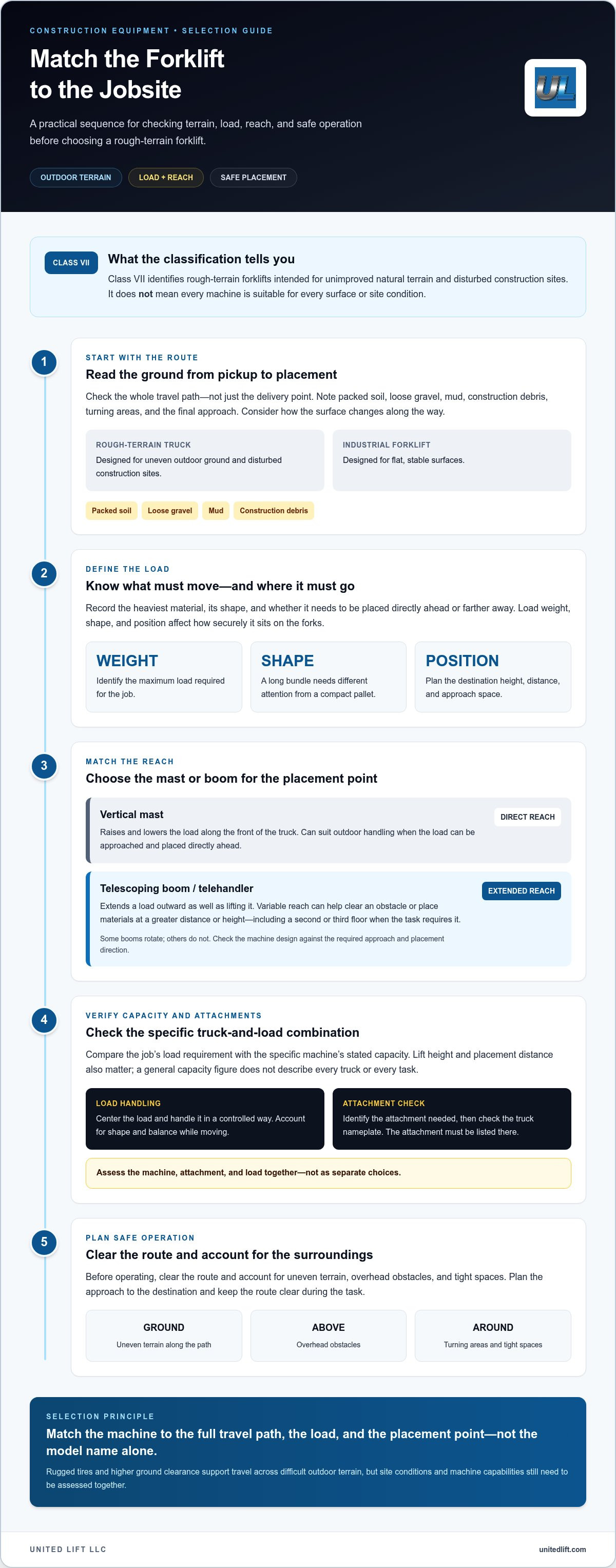
Rough-terrain forklifts and telehandlers are designed for uneven outdoor ground; standard forklifts are better suited to flat, stable surfaces. Before operating, clear the route and account for uneven terrain, overhead obstacles, and tight spaces.
Terrain and Load Selection
Start with the route, not just the delivery point. Note whether it crosses packed soil, loose gravel, mud, or construction debris, and consider how the surface changes between pickup and placement. Class VII rough-terrain forklifts are intended for unimproved natural terrain and disturbed construction sites, but the classification alone does not make every machine suitable for every surface.
Next, define the load and its destination. Record the heaviest material, its shape, and whether it must be placed directly ahead or farther away. A telescoping-boom rough-terrain forklift can place loads at varying distances and heights. That reach can suit tasks a vertical mast cannot handle, such as placing materials on a second or third floor.
For example, moving bundled lumber across a rutted outdoor site calls for a different machine match than moving materials across a finished, level floor. Consider the ground along the entire travel path, turning areas, and final approach. These details help distinguish a rough-terrain machine from an industrial forklift designed for stable floors.
Telehandlers are variable-reach forklifts with telescoping booms, which may or may not rotate. A rotating boom changes how the machine can approach a placement point. Compare the required reach and placement direction with the machine’s design rather than treating all telehandlers and rough-terrain forklifts as interchangeable.
Load Capacity and Stability
Identify the maximum load the job requires before selecting a machine. That figure is not a capacity rating for every model. Compare the specific load requirement with the machine’s stated capacity, and consider how placement distance and lift height affect the task.
Keep load balance central to the selection. A load’s weight, shape, and position affect how securely it sits on the forks. Center the load and handle it in a controlled way. A long bundle, for example, needs different attention from a compact pallet because its length can affect balance and visibility during movement.
Attachments also affect the handling setup. Identify the attachment needed for the material, then check the forklift nameplate for the truck specifications and listed attachment. The attachment must appear there. Consider the machine, attachment, and load as one operating combination rather than choosing an attachment separately from capacity requirements.
Plan the placement before lifting. Check the destination’s height, approach space, and distance from the machine. A telescoping boom lets the operator place loads at different distances and heights in front of the machine. Keep the route clear during operation and account for obstacles and tight spaces. Correct load handling and a suitable machine match support stability throughout the task.
Definition and capabilities of all-terrain forklifts
An all-terrain forklift is designed for outdoor material handling across unimproved natural terrain and disturbed construction sites. Its rugged construction, tires, and ground clearance help it travel over surfaces that can challenge standard industrial trucks. This design suits tasks such as moving pallets along a dirt access route or carrying supplies through an active outdoor work area. It does not make every machine suitable for every ground condition.
Rough-terrain forklifts include vertical-mast models and variable-reach models, commonly called telehandlers. A vertical mast raises and lowers a load along the front of the truck. A telehandler uses a telescoping boom to extend a load outward as well as lift it. Some booms rotate, while others do not. The design determines how the truck can approach a placement point and where it can set materials.
For example, a vertical-mast machine can suit outdoor lumber handling when loads can be approached and placed directly in front. A telehandler can reach farther forward, which helps when a load must clear an obstacle or reach a higher placement point. Variable-reach forklifts may place loads on a second or third floor when a vertical mast cannot reach the required location. Site layout and placement needs determine which capability matters.
Capacity varies by machine. The upper figure does not describe every truck’s capacity. The load’s weight, required lift height, and placement distance all matter when matching a machine to the task. Read the truck’s specifications and account for any attachment used to handle the material.
These forklifts are intended primarily for outdoor use. Their size, tire design, and emissions output can make them impractical indoors. A job that moves materials between an outdoor staging area and an enclosed building may need a different machine for each part of the route. Consider the surface and operating environment at every stage, not just the loading area.
Some portable, self-propelled rough-terrain forklifts ride on a truck or trailer, then unload heavy items at a job site. That is one use case, not a description of every truck- or trailer-mounted forklift: they are not all rough-terrain models. Identify the equipment type before relying on it for an unpaved route. For construction planning, compare the surface, travel path, load, reach, and placement point with the machine’s capabilities.
Consider the work setting before choosing. Vertical-mast rough-terrain forklifts are designed for rugged outdoor applications such as construction and lumber handling. Rough-terrain forklifts are best suited to outdoor environments; their size, tire design, and emissions output can make them impractical indoors. The intended work area is therefore an important selection factor, alongside the handling and placement demands.
Rough-terrain forklift applications on construction sites
On a construction site, these trucks move heavy materials across uneven outdoor ground. Typical tasks include carrying pallets from a staging area to a work zone, moving lumber over disturbed soil, or unloading supplies near active construction. Map the route from pickup to placement, including turning areas and the final approach. A clear route helps operators account for ruts, loose material, overhead obstacles, and tight spaces.
Class VII rough-terrain forklifts are typically intended for unimproved natural terrain and disturbed construction sites. That classification does not mean every surface is safe to cross. Muddy access paths, rocky sections, or steep changes in the ground can affect travel and stability. Plan the route around actual ground conditions, and keep materials that obstruct visibility or movement out of the way.
OSHA classifies rough-terrain forklift trucks as Class VII, but safe operation still depends on the machine, ground, and working conditions. Operators should use caution around uneven terrain, overhead obstacles, and tight spaces, while keeping travel paths clear to reduce accident risks.
Operators need specialized training for the forklift classification, especially for rough-terrain trucks and telehandlers. According to the Occupational Safety and Health Administration, operators must be at least 18 years old to meet its stated certification requirements. The stated requirements also include a standard driver’s license and equipment operator certification; certification is renewed every three years. An employer administers a jobsite performance evaluation for the C4 Forklift Operation Certificate.
Rental costs and terms depend on project duration, machine capacity, and the worksite’s access and delivery needs. Compare these factors with the planned material moves and period of use. Rough-terrain forklifts generally require more maintenance over time, so project duration also matters when weighing a rental against other equipment plans. Ongoing site logistics—such as scheduling on-site diesel delivery through React Fueling—can also keep heavy equipment powered and productive throughout longer projects.
Build inspections into the work routine. A detailed pre-shift inspection should cover all parts of the lift, including tires, engine, and suspension. Rough-terrain forklift inspections should be conducted at least once per month, and the power take-off system should be checked daily. Inspect brakes and gears frequently for wear or damage. Remove a truck from operation if an inspection identifies a condition that could affect safe handling.
Before each move, check the load, route, and destination. Keep the travel path clear, account for overhead hazards, and avoid tight approaches that limit maneuvering space. On uneven construction ground, safe operation depends on matching the machine and route to the task, not relying on its Class VII designation alone.
Rugged tires and higher ground clearance
Rugged tires and higher ground clearance help rough-terrain forklifts handle difficult outdoor ground. Each feature addresses a different point of contact: the tires meet the surface, while clearance separates the machine’s underside from it. Both affect how a truck travels on an uneven construction route. Neither feature makes every surface suitable for every machine.
Tires affect how the forklift meets compacted soil, gravel, or disturbed ground. Changes in the surface can affect contact and stability, so assess the full route rather than a single section. For example, a firm staging area may lead to softer ground near a work zone. Select equipment for the conditions along the travel path, not just its starting point.
Ground clearance creates space between the underside of the truck and the surface below. This space can help reduce contact with raised or uneven features during travel. Before operating, look for route changes such as ruts, loose material, or debris. Raised obstructions can still affect a forklift, so clearance does not replace route planning or careful operation.
These features work together, but they do not remove the need to assess site conditions. Tires designed for rugged outdoor work do not make a muddy route stable, and added clearance does not make every obstacle safe to cross. Assess the surface, its condition, and the planned travel path together. If conditions change during a shift, reassess the route before continuing.
Include tire condition in regular equipment checks. Inspect tires for visible wear or damage before operating the machine, and make tire inspections part of its maintenance routine. Compare all tires, since uneven wear or visible damage can affect how the forklift contacts the ground. The condition of the specific machine matters as much as its rugged design.
Review the ground before assigning a forklift. Identify soft areas, uneven transitions, and obstacles along the route. Then consider whether the machine’s tires and clearance suit those conditions, including the approaches to pickup and drop-off points. A clear route across a rough outdoor work area presents different demands from travel over debris-strewn ground. Match the truck to the actual path, not a general label such as “all-terrain.”
During operation, keep travel controlled and paths clear. Watch for changing ground conditions, and do not treat rugged tires or ground clearance as permission to cross unsafe terrain. These features support outdoor use, but stable handling still depends on the machine, its load, and the surface. A suitable rough-ground setup starts with inspection and a route that fits the equipment.
Which rough terrain forklift brands and models are best for construction?
There is no single best brand or model for every construction site. Choose by matching the machine’s design to the ground, load, placement point, and route. A vertical-mast rough-terrain forklift and a variable-reach telehandler serve different material-handling needs. Start with the work, then compare suitable machines. A rough terrain forklift for construction should fit the specific job, not just a familiar brand name.
Brand names can help narrow a search, but they cannot replace a job-specific comparison. Hyster, Yale, Toyota, and Caterpillar are among the equipment brands available through material-handling dealers. A brand alone does not show whether a particular machine suits your terrain or load. Compare the specifications of the specific configuration with the task it must perform. A model suited to one site may not fit another with different ground conditions or placement needs.
Use this sequence to build a practical shortlist:
- Describe the route. Note the surface, uneven sections, turning space, and access to the delivery point.
- Define the load. Identify its weight, shape, and how the operator must handle it.
- Set the placement need. Decide whether materials can be placed directly ahead or need telescoping reach.
- Match the machine type. Compare vertical-mast rough-terrain forklifts with telehandlers for the required approach and placement.
- Review the configuration. Check the machine’s stated capacity and specifications for any attachment.
For example, a site moving materials along an outdoor route and placing them directly ahead may suit a vertical-mast configuration. If the task requires placing a load farther forward or higher, a telescoping-boom telehandler may be a better match. These examples describe different capabilities, not a universal brand ranking. Let the site conditions and placement task guide the model comparison.
Before choosing a specific model, compare its capacity with the maximum load and account for the required reach and lift height. Check that any attachment used to handle the load is listed in the truck’s specifications. Then consider whether the tires and ground clearance suit the route. These checks help distinguish a suitable configuration from a familiar name that may not fit the job. When comparing a rough terrain forklift for construction, assess the complete configuration against the actual work.
Keep the shortlist focused. Compare machines using the same requirements, including terrain, load, reach, placement, and attachments. A rough-terrain forklift is designed for outdoor work, but its classification doesn’t make every surface safe. Select for the actual site rather than assuming one brand or model works across every construction task. Explore forklift options as you narrow your equipment choices.
United Lift: Forklifts
United Lift LLC helps construction teams compare equipment when site conditions, load handling, and placement needs shape the decision. Its new and used forklifts include options from brands such as Hyster, Yale, Toyota, and Caterpillar. For jobs requiring telescoping reach, telehandlers are another equipment category to consider.
Start with the work: describe the ground, materials, route, and delivery point. Those details provide a practical basis for comparing equipment types and configurations. If your project also involves elevated work areas, boom lifts and scissor lifts address different access needs.
Use your job details to narrow your equipment search, then contact United Lift LLC to discuss your construction equipment needs.
Plan Your Next Equipment Move
Your next step is to turn the job’s material-handling needs into a clear equipment brief. Note the work area, the loads to move, and where each load must end up. These details provide a practical starting point for comparing machine types and configurations. For projects that also involve aggregate separation and on-site material processing, industrial screening providers such as Compass Wire Cloth offer specialized screening solutions to keep jobsite operations running smoothly.
Choosing a rough terrain forklift for construction is one part of planning a site’s equipment needs. United Lift LLC offers forklifts and telehandlers for material handling, plus boom lifts for elevated work. Identify which tasks involve lifting, reaching, or moving materials, then focus your equipment search on those jobs.
Bring your project requirements into the conversation and explore equipment options that fit the work. Contact United Lift LLC about forklifts to discuss your needs and take the next step with confidence.
Frequently Asked Questions
What is a rough terrain forklift and how is it used in construction?
A rough-terrain forklift is an outdoor truck used to move materials across unimproved or disturbed ground. On construction sites, crews can use one to move palletized supplies from a staging area toward a work zone. Its Class VII designation describes its intended terrain, not approval for every surface. Before a move, plan a route around soft ground, overhead obstructions, and tight approaches, then match the machine to the placement task.
What rough terrain forklift capacity and lift height do construction sites need?
Choose capacity and lift height based on the heaviest load and its exact destination. A vertical mast may suit a direct lift, while a variable-reach forklift can place loads on the second or third floor when a mast cannot reach. Include load weight and placement distance in your comparison.
What site conditions, tire types, and attachments should be considered when choosing a rough terrain forklift?
Assess the entire route, including rocky or muddy sections, disturbed ground, turning areas, and the delivery point. Rugged tires are designed for rough outdoor use, so inspect their condition as part of equipment checks. Match the attachment to the material, especially when it needs a different handling setup from a standard pallet. Check the forklift nameplate: the truck specifications and any special attachment must be listed there.
- Tags: Class VII forklifts, construction equipment, heavy machinery, jobsite safety, material handling, rough terrain forklift for construction, rough terrain forklifts, telehandlers
