
Best Way to Finance a Forklift: 2026 Guide
Posted by United Lift LLC on
Why would a business with plenty of cash in the bank still choose to finance their next forklift? It's a question many savvy operators ask when they realize that liquid capital is often better spent on growth than on depreciating assets. Most warehouse managers feel the weight of high upfront costs when looking at new industrial machinery. It's a massive hit to your budget that can leave you feeling stuck with aging technology. You want a modern fleet, but you don't want to sacrifice your cash flow or get trapped in a complex lease that doesn't fit your specific needs. Finding the best way to finance a forklift in 2026 is about more than just a monthly payment; it's about a strategy that protects your bottom line.
In this guide, you'll discover the most cost-effective financing strategies to acquire material handling equipment while maximizing your tax benefits. We'll show you how to achieve low monthly payments and maintain a modern fleet without the headache of traditional bank loans. We'll break down the differences between leasing and buying, explore 2026 tax write-offs like Section 179, and provide a clear path to getting the equipment you need today. Whether you're looking for a single unit or an entire fleet, these insights will help you make a confident decision for your operation.
Key Takeaways
- Learn how strategic financing preserves your liquid capital for essential operational needs like payroll and inventory.
- Compare operating and capital leases to determine if you should prioritize frequent technology upgrades or long term equipment ownership.
- Discover the best way to finance a forklift by aligning your payment structure with your industry's specific seasonal cash flow.
- Follow a simple roadmap to streamline your approval process and gather the right financial documentation for your next lift.
- Maximize your 2026 tax write offs by understanding how Section 179 applies to your new or used equipment purchase.
Why Financing is the Strategic Choice for Material Handling
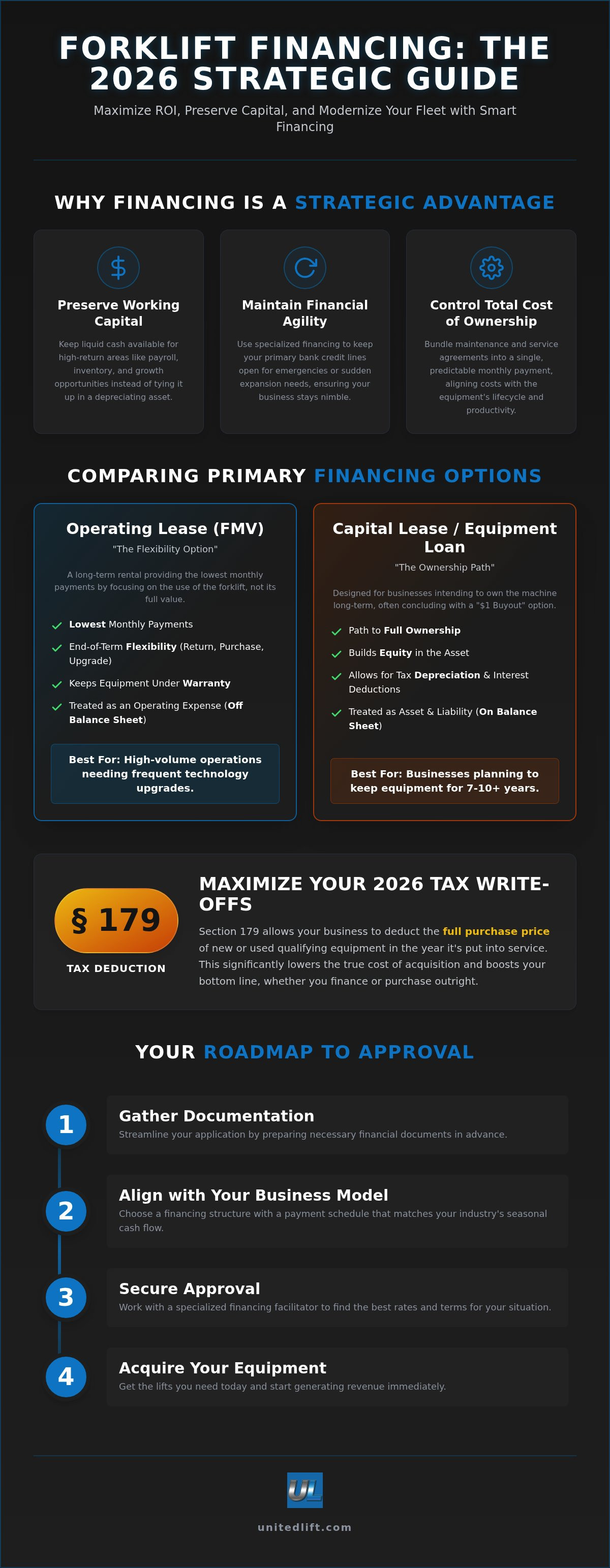
Buying industrial equipment isn't just a purchase; it's a capital allocation decision. Many businesses assume that paying cash is the most cost-effective route because it avoids interest. However, for most operations, the best way to finance a forklift involves keeping your cash in the bank to fuel daily growth. When you tie up a massive amount of capital in a single asset, you lose the ability to pivot quickly or invest in high-return areas like inventory or payroll. Financing allows you to pay for the equipment as it generates revenue, turning a heavy upfront cost into a manageable operating expense.
Maintaining open credit lines is another critical factor. If you use your primary bank lines to buy a fleet, you might find yourself short on options when an emergency strikes or a sudden expansion opportunity arises. Strategic financing through a specialized facilitator keeps your business agile. This is often the best way to finance a forklift while keeping your primary bank lines open for other needs. It ensures you have the tools to do the job without draining the accounts you need for rainy days. It's about efficiency, not just in your warehouse, but in your accounting office too.
Preserving Working Capital for Operations
In high-growth industrial sectors, cash is the primary driver of momentum. Working capital is the difference between a business's current assets and its current liabilities, representing the liquidity available to fund day to day operations and meet short term obligations. By choosing to finance, you hedge against inflation. You lock in a fixed payment today for an asset that will likely cost significantly more in the future. This approach keeps your liquid assets free to handle seasonal spikes or unexpected supply chain shifts.
Managing Total Cost of Ownership (TCO)
A forklift's price tag is only part of the story. You also have to consider the long term expenses that hit your ledger over the machine's life. Financing plans often allow you to bundle service agreements into one monthly payment. This creates a predictable budget and ensures your fleet stays in peak condition. Consider these factors when choosing your term:
- Maintenance schedules: Align your term with the manufacturer's suggested service intervals.
- Equipment lifecycle: Don't pay for a machine longer than you plan to use it.
- Technology shifts: Shorter terms allow you to upgrade to more efficient battery or engine technology sooner.
Balancing your monthly payments against the aging of a forklift is vital. Whether you are adding a Hyster to your warehouse or a Toyota to your yard, the financial logic remains the same. This prevents you from paying for a machine that costs more in repairs than it earns in productivity.
Comparing the Primary Forklift Financing Options
Choosing the right structure is just as important as choosing the right machine. While some managers prefer total ownership, others value the agility of a fleet that stays under warranty. The best way to finance a forklift depends on whether you view the equipment as a long term asset or a tool with a specific expiration date. Each option has a distinct impact on your cash flow and your year end balance sheet.
Operating Leases and Fair Market Value (FMV)
An Operating Lease, often called a Fair Market Value (FMV) lease, is essentially a long term rental with a strategic twist. You pay for the use of the forklift rather than the machine itself. This typically results in the lowest possible monthly payments. At the end of the term, you can return the lift, purchase it at its current market value, or roll into a newer model. It's an excellent choice for high volume warehouses that put heavy hours on their equipment. Because these are often treated as operating expenses, they help keep your debt-to-equity ratio looking healthy.
Equipment Loans and Capital Leases
If your goal is to own the machine at the end of the term, a Capital Lease or a traditional equipment loan is likely the best way to finance a forklift. These structures are designed for businesses that plan to keep their machinery for seven to ten years. A popular version is the "$1 Buyout" lease. You make monthly payments over a set period, and once the final payment is made, you own the forklift for a single dollar. Unlike FMV leases, these are treated as assets and liabilities on your balance sheet. This allows you to claim depreciation and interest deductions.
- Fixed Rates: Protect your budget from market volatility with predictable payments.
- Ownership: Build equity in your fleet over time and eliminate payments once the term ends.
- Section 179: These options are often eligible for immediate tax write-offs in the year of purchase.
Finding the right balance is easier with a partner who understands the equipment as well as the numbers. You can browse our current inventory to see which models best fit your operational goals before deciding on a finance structure. Whether you need a rugged telehandler or an economy lift, matching the finance type to the machine's expected workload is the key to a successful acquisition. We support major brands like Hyster, Yale, and Toyota, ensuring your financing plan works for the specific equipment your job site requires.
Determining the Best Method for Your Business Model
Every business has a different operational rhythm. A construction firm in a northern climate doesn't have the same cash flow as a year round distribution center. Identifying the best way to finance a forklift requires looking at your specific cycle. If you operate in a seasonal industry, you might need a plan that allows for flexible payments during your slow months. Scalability is also vital. You need a financing partner who lets you add a telehandler or a boom lift to your fleet as your contract list grows. Your business model should dictate your finance terms, not the other way around.
Multi shift operations add another layer of complexity. If your equipment runs 24/7, it will reach its economic limit much faster than a machine used four hours a day. In these cases, the best way to finance a forklift is to align the term with the expected hours of use. This ensures you aren't still paying for a machine that has become a maintenance liability. We focus on matching the right machine, whether it's a rugged Caterpillar or a specialized Yale, to a payment structure that reflects its actual workload.
For Startups and Small Growing Operations
Startups often face higher hurdles due to a lack of deep credit history. In these cases, financing used equipment is often the smartest move. It lowers the barrier to entry while still providing a reliable machine from a major brand. Focus on structures that prioritize low monthly payments. This strategy keeps your early stage cash flow available for marketing and hiring. It's about getting the job done today without overextending your future. We work with you to find economy solutions that fit a tighter budget while building your business credit.
For High-Volume, Multi-Shift Facilities
When your machines run across multiple shifts, the math changes. High hour usage means faster depreciation and more frequent maintenance requirements. For these facilities, an FMV lease is usually the standard. You should plan for a three to five year replacement cycle. This keeps your fleet modern and minimizes the downtime that comes with aging equipment. Pay close attention to hour limits in your agreement. Most leases include a set number of annual hours. If you exceed these, you'll face over hour charges. Calculating these projections accurately at the start prevents costly surprises when the term ends.
The Roadmap to Approval: Application and Documentation
Getting approved for industrial equipment doesn't have to be a slow or painful process. If you have already identified your operational needs, the best way to finance a forklift is to approach the application with a clear plan and a complete file. Preparation is the difference between a rapid decision and a week of back and forth emails. Underwriters look for stability and clarity, so presenting a professional package from the start is vital. This roadmap ensures you move from identifying a need to equipment delivery without unnecessary friction.
- Step 1: Determine your budget and equipment specifications. Know exactly what you need, whether it's a Hyster for the warehouse or a JLG boom lift for outdoor work.
- Step 2: Gather financial documentation and credit history. Having your records ready prevents delays during the review stage.
- Step 3: Submit the application for a prompt decision. Use a facilitator who understands the material handling industry to ensure your application is seen by the right lenders.
- Step 4: Review terms and finalize the agreement. Carefully check the interest structure, buyout options, and any hour limits mentioned in previous sections.
- Step 5: Equipment delivery and fleet integration. Once the documents are signed, the equipment is released for delivery to your job site.
Essential Documents for Your Application
Lenders need to see a snapshot of your business's financial health to move forward. Most applications require business tax returns and recent financial statements, including your Profit and Loss (P&L) statement and Balance Sheet. You should also have bank statements for the most recent three to six months ready for review. Finally, include the specific equipment quote or invoice from your dealer so the lender knows exactly what asset they are securing. Precise documentation acts as a fast track for underwriters, allowing them to verify your business health without unnecessary delays.
Maximizing Benefits with Section 179 Tax Deductions
The Section 179 deduction is a powerful financial tool for 2026. It allows businesses to deduct the full purchase price of qualifying equipment from their taxable income in the year the asset is put into service. This is often considered the best way to finance a forklift because you can receive a tax benefit that might exceed the total amount of lease payments made in the first year. Even if you are still paying off the loan, the IRS allows for the full write off as long as the equipment is used for business purposes more than 50% of the time. This interaction between financing and tax savings can significantly lower the net cost of your new machinery.
Ready to put these strategies into action for your fleet? You can apply for forklift financing today and get a decision that keeps your project on schedule. Our team is ready to help you navigate the paperwork and find the structure that best supports your 2026 growth goals.
Facilitating Your Next Lift Purchase with United Lift
United Lift understands that the best way to finance a forklift is to work with a partner who knows the machinery as well as the financial structures. We don't just facilitate loans; we act as a bridge between your operational requirements and the capital needed to meet them. Our inventory spans the entire spectrum of material handling needs. Whether you require a high capacity telehandler for a construction site or a compact scissor lift for warehouse maintenance, we provide the access you need. We maintain strong partnerships with industry leading brands like Hyster, Yale, Toyota, and JLG. This ensures that your financing plan is backed by reliable, high performance equipment.
Our reach is national, meaning we can support your operations wherever they are located. We recognize that every business has different standards for its fleet. Some operations require the latest technology from premium brands like Genie or Caterpillar, while others need cost effective economy lifts to handle occasional tasks. We provide financing solutions tailored for both tiers, ensuring you never pay for more machine than you actually need. By focusing on your specific job site requirements, we help you build a fleet that is both productive and affordable.
Flexible Solutions for New and Used Inventory
One of the biggest hurdles in the industry is finding competitive terms for pre-owned machinery. Many traditional lenders shy away from older models, but we believe used equipment financing is a core part of a balanced fleet strategy. For many growing businesses, acquiring a vetted pre-owned unit is the best way to finance a forklift while keeping monthly costs manageable. We ensure reliability across all our inventory tiers. We also understand that a forklift is often only as good as its accessories. We customize our terms to include equipment attachments and industrial batteries. This comprehensive approach means you aren't stuck with multiple separate payments for a single working unit.
Seven-Day Support and Expert Guidance
The material handling industry doesn't stop at 5:00 PM on Friday. Neither do we. We offer national support seven days a week via phone and email. If you have a question about your application or need to pivot your equipment strategy mid project, our experts are available to assist. We take a no-nonsense approach to getting your machinery on-site fast because we know that downtime is lost revenue. Our goal is to be a reliable facilitator that removes the complexity from the buying process. To get a deeper look at selecting the right machine for your specific application, check out The Ultimate Forklift Buying Guide for Industrial Success in 2026. We are here to ensure your fleet is ready for the demands of 2026 and beyond.
Ready to Optimize Your Material Handling Strategy?
Choosing the right equipment is only half the battle. Securing a payment structure that protects your cash flow and maximizes tax write-offs is what keeps your business competitive. We have explored how matching your financing to your specific industry needs and equipment lifecycle is the best way to finance a forklift in 2026. Whether you choose an FMV lease for technology flexibility or a capital lease for long term ownership, the goal is to align your expenses with the revenue your machinery generates.
United Lift is here to simplify this process with national support available seven days a week. We provide flexible financing for all major brands, including Hyster, Toyota, and Yale, across both new and used equipment options. You don't have to navigate complex documentation alone. Our team is ready to help you find the right lift and the right terms for your specific project. It's time to stop worrying about upfront costs and start focusing on your operational growth.
Browse our inventory and get a financing quote today to see how easy it is to upgrade your fleet. Let's get your operation moving toward a more profitable year.
Frequently Asked Questions
Is it better to lease or buy a forklift in 2026?
The choice depends on your operational goals. Leasing is often ideal for high-volume facilities that want to upgrade every three to five years to avoid maintenance costs. Buying makes more sense if you plan to keep the machine for a decade or have low daily usage. Identifying the best way to finance a forklift involves looking at your cash flow and how much you value long-term asset ownership versus fleet agility.
What is the minimum credit score for forklift financing?
There is no single minimum score that applies to every lender. Most facilitators look at your entire business profile, including time in business and bank statements. While a higher score generally secures lower monthly payments, there are options for startups and those with less established credit. We focus on finding a path forward for various business sizes. It's always best to submit an application to see what specific terms you qualify for today.
Can I finance a used forklift?
You can certainly finance used equipment. Financing a pre-owned Hyster or Toyota is a smart move for businesses looking to lower their entry costs while still getting a reliable machine. It's often the best way to finance a forklift when you need to expand your fleet quickly without the premium price tag of new inventory. We support major brands across all inventory tiers to ensure your budget stays on track and your operations remain productive.
How much are monthly payments for a $30,000 forklift?
Monthly payments are calculated based on several variables, including the equipment's total cost, the length of the term, and the type of lease you choose. An FMV lease will typically have a lower payment than a $1 buyout lease because you aren't paying for full ownership. Since interest rates and market conditions fluctuate, we provide custom quotes based on your specific application and credit profile. This ensures your payment matches your budget and operational needs.
Does Section 179 apply to leased forklifts?
Section 179 usually applies to leased equipment as long as the structure is a capital lease, such as a $1 buyout option. This allows you to deduct the full purchase price in the year you put the machine into service. It's a significant advantage for 2026 tax planning. However, operating leases may be treated differently. You should always consult with your tax advisor to confirm how these deductions apply to your specific business filing and equipment acquisition.
How long does the forklift financing approval process take?
The approval process is designed to be efficient. Once you submit your financial documentation and bank statements, a decision can often be reached within a few business days. Having your paperwork organized is the fastest way to move from application to delivery. We prioritize a no-nonsense approach to minimize your downtime. This speed allows you to get your boom lift or telehandler on-site and working as quickly as possible without unnecessary bureaucratic delays.
What happens if I exceed the hours on my forklift lease?
Exceeding the hour limit on an FMV lease usually results in additional fees at the end of the term. These charges are calculated on a per-hour basis and vary depending on the agreement. To avoid these costs, it's vital to estimate your usage accurately before signing. If you run multiple shifts, you should choose a term that reflects that high-hour workload. This ensures your fleet remains cost-effective throughout its entire lifecycle and prevents unexpected expenses later.
Can I finance forklift attachments and batteries?
You can bundle attachments and industrial batteries into your primary financing agreement. This allows you to include essential tools like side shifters or specialized clamps in a single monthly payment. It's a practical way to ensure your forklift is fully equipped for your specific job site from day one. We offer financing for a wide range of accessories to help you customize your lift solution while maintaining a predictable and manageable budget for your entire fleet.
- Tags: best way to finance a forklift, business finance, capital preservation, equipment leasing, forklift financing, forklift fleet, material handling, Section 179, warehouse management
