
Commercial Equipment Financing Rates 2026: The Complete Reference Guide
Posted by United Lift LLC on
Did you know that 78% of U.S. businesses now choose to finance or lease their machinery instead of paying cash? It's a smart strategy to preserve capital, yet the process often feels like a gamble. You're likely concerned about fluctuating interest rates and the hidden fees that sometimes hide in complex lease agreements. You want predictable monthly payments and a clear path to ownership without the headache of unexpected tax implications.
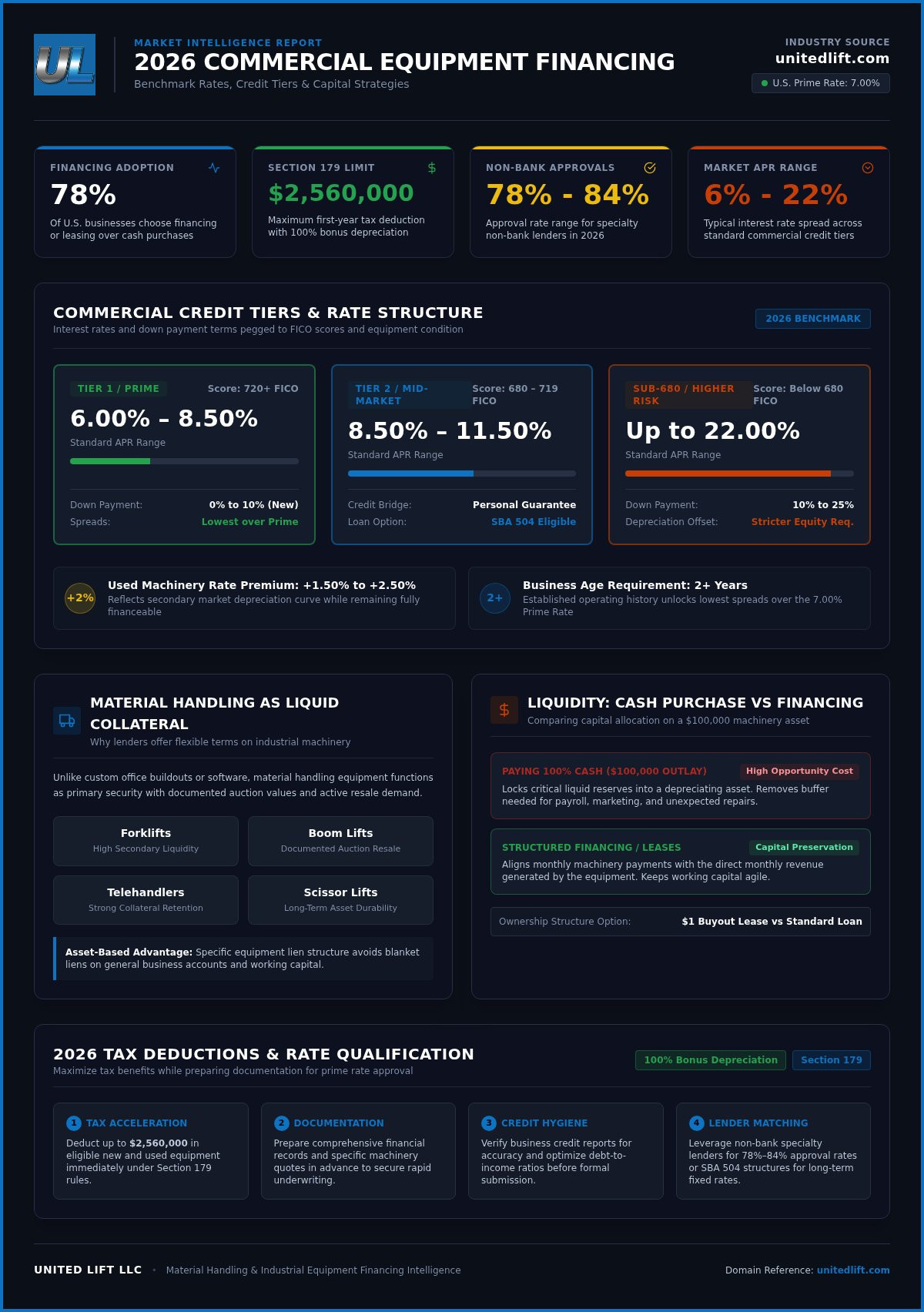
We understand that timing your investment is critical for your growth. This guide delivers the most current data on commercial equipment financing rates 2026, covering everything from industrial interest rates to the latest lease structures. You'll learn how to navigate current market APR tiers, which typically range from 6.00% to 22.00% for standard credit profiles, and see exactly what's required to qualify for prime terms.
We will also show you how to maximize your Section 179 tax benefits, which have reached a $2,560,000 deduction limit for the year. By the end of this article, you'll have a clear roadmap for fast equipment acquisition and a strategy to leverage 100% bonus depreciation effectively. Let's look at what these numbers mean for your fleet and your bottom line.
Key Takeaways
- Review the current market APR ranges to understand how commercial equipment financing rates 2026 are trending for different credit tiers and asset types.
- Capitalize on the $2,560,000 Section 179 deduction limit and 100% bonus depreciation to significantly reduce the effective cost of your new or used machinery.
- Evaluate the differences between $1 Buyout leases and standard loans to ensure your monthly payments align with your long-term ownership goals.
- Prepare your financial documentation and specific equipment quotes in advance to secure faster approvals and more flexible lending structures.
- Identify how to streamline the acquisition process for essential material handling equipment, including forklifts, boom lifts, and telehandlers.
Understanding the Commercial Equipment Financing Landscape in 2026
In 2026, commercial equipment financing operates as a specialized credit facility where the machinery you acquire serves as the primary security for the debt. This structure allows you to secure a loan or lease specifically for the asset itself. Unlike general business lines of credit, which often require blanket liens on all company assets, these agreements focus on the specific unit. Current commercial equipment financing rates 2026 are heavily influenced by a 7.00% U.S. Prime Rate and a shifting lending environment where 78% of businesses now prefer financing over cash purchases. This high demand has led to a surge in specialty non-bank lenders who offer approval rates between 78% and 84%, providing a more accessible path than traditional large national banks.
Material handling equipment holds a unique position in this landscape. Forklifts, boom lifts, and telehandlers are considered "liquid" assets because they maintain strong resale value in a robust secondary market. Lenders view these machines as lower-risk collateral compared to specialized software or custom office fit-outs. This inherent value helps borrowers secure more favorable terms and lower down payments, as the lender has a clear path to recover their investment if the borrower defaults.
The Role of Equipment as Collateral
When you choose to finance, you are essentially utilizing asset-based lending structures to grow your fleet. Because the equipment is the collateral, lenders are often more flexible with credit requirements than they would be for an unsecured cash flow loan. This is especially true for material handling assets like scissor lifts and telehandlers. New equipment typically commands the lowest rates, often between 6.00% and 8.50% for Tier 1 credit. While used machinery carries a rate premium of 1.50% to 2.50%, it remains a highly financeable option because these machines are built for long-term durability and have documented auction values.
Financing vs. Capital Expenditure (CapEx)
Preserving your working capital is vital for managing seasonal fluctuations and unexpected repairs. Paying cash for a $100,000 forklift creates a significant opportunity cost; those funds are then locked in a depreciating asset rather than being available for payroll, marketing, or inventory. Equipment financing serves as a primary tool for liquidity management by allowing businesses to acquire high-value assets without depleting the cash reserves needed for daily operations. By opting for a structured payment plan, you align the cost of the equipment with the revenue it generates each month. This approach ensures your business stays agile and ready to respond to new contracts without the strain of a massive upfront cash outlay.
Key Factors Influencing Equipment Financing Rates in 2026
Several core variables determine your final interest rate and monthly payment. Lenders in 2026 look closely at your credit profile, the age of your business, and the specific machinery you're buying. Understanding how these factors interact helps you secure the most competitive commercial equipment financing rates 2026 has to offer. Generally, businesses with over two years of history and strong cash flow access the lowest spreads over the 7.00% Prime Rate. If your business is newer, you may face higher rates or more stringent down payment requirements to offset the perceived risk.
Credit Profiles and Risk Assessment
Lenders categorize borrowers into distinct tiers based on FICO scores. Tier 1 / Prime Credit (720+) typically secures rates between 6.00% and 8.50% APR. If your score falls in the Tier 2 or Mid-Market range (680 to 719), expect rates between 8.50% and 11.50% APR. For small business owners, providing a personal guarantee can often bridge the gap between tiers. This provides the lender with additional security that can lead to lower rates. You might also consider the SBA 504 loan program for long-term, fixed-rate financing on major machinery acquisitions. Improving your debt-to-income ratio and ensuring your business credit report is error-free are the fastest ways to move into a higher tier before you sign a contract.
Down payment requirements also shift based on risk. Prime borrowers buying new forklifts or telehandlers often qualify for 0% to 10% down structures. However, if you're acquiring used machinery or have a credit score below 680, lenders may require 10% to 25% down to offset the asset's depreciation curve. Since material handling equipment holds its value well, you have more leverage here than with specialized tech. If you're ready to see how your profile matches current options, you can browse our available inventory to get started.
The Section 179 Tax Advantage
The true cost of financing is often much lower than the interest rate suggests once you factor in tax savings. For the 2026 tax year, the Section 179 deduction limit has increased to $2,560,000. This allows you to deduct the full purchase price of qualifying equipment in the first year, even if you've only made a few monthly payments. When you combine this with the 100% bonus depreciation currently available under the OBBBA, the "net cost" of your equipment drops significantly. For example, a company in a 25% tax bracket buying a $100,000 boom lift could see $25,000 in immediate tax savings. This effectively offsets several years of interest expenses. Always consult with a tax professional to confirm how these 2026-specific depreciation rules apply to your specific filing status.
Comparing Financing Structures: Loans vs. Leases
Choosing the right structure depends on whether you want to own the machine long-term or simply use it for its peak productive years. In the current market, commercial equipment financing rates 2026 for Equipment Finance Agreements (EFAs) often range from 6.00% to 22.00% APR. An EFA is a hybrid that feels like a loan but uses a simplified lease-style contract. Unlike traditional term loans, EFAs typically don't require blanket liens on your business assets. This keeps your balance sheet flexible while still allowing you to claim ownership and depreciation benefits from day one.
Leasing offers different advantages, particularly regarding cash flow and technology cycles. A Fair Market Value (FMV) lease is essentially a rental with a purchase option; it offers the lowest monthly payments and is ideal for equipment you plan to replace every few years. If your goal is eventual ownership, the $1 Buyout Lease is the standard choice. It functions as a capital lease, meaning you pay for the full value of the equipment over time and own it for a single dollar at the end. Both structures must follow specific Section 179 and depreciation guidelines to ensure you maximize your 2026 tax deductions.
Lease Options for Material Handling
Material handling fleets often require a mix of structures. You might choose an FMV lease for scissor lifts or boom lifts that experience high wear and tear. This allows you to return the units before maintenance costs spike. For your core forklift fleet, a $1 Buyout Lease is often better. It allows you to build equity in machines that can last a decade or more. Many modern 2026 lease agreements also offer factor rates between 0.018 and 0.035, depending on your credit tier. Bundling industrial batteries or attachments into these leases is a common way to simplify your monthly accounting.
Loan Structures for Heavy Machinery
When opting for a loan, you must decide between fixed and variable interest rates. Fixed rates are currently popular as they lock in commercial equipment financing rates 2026 against future market volatility. Variable rates may offer a lower starting point but can increase if benchmark rates rise. Some industrial buyers also utilize balloon payments. This structure keeps your monthly overhead low by deferring a portion of the principal to a final lump sum. It's a useful tool for managing cash flow during rapid expansion. For a comprehensive look at fleet planning, our Ultimate Forklift Buying Guide provides deeper insights into selecting the right machinery for your specific operational needs.
How to Qualify for the Best Rates in 2026
Securing the most competitive commercial equipment financing rates 2026 requires a proactive approach. Lenders don't just look at your FICO score; they analyze your business's ability to service debt over the long term. A primary factor in this evaluation is your debt-to-income ratio. Most specialty lenders want to see that your monthly net income comfortably covers your existing obligations plus the new equipment payment. If you're planning a fleet expansion, consider financing multiple units simultaneously. Bundling two or three telehandlers or forklifts into a single transaction often allows you to leverage bulk rate discounts that aren't available for individual unit purchases.
Having a specific equipment quote or invoice ready is essential for a fast approval. Vague estimates often lead to delays or conservative rate offers. A detailed invoice provides the lender with the exact collateral value, which reduces their risk and helps them finalize your terms quickly. If you have your eye on a specific machine, request a quote today to jumpstart your application process.
Essential Documentation Checklist
Lenders in 2026 have streamlined their processes, but they still require a standardized set of records for mid-to-large-ticket transactions. For transactions exceeding $100,000, you should have the following documents organized and ready for submission:
- Two years of complete business tax returns and the last six months of business bank statements.
- Current interim financial statements, specifically your Year-to-Date Profit and Loss (P&L) and Balance Sheet.
- Detailed equipment specifications, including year, make, model, and serial numbers for all used machinery.
The Approval Timeline
The speed of your funding depends largely on the transaction size and your documentation readiness. Application-only decisions for amounts up to $100,000 can fund in as little as 24 to 72 hours. Larger transactions ranging from $100,000 to several million typically require a more detailed underwriting process that can take one to four weeks. Common pitfalls that delay funding include missing serial numbers on invoices or outdated tax records. Pre-approval is the best negotiation tool because it proves to the seller that you have the immediate capital to close the deal. Once your documentation is verified, the final step is a simple digital signature on the lease or loan agreement, followed by the direct wire transfer to the equipment provider.
United Lift: Facilitating Your 2026 Equipment Investment
United Lift LLC acts as your no-nonsense partner in a complex market. We understand that finding competitive commercial equipment financing rates 2026 is only half the battle; you also need a partner who values your time. Our team operates as a reliable facilitator, bridging the gap between your operational needs and a national network of financing partners. Whether you're a seasoned enterprise with Tier 1 credit or a growing business in a lower credit tier, we have the connections to find a structure that works. We don't just sell machinery. We help you navigate the entire acquisition process with speed and expertise.
Our reach extends across the country, supporting businesses in every industry that requires heavy lifting. We focus on direct communication. You won't get stuck in a corporate phone tree here. We provide rapid responses because we know that a missing telehandler or a broken forklift costs you money every hour it's not on the job. Our goal is to move you from identifying a need to finding a point of contact as quickly as possible. Our facilitators stay updated on commercial equipment financing rates 2026 to ensure you get the most accurate information for your fleet planning.
Financing New and Used Inventory
We facilitate financing for our entire inventory, ranging from budget-friendly economy lifts to premium, high-performance models. This includes support for major brands like Hyster, Yale, Toyota, and JLG. Many buyers assume that used equipment is harder to finance, but United Lift LLC specializes in securing loans and leases for pre-owned assets that still have years of productive life. We know these machines inside and out. Our team is available 7 days a week to handle your inquiries. This constant availability ensures you can move quickly when the right piece of equipment becomes available, keeping your projects on schedule and your budget intact.
Get Started with Your Quote
Do you need to add to your fleet before the next quarter? Our process is designed for maximum efficiency. First, we identify your specific material handling needs, whether that's a fleet of scissor lifts or a single high-capacity telehandler. Next, United Lift LLC matches your business profile to the most appropriate financial structure, such as a $1 Buyout Lease or a standard equipment loan. This tailored approach ensures you maximize your Section 179 benefits while keeping your monthly payments predictable. It's about finding the balance between liquidity and growth. We handle the heavy lifting of the financial landscape so you can focus on your job site. View our current inventory and request a financing quote today.
Maximize Your Industrial Growth in 2026
Staying ahead of the market requires more than just watching the numbers. You now have the data to navigate commercial equipment financing rates 2026 with confidence. Whether you're targeting the $2,560,000 Section 179 limit or deciding between a $1 Buyout lease and a traditional loan, the goal remains the same: maximizing your operational liquidity. By matching your credit profile to the right lending tier, you can secure predictable payments that keep your business agile.
United Lift is ready to help you execute these strategies. We provide national financing facilitation for a massive range of new and used equipment. Our team supports major brands like Hyster, Yale, and Toyota, ensuring you have access to the best forklifts, boom lifts, and telehandlers on the market. Don't let complex tax rules or fluctuating rates stall your expansion. Browse our inventory and get a financing quote today to see how we can simplify your next acquisition. We're here to ensure your fleet is ready for every project on your calendar.
Frequently Asked Questions
What is the average interest rate for commercial equipment in 2026?
Market rates for commercial equipment financing rates 2026 typically range from 6.00% to 22.00% APR. The specific rate you receive depends on your FICO score, business history, and the type of machinery you're acquiring. Prime credit borrowers with scores above 720 usually see offers between 6.00% and 8.50%. These figures are influenced by a U.S. Prime Rate of 7.00% and current benchmark spreads for industrial assets.
Can I finance used forklifts or boom lifts?
Yes, you can finance both new and pre-owned material handling machinery. Financing used forklifts or boom lifts is a common way to reduce total acquisition costs while maintaining productivity. Lenders typically apply an interest rate spread of 1.50% to 2.50% higher than new equipment to account for the asset's age. United Lift facilitates loans and leases for major brands like Hyster and Yale, regardless of whether the unit is new or used.
How does Section 179 affect my equipment financing?
Section 179 allows you to deduct the full purchase price of qualifying equipment in the first year it's placed in service. For 2026, the maximum deduction limit is $2,560,000. This tax provision is especially powerful when paired with financing because you can deduct the total cost of a telehandler or scissor lift even if you've only made a few monthly payments. It significantly lowers the net cost of your machinery by providing immediate tax relief.
Is it better to lease or buy a forklift for a small business?
The choice depends on your long-term ownership goals and cash flow needs. Leasing often provides lower monthly payments and more flexibility for high-turnover fleets that need frequent technology updates. Buying, or using a $1 Buyout Lease, is generally better for businesses that want to build equity and own the asset long-term. Small businesses often prefer financing to preserve working capital for daily operational expenses rather than locking cash into a single machine.
What credit score do I need for equipment financing?
Most lenders look for a FICO score of 620 or higher, though options exist for all credit tiers. Tier 1 borrowers with scores of 720+ qualify for the most competitive commercial equipment financing rates 2026. If your score is between 620 and 679, you can still secure financing, but you might face higher APRs or larger down payment requirements. Specialty non-bank lenders often have higher approval rates than national banks for businesses with mid-range credit profiles.
How long are typical financing terms for heavy machinery?
Typical repayment terms range from 24 to 84 months, or two to seven years. Lenders usually match the term length to the economic useful life of the asset. For durable machinery like forklifts or telehandlers, a five-year term is standard. Choosing a longer term can lower your monthly obligation, though it may increase the total interest paid over the life of the loan. You should select a term that balances affordable payments with your fleet rotation schedule.
What is a $1 buyout lease and how does it work?
A $1 buyout lease is a capital lease structure where you pay for the equipment over a set term and own it for exactly one dollar at the end. It's essentially a financing agreement disguised as a lease for tax and accounting purposes. This structure allows you to claim Section 179 and bonus depreciation benefits as if you owned the equipment from day one. It's the most popular choice for businesses that intend to keep their machinery long-term.
Can I finance attachments and industrial batteries along with the lift?
Yes, you can bundle essential attachments and industrial batteries into your primary financing agreement. Including these items in a single loan or lease simplifies your monthly accounting and ensures your machinery is job-ready immediately. Whether you need specialized clamps for a forklift or high-capacity batteries for an electric scissor lift, most lenders allow you to finance the total invoice amount. This approach helps you maintain liquidity while fully outfitting your material handling fleet for maximum efficiency.
- Tags: business financing, capital investment, commercial equipment financing rates 2026, commercial loans, equipment financing, equipment leasing, interest rates 2026, machinery leasing, Section 179
