
Forklift for Food and Beverage Industry: 2026 Buying Guide
Posted by United Lift LLC on
The highest-capacity forklift isn’t automatically the right choice for a food or beverage facility. Cold rooms, damp floors, frequent cleaning, and hygiene procedures can all affect how equipment fits into daily work. Choosing a forklift for food and beverage industry operations means looking beyond load weight and considering the conditions the truck must handle.
It’s understandable to focus first on capacity. But a machine that suits one area or task may not be the best fit across receiving, storage, production, and shipping. Power source, tires, lift height, aisle space, and attachments all matter, especially when equipment moves between work areas.
This guide helps you compare forklift requirements by facility conditions, handling tasks, and operating priorities. You’ll learn what to assess in cold or frequently cleaned areas, how different configurations may suit distinct jobs, and how to weigh new and pre-owned options against your budget. Use these factors to narrow your choices to equipment that supports your operation, rather than relying on a one-size-fits-all recommendation.
Key Takeaways
- Choose a forklift for food and beverage industry work by matching it to facility conditions and handling tasks, not capacity alone.
- Compare electric and internal-combustion configurations by considering indoor air, operating environment, duty cycle, and workflow.
- Build a zone-by-zone comparison using verified load weight and dimensions, lift height, travel paths, and operating frequency.
- Map traffic routes, pedestrian interaction, staging points, and transitions before comparing forklift specifications.
- Use documented facility needs to compare new and pre-owned forklifts, and factor financing into purchase planning.
Why Food and Beverage Facilities Need a Facility-Fit Forklift
A single facility can include ambient storage, refrigerated rooms, freezer areas, loading docks, and production-adjacent routes. Each zone has different conditions and tasks, so a forklift that works well in one area may be a poor match for another. Choosing a forklift for food and beverage industry work starts with mapping how products and equipment move through the operation, not selecting by lift capacity alone.
Consider how often a truck travels from a dry warehouse into a damp dock or temperature-controlled room. Those transitions, along with narrow travel paths and cleaning schedules, shape what operators encounter during a shift. A general forklift overview can explain common equipment types, but your facility’s conditions determine which features need closer attention.
Which facility conditions change forklift requirements?
Cold rooms and freezer areas call for attention to operating conditions and manufacturer guidance for the intended temperature range. Damp floors and washdown routines can affect traction and expose equipment to moisture. At docks, changing surfaces and outdoor-to-indoor transitions may matter. Production-adjacent routes can add tight turns, doorways, and nearby pedestrian activity.
Record floor surfaces, gradients, thresholds, doorway clearances, and the route between zones. Note where floors may be wet and when cleaning takes place. These details help distinguish a truck that stays in one controlled area from one that regularly crosses several environments.
How do food and beverage handling tasks shape the choice?
Pallet transport between storage and shipping differs from moving ingredients to a production area, staging finished goods, or loading trailers. Each task has its own load dimensions, travel distance, turning requirements, and stopping points. Shift patterns and load frequency matter, too. Equipment used continuously across several shifts faces a different workload from a truck assigned to occasional transfers.
Document each route and task, not just the product category. This gives you a clearer basis for comparing capacity, lift height, tires, power source, and attachments in the next selection steps.
Keep equipment selection separate from facility procedures. A forklift configuration doesn’t establish product-handling, cleaning, or employee-safety practices, and it can’t guarantee food-safety compliance. Those procedures belong to the facility. Equipment choices should support the work while fitting operating conditions. Consider product protection, employee safety, and equipment suitability as related but distinct review areas.
Facility-zone checklist:
- Ambient storage: Note aisle width, floor surface, load movement, and lift requirements.
- Refrigerated rooms and freezers: Record operating temperatures and transitions between temperature zones.
- Docks: Map surface changes, doorways, staging points, and loading routes.
- Production-adjacent routes: Identify narrow paths, pedestrian crossings, and nearby work areas.
- Cleaning areas: Document moisture exposure, washdown routines, and when floors may be damp.
Use this map to turn a mixed facility into a set of clear requirements. It keeps the equipment comparison focused on actual routes, loads, and operating patterns.
Compare Forklift Power and Configurations for Food and Beverage Work
Power source is a useful point of comparison, but it shouldn’t decide the purchase by itself. A forklift on a production route may face different indoor-air considerations and work patterns from one assigned to loading. Compare each option with the zone, schedule, and task it will actually handle.
When should buyers compare electric and internal-combustion forklifts?
Start with where the forklift will operate and how the facility manages ventilation. Electric models don’t produce engine exhaust at the point of use, while internal-combustion models do. That makes indoor air and ventilation important parts of the evaluation. Neither power source is automatically right for every job. Work schedules, operating conditions, and the manufacturer’s equipment specifications also matter.
| Consideration | Electric | Internal combustion |
|---|---|---|
| Indoor air | No engine exhaust at the point of use; consider the facility’s charging arrangements. | Produces engine exhaust; assess the operating area’s ventilation. |
| Operating environment | Compare specifications with the temperatures, moisture, and transitions on the planned route. | Check equipment specifications against indoor, outdoor, and mixed-zone work. |
| Duty cycle | Match battery and charging arrangements to shift patterns and frequency of use. | Compare the equipment’s rated duty with the work schedule and task frequency. |
| Facility workflow | Consider routes through production and storage areas, along with charging logistics. | Consider where the truck will work and how exhaust and traffic fit facility procedures. |
For example, a facility might compare options separately for an indoor production route, a storage task, and dock loading. Record how often each job occurs and whether equipment moves between zones. Review the OSHA forklift safety guidelines alongside your facility procedures. Equipment selection supports those procedures; it doesn’t replace them.
Which configuration details matter beyond the power source?
Consider tires, operator position, maneuverability, and attachment needs together. Tire choice depends on floor surfaces and whether routes include outdoor sections. A sit-down or stand-up configuration can affect operator access and task duration, while tight travel paths make turning space and truck dimensions important. Attachments should suit the handling method and load, not simply add flexibility on paper.
Keep the comparison specific. A forklift assigned to long, repeated pallet moves may have different priorities from one used for short transfers through a constrained production route. Evaluate the relevant specifications for each job, then compare complete configurations rather than power sources in isolation. For a broader buying framework, see this electric versus internal-combustion forklift guide, including its capacity-planning discussion.
The right forklift for food and beverage industry work depends on facility conditions, equipment specifications, and the task. If you’re comparing options against your facility’s routes and workloads, compare forklift options with United Lift.
Build a Food and Beverage Forklift Comparison Around Facility Needs
Turn your facility map into a side-by-side equipment comparison. A useful matrix links each zone and task to real operating conditions, then identifies the forklift attributes to review. This keeps the decision specific to your operation instead of relying on a generic “best forklift” recommendation.
| Facility zone | Task | Operating condition | Forklift attribute to compare |
|---|---|---|---|
| Ambient storage | Move palletized ingredients or supplies | Long travel routes and repeated moves | Rated capacity, travel path, and operating frequency |
| Refrigerated or freezer area | Retrieve and relocate stored loads | Temperature-controlled operation and transitions | Manufacturer specifications for the intended conditions |
| Production-adjacent route | Deliver ingredients or collect finished goods | Constrained aisles and nearby work activity | Truck dimensions, maneuverability, and attachment needs |
| Dock and staging area | Stage or load finished goods | Doorways, thresholds, and changing surfaces | Lift height, tire suitability, and route clearance |
How should buyers compare load handling and attachments?
Record typical and heaviest load weights, load dimensions, pallet size, required lift height, and how often each move occurs. Rated capacity depends on the specific truck configuration and load center, so compare the equipment’s capacity information with the load you intend to handle. Don’t rely on a capacity figure in isolation.
Attachments can change a truck’s rated capacity and operating characteristics. Include the intended attachment in the specification review rather than treating it as an afterthought. United Lift offers equipment attachments that can be considered alongside forklift options as you match equipment to documented tasks.
How do tires and maneuverability affect facility fit?
Start with the surface and route. Cushion tires are generally associated with smooth indoor floors, while pneumatic tires are used for outdoor or rougher surfaces. Actual fit depends on the tire and truck specifications. Measure aisle and doorway clearances, turning space, floor transitions, and thresholds before shortlisting equipment. A tight turn at a staging point can matter as much as the straight aisle.
Rank your criteria before comparing specific trucks. Put non-negotiable requirements first, such as verified load capacity, lift height, and route clearance. Then weigh considerations like task frequency, attachment needs, and tire fit against the work in each zone. The FDA Food Safety Modernization Act (FSMA) provides context for food-facility preventive controls. Equipment selection should be considered alongside facility procedures, not as a substitute for them.
A forklift for food and beverage industry tasks should match documented loads, routes, and operating conditions. Compare those requirements with forklift and attachment options to build a practical shortlist.
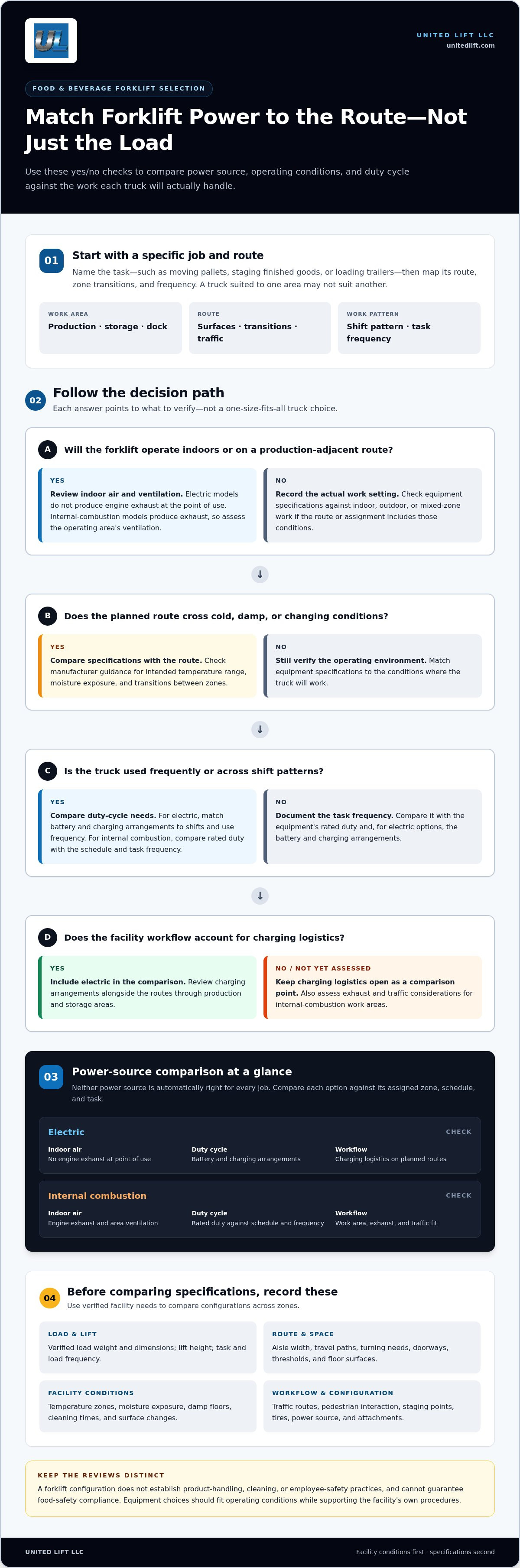
Plan Safe Forklift Operations Across Cold, Wet, and Production Areas
A forklift purchase affects more than the truck’s ability to move a load. Routes, staging points, and work schedules need to fit the way people and products move through the facility. Use a consistent pre-purchase process to give equipment comparisons a clear operational basis.
- Map the zones and transitions. Mark ambient storage, refrigerated and freezer areas, docks, production-adjacent routes, and cleaning areas. Record operating temperatures, floor surfaces, gradients, wet areas, doorway and aisle widths, thresholds, and points where conditions change.
- Document tasks and schedules. For each zone, list the work performed, shift patterns, travel distances, and how often the forklift is used. Include pallet transport, ingredient movement, finished-goods staging, and loading where they apply.
- Assess loads and handling points. Record typical and heaviest loads, pallet dimensions, required lift heights, and where products are picked up, staged, or transferred. Note crossings where people, products, or other vehicles share space.
- Compare complete specifications. Match the documented work against the candidate forklift’s rated capacity, configuration, tires, attachments, and stated operating conditions. Review the manufacturer’s guidance for cold, damp, or other demanding environments.
Route-level details can change the comparison. A truck may have enough capacity for a load but still be poorly suited to the path if it can’t clear a doorway or turn into a staging position. Map pedestrian crossings and shared travel routes, too. A route through a busy production area may need different traffic controls from a dedicated storage aisle. Identify where operators must stop, wait, or transfer a load, and account for those points in the equipment review.
What should a facility document before equipment selection?
Keep one record for each zone, with conditions, tasks, loads, routes, and shift patterns together. Include cleaning schedules and note when floors may be wet or routes temporarily unavailable. This makes it easier to compare equipment with actual work and spot gaps, such as a route without clear staging space or an operating condition missing from the specification review.
How can the operation integrate equipment with site procedures?
Coordinate equipment use with established sanitation, traffic-management, and food-safety procedures. Cleaning schedules and product-handling controls are facility procedures, not forklift certifications. FDA materials on preventive controls, including the Food Safety Modernization Act, may be relevant to a facility’s food-safety planning. OSHA requirements and site policies should be reviewed by qualified personnel. Neither a forklift choice nor this guide establishes compliance.
For a forklift for food and beverage industry operation, keep the zone map and task records with your equipment comparison. They give your team a practical reference for evaluating configurations against daily work. Compare forklift options with United Lift using your documented facility needs.
Source a Food and Beverage Forklift That Fits Your Operation
Once you’ve mapped the work and set your equipment criteria, use them to compare purchase options. A new or pre-owned forklift should meet the same basic test: does its configuration fit the loads, routes, conditions, and duty you documented? United Lift offers new and pre-owned forklifts, including options from Hyster, Yale, Toyota, and Caterpillar. Compare equipment against your operation rather than choosing by brand name alone.
Should a facility consider new or pre-owned forklifts?
A new forklift may suit buyers prioritizing a particular configuration for planned work. A pre-owned option may be worth considering when its condition and specifications fit the task and purchasing priorities. Neither category is automatically the better fit. Review condition, configuration, intended duty, and how closely the equipment matches your documented requirements. For a used truck, evaluate its condition and available specifications as part of the purchase decision, without assuming a fixed remaining lifespan or guaranteed savings.
Use the same requirements checklist for each candidate. That makes the comparison more useful than weighing “new” against “used” in isolation:
- Specification fit: Compare rated capacity for the intended load and configuration, lift height, dimensions, power source, tires, and any required attachments.
- Condition and intended duty: Consider the equipment’s condition alongside how often and where it will operate.
- Purchase priorities: Balance configuration needs, acquisition preferences, and the planned role of the forklift in your operation.
For example, a pre-owned forklift that matches a defined storage task may be a stronger candidate than a new configuration that doesn’t suit the route or load. Conversely, if a particular requirement is central to the job, prioritize specification fit and compare options accordingly. Let the documented work guide the decision.
What should buyers share when comparing available equipment?
Bring a concise summary of your operating needs: load weights and dimensions, required lift heights, facility zones, floor conditions, routes, and operating schedule. Note any temperature-controlled or damp areas, frequent transitions, and attachment requirements. These details focus the comparison on real tasks and make it easier to see where specifications align or where a candidate may not suit the intended duty.
Also share your purchase preferences and whether financing is part of your planning. Financing can be considered alongside the equipment choice as a way to plan the purchase, without assuming particular rates, terms, or savings. United Lift facilitates financing options, and its team can help compare forklift choices against the requirements you’ve gathered.
A forklift for food and beverage industry work should make sense for both the facility and the purchase plan. Ready to compare options? Talk with United Lift about forklift options and share the loads, routes, and operating conditions your equipment needs to handle.
Turn Your Requirements Into a Confident Purchase
Your next step is to turn equipment needs into a clear purchasing brief. Share it with the people who understand daily workflows, facility conditions, and purchasing priorities. Their input can surface practical details that are easy to miss on paper, such as a route that changes between shifts or a task that needs a different configuration. Keep the brief focused on the work the forklift must do so comparisons stay useful as you narrow your choices.
The right forklift for food and beverage industry operations should fit today’s job while making sense for your facility’s plans. United Lift offers new and pre-owned forklifts from Hyster, Yale, Toyota, and Caterpillar, along with equipment financing options. Phone and email support are available seven days a week as you consider your next purchase. Take the next step with your requirements in hand: Compare forklift options for your operation. A well-informed comparison is a practical way to move forward with confidence.
Frequently Asked Questions
What type of forklift is best for a food and beverage warehouse?
No single forklift type is best for every food and beverage warehouse. A counterbalance forklift may suit general pallet moves and dock work, while a reach truck may fit certain high-rack storage layouts. Start with the warehouse’s aisle dimensions, rack layout, floor conditions, and load flow. If one truck must cover several areas, compare its specifications against the tightest route and most demanding task.
Can forklifts operate in refrigerated or freezer environments?
Yes, forklifts can operate in refrigerated or freezer environments when the specific equipment is rated for the intended conditions. Check manufacturer guidance for the operating temperature range and any limits on components or battery use. Also consider transitions between warm and cold zones, where condensation or changes in floor conditions may affect daily operation. A truck moving between zones needs evaluation for the full route, not just the coldest room.
Are electric forklifts suitable for food and beverage facilities?
Electric forklifts can be suitable, particularly for indoor work where engine exhaust is a consideration. Suitability still depends on the task, charging arrangements, operating schedule, and environmental conditions. For example, a truck making repeated moves through a production building needs a charging plan that fits the work pattern and facility layout. Compare the specific truck and battery specifications with the intended shifts rather than assuming every electric setup fits every zone.
What forklift tires work best on wet or frequently cleaned floors?
No tire type makes a wet floor automatically safe. The right choice depends on the surface, how water or cleaning residue affects traction, and the forklift’s intended route. Identify where floors are wet, how long they take to dry, and whether routes cross thresholds or textured surfaces. Then compare tire specifications and operating guidance for those conditions. Facility traffic controls and cleaning procedures remain important alongside tire selection.
How do I choose forklift capacity for food and beverage pallets?
Use the forklift’s rated capacity for its actual configuration, not a general capacity label alone. Compare the load’s weight and dimensions with the truck’s capacity information at the required lift height and load center. Include any attachment in that review, since it can affect capacity. For mixed products, check the heaviest and least evenly distributed loads you expect to handle, and use the manufacturer’s specifications to confirm the match.
Do food and beverage forklifts need special sanitation features?
There isn’t one forklift feature that guarantees sanitation or food-safety compliance. The equipment should be compatible with your facility’s established cleaning and product-handling procedures. Review the manufacturer’s guidance for cleaning methods and materials, and consider where the truck operates relative to exposed products. Keep equipment selection separate from sanitation controls: the forklift can support the workflow, but facility procedures govern how cleaning and contamination risks are managed.
Should a food and beverage business buy a new or used forklift?
Choose based on specification fit, equipment condition, expected workload, and purchasing priorities. A pre-owned forklift may be worth considering if its condition and configuration suit the planned work; a new truck may better match specific requirements. For used equipment, review available condition information and records, then compare its capacity and features against your operating needs. United Lift offers new and pre-owned forklift options to consider.
- Tags: cold storage, electric forklifts, facility management, food and beverage, forklift buying guide, forklift for food and beverage industry, forklift guide, material handling, warehouse equipment
