
Forklift Fork Extensions: How to Choose and Use Them Safely
Posted by United Lift LLC on
Will extra reach solve a handling problem, or create a capacity risk? Forklift fork extensions can support longer loads, but they also move the load farther from the truck and can reduce lifting capacity. An extension that appears to fit the forks isn’t automatically safe for the forklift or the task.
Before choosing extensions, establish how much reach the load needs, whether the extensions fit the forks, and how the complete setup affects stability and capacity. Match the attachment to the load and fork dimensions, then check the forklift’s approved documentation for the operating limits.
This guide explains what fork extensions can and can’t do, which measurements and operating details matter, and what to review before selecting or using them. It also covers why rated capacity, manufacturer approval, updated capacity information, and operator familiarity matter. For heavy or frequently handled loads, longer original forks may be a better fit than extensions.
Key Takeaways
- Forklift fork extensions add reach for suitable loads, but they don’t increase the truck’s rated capacity.
- Assess forklift details, fork dimensions, load requirements, and documentation together before selecting forklift fork extensions.
- Compare extension configurations by the reach needed, how they attach, and the limits of each setup.
- Use a pre-lift check to spot attachment damage, poor fit, or unstable load placement before handling begins.
- For frequent or demanding loads, consider whether extensions or a forklift with longer original forks better suits the application.
What Are Forklift Fork Extensions, and When Do They Help?
Forklift fork extensions are attachments fitted over a forklift’s existing forks to extend their effective reach and support longer loads. They can help when a load extends beyond the usable length of the original forks, provided the extensions, truck, forks, and load are a suitable match. They add reach, not lifting capacity.
Think of extensions as a solution for a specific handling need, not a way to make any forklift handle any load. A general overview of forklifts explains how the forks work as part of the wider lifting system. Adding an attachment changes that setup, so the load and operating conditions still need careful consideration.
What loads and tasks can fork extensions help handle?
Extensions may help with long or oversized materials that need more fork support than the truck’s original forks provide. For example, a warehouse may handle long bundles, a construction site may move building materials, and an industrial facility may transport extended components between work areas.
Choose an attachment for the actual task. Consider the load’s overall length and weight, where its weight is concentrated, and how it will be picked up, moved, and set down. A long load with weight concentrated at one end can behave differently from a balanced load of the same length. Floor conditions, aisle width, turning space, and visibility also affect whether the load can be handled safely.
Extensions are most relevant when extra reach is needed occasionally or for particular loads. If longer loads are part of routine work, a forklift equipped with longer original forks may be more appropriate. Other handling needs may call for a different attachment or truck configuration rather than simply adding length.
What fork extensions cannot do
Added length does not raise the forklift’s rated capacity. An attachment can affect capacity because it changes the relationship between the load and the forklift. The safe limit depends on the specific truck and attachment configuration, so never assume the truck can lift its original rated load with extensions fitted.
Extensions also don’t increase lifting height or improve load control by themselves. They provide additional reach along the forks, but the load still needs proper support and balanced placement. Any portion that projects beyond the supported area can contribute to instability, especially during turning, braking, or travel over uneven surfaces. Keep the load controlled and within the limits documented for the complete setup.
Before treating extensions as the answer, identify what the task actually requires: more reach, greater lifting height, higher capacity, or better control of a particular load. These are different needs. A longer attachment won’t solve a capacity or height limitation, and an unsuitable setup can make handling less stable. Assess the truck, forks, load, and attachment together before choosing a solution.
How to Check Fork Extension Fit, Length, and Capacity
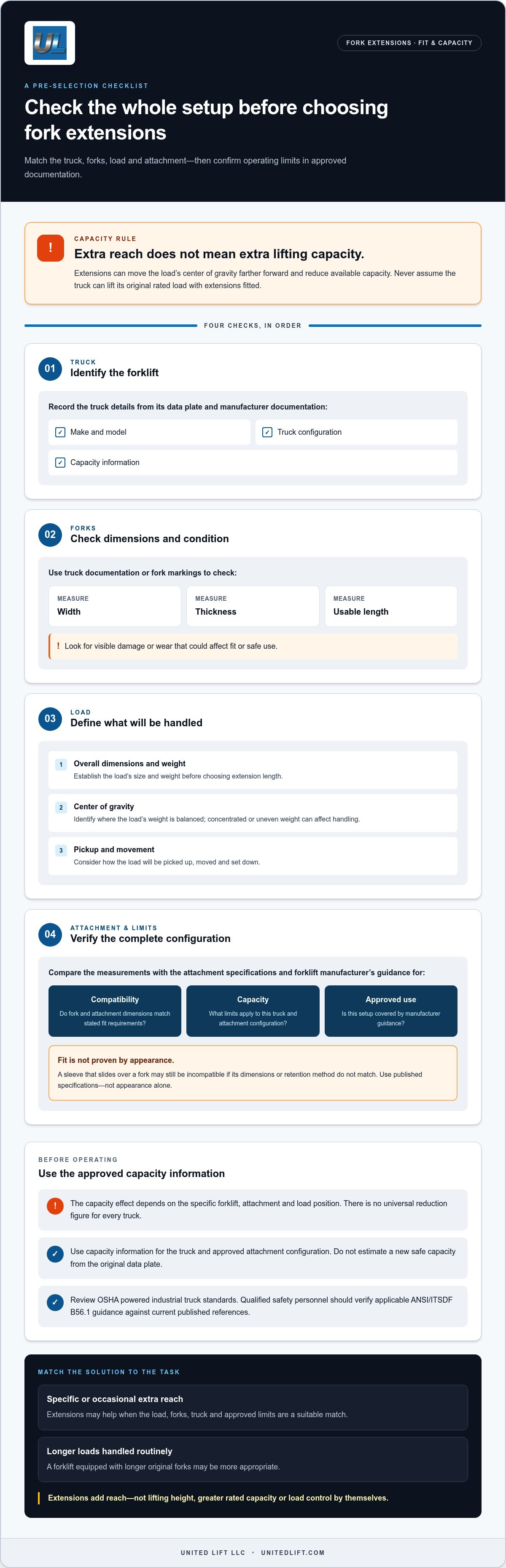
Don’t judge fit by appearance. Check the forklift, forks, load, and attachment as one setup, then use the truck’s approved documentation to establish operating limits. The forklift’s rated capacity remains the governing limit; extensions never authorize a heavier lift.
Follow this sequence before selecting or using forklift fork extensions:
- Identify the truck. Record its make, model, configuration, and capacity information from the data plate and manufacturer documentation.
- Inspect the forks. Note their width, thickness, and usable length. Check for visible damage or wear that could affect fit or safe use.
- Define the load. Record its overall dimensions and weight, identify its center of gravity, or the point around which its weight is balanced, and consider how it will be picked up and moved.
- Check the documentation. Compare your measurements with the attachment specifications and the forklift manufacturer’s guidance on compatibility, capacity, and approved use.
Which measurements matter before choosing extensions?
Use truck documentation or fork markings to determine each fork’s width, thickness, and usable length. Compare those figures with the attachment’s stated fit requirements. A sleeve that appears to slide over a fork may still be incompatible if its dimensions or retention method don’t match the fork.
Measure the load, too. Its overall length helps establish how much support it needs, while its center of gravity affects how far its weight sits from the forklift. Don’t choose extension length in isolation. Fork dimensions, attachment fit, load placement, and manufacturer limits all need to work together. Rely on published specifications, not appearance alone.
How do extensions affect rated capacity and load center?
An extension can move the load’s center of gravity farther forward from the forklift. That changes the leverage acting on the truck and can reduce its available lifting capacity. The effect depends on the specific forklift, attachment, and load position. There’s no universal reduction figure that applies across trucks.
Use the capacity information for the truck and approved attachment configuration. Don’t estimate a new safe capacity from the original data plate or assume the full rated load remains permissible. The OSHA powered industrial truck standards address truck operation and attachments; review the OSHA Standards for Powered Industrial Trucks. Qualified safety personnel should also verify applicable ANSI/ITSDF B56.1 guidance against current published references.
United Lift offers forklifts and equipment attachments, helping you consider the attachment alongside the truck and material-handling application. Explore forklift and attachment options as you assess the complete setup.
Fork Extensions Compared: Sleeve Style, Telescoping Reach, and Alternatives
The right choice depends on how often you need extra reach, the loads you handle, and what the forklift manufacturer approves. A basic sleeve-style extension may suit occasional work with compatible loads. Adjustable or telescoping configurations may address changing reach needs, but their operating methods and limits depend on the specific attachment. Neither type is automatically suitable for every truck or load.
Use the comparison below to narrow your options, then match the choice to the forklift and attachment documentation. Don’t select by reach alone.
| Option | Reach need | Attachment setup | Operating considerations | Key limitation |
|---|---|---|---|---|
| Sleeve-style extension | Occasional extra reach for a compatible load | Fits over the existing forks and is retained as designed | Check fit, secure retention, load placement, and approved capacity information | Fit and reach are limited to the attachment’s specifications and approved use |
| Telescoping or adjustable-reach attachment | Work that calls for changing reach | Uses a mechanism to alter reach; setup and controls vary by attachment | Follow the specific operating instructions and capacity information for each configuration | Adjustment range, compatibility, and capacity depend on the documented setup |
| Different fork configuration or forklift | Recurring work that routinely needs greater reach or support | Uses equipment selected for the regular load and task | Assess the truck, load, work area, and operating pattern together | Requires selecting a suitable equipment configuration, not simply adding an extension |
When might a basic sleeve-style extension suit the task?
A sleeve-style option can be practical when extra reach is needed for occasional, compatible loads and its specifications match the forklift forks and application. Install and retain it exactly as the attachment manufacturer directs. Before each use, make sure it’s seated and secured as designed. Don’t rely on a visual match or assume one sleeve will fit different forks or trucks.
Check the attachment’s stated compatibility and operating limits against the truck’s documentation and the load. If the approved information doesn’t cover a detail, don’t assume the combination is suitable.
When should you consider a different handling solution?
If oversized loads are routine, reassess the whole setup instead of treating extensions as the default. A forklift with a more suitable original fork configuration, or another attachment designed for the task, may better match repeated handling needs. Consider load dimensions, weight distribution, work frequency, and site conditions. OSHA’s forklift safety alert also emphasizes safe load handling and staying within rated limits.
For broader equipment decisions, use a forklift buying guide to consider how truck choice relates to the work. Compare forklift fork extensions with other equipment options as part of that application-level assessment, not as a stand-alone purchase.
Safe Fork Extension Use: Checks Before and During Each Lift
Fork extensions change the forklift’s setup, so treat the truck, attachment, and load as one system. Before lifting, inspect visible components, confirm the attachment is installed as directed, and make sure the load is stable and within documented limits. Inspect the setup and load before lifting.
Follow the manufacturer’s instructions and your workplace procedures. If the equipment configuration has changed, make sure the truck’s capacity and operating information reflects the approved setup. Operators should understand how the attachment affects the truck before using it. Don’t proceed if the correct operating limits or instructions aren’t available.
What should operators inspect before lifting?
Start with a visual check. Look for visible damage, bending or other deformation, excessive wear, or signs that an extension is loose. Verify that each extension is fitted and retained according to its manufacturer’s instructions. A secure fit matters, so don’t use an attachment that appears damaged or isn’t held in place as designed.
Check the load before raising it. Confirm that it’s positioned to receive adequate support from both forks and extensions, and that its weight is balanced for the lift. Make sure the load isn’t likely to slide, tip, or shift as the truck moves. If its condition or placement makes stability uncertain, pause and reassess rather than lifting to see what happens.
- Inspect extensions and forks for visible damage, deformation, and wear.
- Confirm that the attachment is seated and retained as specified.
- Check load position, support, balance, and stability.
- Review the approved capacity information for the complete truck and attachment setup.
- Make sure the route and destination allow the load to be moved and placed under control.
How should operators handle loads with added reach?
Move smoothly and keep the load low and controlled during travel, following the forklift manufacturer’s instructions and workplace procedures. Extra reach can make the setup more sensitive to abrupt movement, so avoid sudden turns, braking, or lifting actions that could shift the load or affect stability. Keep a clear view and travel at a speed suited to the load, route, and site conditions.
Don’t lift, travel, or place a load beyond the limits shown for the approved configuration. If the load shifts, the extension moves, or the truck feels unstable, stop in a safe position and reassess. Don’t try to correct an unstable load while continuing to travel. Follow workplace procedures for securing or repositioning it before resuming.
Build these checks into the normal handling routine, not just the first lift of a shift. A change in the load, attachment, or truck setup can change what needs attention. Clear instructions and consistent checks help operators catch problems early and keep each lift controlled.
To consider the forklift and attachment together for your material-handling setup, explore United Lift’s forklift and attachment options.
Choose Fork Extensions Around Your Work and Forklift
Start with the job, not a guess about attachment length. Match the forklift, fork dimensions, loads, handling frequency, and work environment as one application. This helps distinguish an occasional reach requirement from a recurring need that may call for a different truck or attachment. It also gives you a practical basis for comparing equipment options.
Before comparing forklift fork extensions, gather the key details in one place. Use truck and attachment documentation to assess compatibility and operating limits, and include the actual loads and conditions your team encounters. A clear brief helps you evaluate whether an extension suits the work or whether another equipment configuration is a better fit.
Build a concise attachment requirements brief
Gather the details below before reviewing options. Use manufacturer documentation and equipment markings for specifications, and describe the work as it happens. Include both regular tasks and occasional demanding lifts so the requirements reflect more than an average load.
- Forklift: Make, model, configuration, and relevant capacity information from the data plate and documentation.
- Forks: Width, thickness, and usable length, along with any condition or fit concerns.
- Loads: Typical and maximum weight, overall dimensions, and where the load’s weight is concentrated.
- Work pattern: How often the loads are handled and whether added reach is needed occasionally or throughout the shift.
- Environment: Floor and outdoor surfaces, aisle or work-area constraints, travel routes, and recurring reach challenges.
Be specific about how loads are picked up, moved, and set down. A long load handled repeatedly in a restricted area can create different equipment needs from an occasional oversized item moved across an open floor. Those details help frame the decision without assuming one attachment type fits every truck or task.
Explore attachment and forklift options with United Lift
United Lift offers equipment attachments alongside new and pre-owned forklifts and other material-handling equipment. This broader equipment perspective helps connect attachment selection to the truck, the load, and the work environment. When discussing equipment, share your requirements brief, including the data-plate details, fork measurements, load range, and how often the task occurs.
Keep the final decision tied to documented compatibility and capacity information for the complete setup. If the work routinely pushes beyond the reach or support of the current forks, consider whether a different fork configuration, attachment, or forklift better matches the application. The goal is a practical fit for the work, not extra reach at the expense of safe handling.
Ready to discuss your material-handling needs? Talk with United Lift about forklift and attachment options.
Plan the Next Move for Your Material-Handling Setup
Before settling on forklift fork extensions, consider how the handling task may change over time. A solution that suits occasional loads may not be the best fit if load sizes, workflow, or operating conditions shift. Treat attachment selection as part of planning a material-handling setup, not just a quick way to add reach.
If your review points to a broader equipment need, United Lift offers equipment attachments alongside forklift options. Business customers can also consider equipment financing options when planning a purchase.
Explore United Lift’s equipment attachments and take the next step toward equipment that fits your work. With the right application details in hand, you can make a more informed selection.
Frequently Asked Questions
Are forklift fork extensions universal?
No. Compatibility depends on the forks’ dimensions and the extension’s specified fit and attachment method. Compare the forklift and attachment documentation, including fit limits and installation instructions, before use. A sleeve that slides onto a fork or looks close in size isn’t proof that it fits securely. If the specifications don’t match, don’t use that combination.
Can fork extensions be used on damaged or worn forks?
No. Don’t fit extensions to forks that are damaged, excessively worn, or visibly deformed. An extension won’t repair a defect or restore a fork’s capacity, and covering part of a fork can make a problem less obvious during a quick glance. Follow your workplace inspection process and the manufacturer’s guidance. If a fork’s condition is questionable, take the equipment out of service according to those procedures.
Do fork extensions change a forklift's lifting capacity?
Extensions don’t increase a forklift’s rated capacity. Added reach can move the load center forward, affecting how much the truck can safely lift in a particular configuration. Don’t rely on the capacity figure for a different setup or use a general estimate to calculate a new limit. Operators should follow the truck’s data plate, approved attachment information, and manufacturer instructions for the actual lift.
How long should forklift fork extensions be?
There isn’t one suitable length for every forklift and load. Selection depends on the original fork dimensions, the load’s length and weight distribution, the load center, and the extension’s specifications. Longer isn’t automatically better: extra reach can affect handling and the truck’s available capacity. Compare the intended load and forklift with manufacturer documentation, and don’t choose extensions solely because they offer the greatest reach.
Can you use fork extensions to lift two pallets at once?
Only if the complete setup and lift are approved for that use. Two pallets may fit on the forks yet still exceed the truck’s capacity, shift during travel, or lack stable support. Consider the forklift, extension specifications, pallet dimensions, combined load, and pallet positions. Check the truck and attachment documentation before attempting the lift. Physical fit alone doesn’t establish safe capacity or stability.
Do forklift fork extensions need to be inspected?
Operators should check extensions before use, following applicable workplace procedures and the manufacturer’s instructions. Look for visible damage, deformation, wear, loose retention, or a fit that has changed since installation. Also check for debris or obstructions that could prevent the attachment from seating correctly. If you find a concern, follow workplace procedures before using the equipment. Verify current OSHA and other applicable requirements for your operation.
- Tags: equipment maintenance, forklift attachments, forklift fork extensions, forklift safety, load capacity, material handling, warehouse safety
