
Industrial Lift Equipment Financing: The Complete Guide to Scaling Your Fleet in 2026
Posted by United Lift LLC on
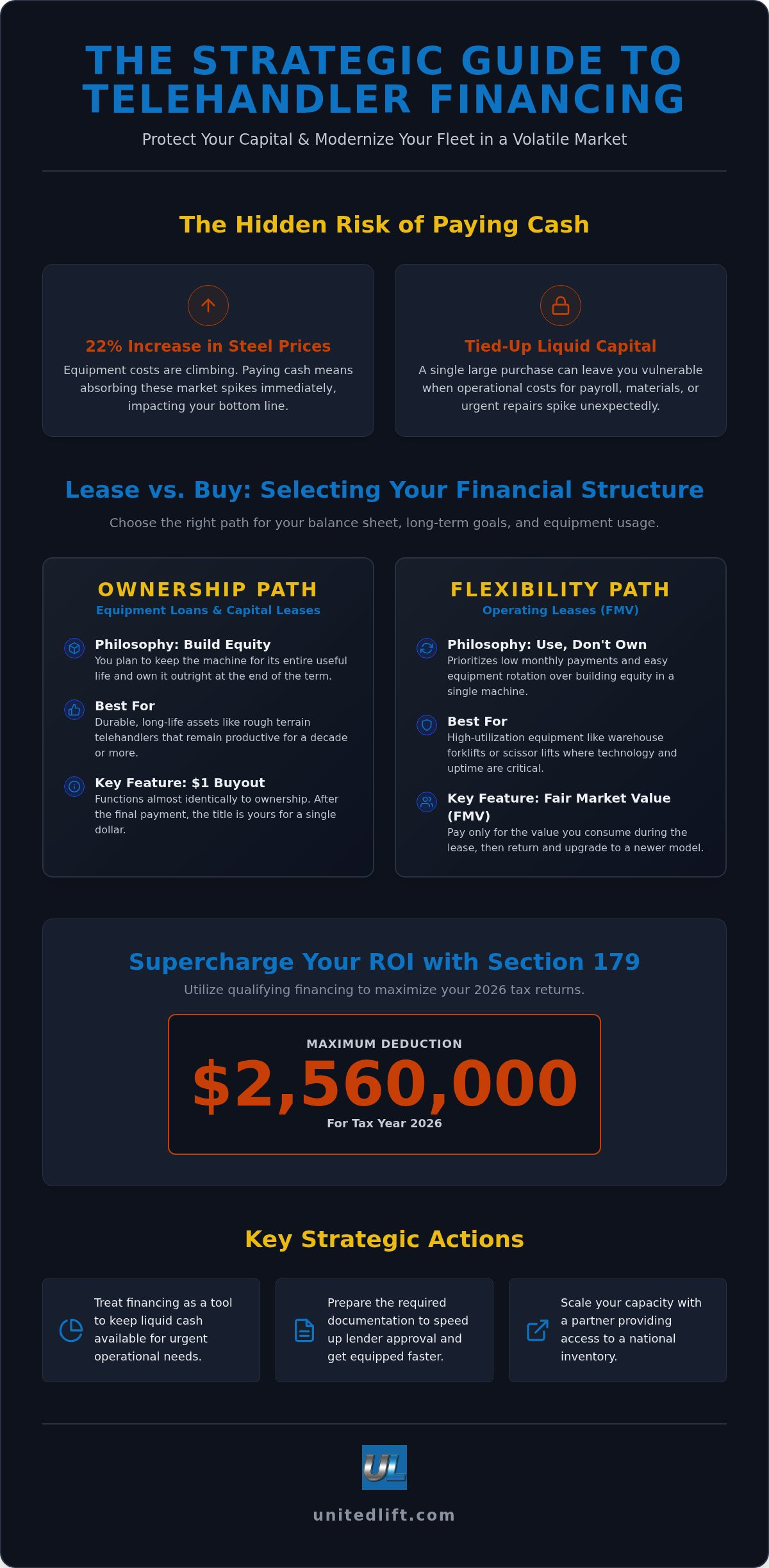
Paying cash for your next machine might be the riskiest move you make this year. It's natural to want to own your assets outright to keep things simple. But with steel prices up 22% and equipment costs steadily climbing, tying up your liquid capital in a single machine can leave you stranded when other operational costs spike. Understanding your telehandler financing options isn't just about debt. It's about protecting your cash flow while keeping your job site equipped with the most reliable tech available.
You'll learn how to master equipment loans, decode complex lease structures, and claim the maximum $2,560,000 Section 179 deduction for 2026. We'll break down the strategies for preserving your working capital and modernizing your fleet for higher uptime. This guide provides a clear path to growing your industrial capacity without draining your bank account or getting stuck with obsolete gear. We're going to show you how to turn your equipment needs into a strategic advantage that keeps your business agile and productive.
Key Takeaways
- Treat equipment financing as a strategic tool to keep your liquid cash available for urgent operational needs.
- Compare the long-term benefits of ownership against the flexibility of leasing to find the right structure for your fleet.
- Maximize your 2026 tax returns by utilizing telehandler financing options that qualify for the $2,560,000 Section 179 deduction.
- Speed up your equipment acquisition by preparing the specific documentation required for fast lender approval.
- Scale your capacity nationwide with a partner that provides access to both premium and economy material handling solutions.
Strategic Benefits of Industrial Lift Equipment Financing
Industrial lift financing is more than just a loan. It's a sophisticated capital management tool for the modern job site. In 2026, hot-rolled coil steel prices have jumped 22% year-over-year, which directly impacts the production cost of every new machine. Buying equipment outright often means absorbing these market spikes immediately. Exploring various telehandler financing options allows you to spread that cost over several years, effectively inflation-proofing your fleet. It transforms a massive capital expenditure into a predictable monthly line item. This stability is vital for warehouse operations that need to forecast expenses far in advance. Deciding on the best path involves understanding the Lease vs. Buy: Selecting the Right Financial Structure debate, which helps you align payments with your actual revenue cycles.
Preserving Cash Flow for Operational Agility
Liquidity remains the lifeblood of the industrial sector. Construction and material handling are inherently volatile. You need cash on hand for payroll, raw materials, and unexpected site delays. When you choose specific telehandler financing options, you avoid the heavy opportunity cost of a massive down payment. That capital stays in your bank account, ready for emergency repairs or new project bids. Think of it as a strategic buffer. Your equipment starts generating revenue on its first day in the dirt. It essentially pays for its own monthly installment while your cash reserves stay untouched for growth opportunities. This flexibility lets you say yes to bigger contracts that require significant upfront mobilization costs, including essential site services like dumpster rental Groves TX for efficient waste management.
Old machinery is a liability. Maintenance costs for aging lifts can quickly erode your profit margins and create dangerous downtime. Financing facilitates a consistent fleet rotation strategy, ensuring you always have the latest technology on-site. This approach maximizes uptime and keeps your operators safe. It also provides a gateway to premium brands like Hyster, Yale, and Toyota without requiring massive liquid assets. Instead of running a machine into the ground, you can cycle it out before it becomes a maintenance sinkhole. This keeps your operations lean and your equipment modern. You get the benefit of higher reliability and lower repair bills, which directly supports your bottom line. Regular replacement cycles also mean you're always operating with the most fuel-efficient engines available.
Lease vs. Buy: Selecting the Right Financial Structure
Deciding whether to own your machinery or simply pay for its use is a pivotal choice for your balance sheet. Both paths offer distinct advantages depending on your long-term goals. While Section 1 mentioned the strategic benefit of preserving cash, the specific structure you choose determines how much equity you build and who handles the equipment at the end of its lifecycle. Evaluating telehandler financing options requires a clear look at your projected machine hours and how long you intend to keep the unit in your fleet.
Equipment Loans and Capital Leases ($1 Buyout)
If you plan to keep a machine for its entire useful life, a capital lease or a traditional equipment loan is usually the best fit. A $1 buyout lease functions almost exactly like ownership. You make monthly payments over a fixed term, and once the final check clears, you own the title for a single dollar. This is a powerful way to build long-term equity in your material handling fleet. It's particularly effective for rough terrain telehandlers, which are built for durability and often stay productive for a decade or more. You get the benefit of depreciation and the long-term value of a paid-off asset that still performs on the job site.
Operating Leases and Fair Market Value (FMV) Options
For high-utilization equipment like warehouse forklifts or scissor lifts, an operating lease often makes more sense. This "use it, don't own it" philosophy prioritizes low monthly payments and easy equipment rotation. With a Fair Market Value (FMV) option, you aren't paying for the full cost of the machine. Instead, you're paying for the value you consume during the lease term. This structure keeps your fleet modern and helps you avoid the steep maintenance costs that hit during a machine's later years. When the term ends, you simply return the equipment and upgrade to a newer model.
Flexibility at the end of your term is a major factor in this decision. Some businesses prefer the certainty of a fixed buyout, while others value the ability to walk away or extend the lease based on current project needs. If you're unsure which path fits your specific workload, you can explore our national inventory to see how different models align with these financial structures. Choosing the right telehandler financing options ensures that your fleet remains a productive asset rather than a financial burden. Whether you're looking for the equity of a loan or the agility of an FMV lease, matching the finance to the machine's role is the key to scaling effectively.
Maximizing ROI with Section 179 and Tax Incentives
Section 179 is a powerful financial lever for fleet owners in 2026. For this tax year, the maximum deduction limit has climbed to $2,560,000. This provision allows you to deduct the full purchase price of qualifying equipment immediately instead of spreading it over several years. It's a form of accelerated depreciation that rewards businesses for investing in their own growth. Many people assume you need to pay cash to get this benefit, but that isn't the case. When you utilize telehandler financing options, you can claim the entire deduction in the year you put the machine to work, even if you've only made a handful of monthly payments. This creates a massive cash flow advantage. Always consult with a qualified tax professional to confirm how these rules apply to your specific business structure.
Financing Used Equipment: Tax Benefits and Criteria
Don't fall for the myth that tax breaks are reserved for brand-new machinery. Pre-owned equipment from reliable brands like Caterpillar or Yale often qualifies for the same Section 179 benefits. Financing a used telehandler can drastically lower your total cost of ownership by combining a lower purchase price with immediate tax relief. To qualify, the equipment simply needs to be "new to you" and used for business purposes more than 50% of the time. This makes high-quality, pre-owned lifts an incredibly efficient way to scale your capacity. You get the reach and power you need without the "new machine" premium, all while keeping your tax bill lean.
Calculating the Real Cost After Tax Savings
Tax deductions effectively lower your purchase price by reducing the total amount of income tax your business owes at the end of the year. If you're in a high tax bracket, the savings can represent a significant percentage of the equipment's value. This has a direct impact on your first-year ROI. Instead of sending that capital to the IRS, you keep it in your operating budget. You can then reinvest those savings into equipment attachments or new industrial batteries to further boost your site's productivity. This strategic approach to telehandler financing options turns a standard equipment acquisition into a comprehensive growth plan. It ensures your fleet stays modern and your cash reserves stay healthy.
The Application Process: How to Secure Quick Approval
Securing the right capital shouldn't stall your operations. Most lenders in the industrial space aim for a turnaround of 24 to 48 hours for initial approval. Once the paperwork is signed, equipment delivery can often happen within the same week. It's vital to work with a partner who understands material handling equipment rather than a general bank. Specialized lenders recognize the residual value of a Hyster forklift or a JLG boom lift, which often leads to more favorable terms. Many modern facilitators use soft credit pulls for your initial quote. This allows you to compare telehandler financing options without leaving a permanent mark on your credit report during the shopping phase.
Essential Documentation Checklist
Lenders need to see that your business is stable and the equipment is a sound investment. Having your paperwork ready before you apply can shave days off the process. It's about proving reliability and machine value simultaneously.
- Financial Records: For larger fleet expansions, expect to provide the last two years of business tax returns and a current balance sheet.
- Machine Specifications: You need a detailed quote from the dealer. This must include the make, model, year, and serial number of the unit to verify the collateral.
- Startup Requirements: If your business is under two years old, be prepared to provide personal financial statements to show your ability to back the loan.
Optimizing Your Credit Profile for Heavy Machinery
Your business credit score is the primary factor in determining your interest rate and down payment requirement. Lenders look for a history of on-time payments with other industrial vendors or lenders. Time-in-business is equally important. Once you cross the two-year mark, you often unlock lower rates and longer repayment terms. If you're a newer operation, you can still secure a loan by offering a larger down payment or providing additional collateral. Building a relationship with a national facilitator helps you navigate these requirements efficiently. They can match your profile with the specific lender most likely to approve your application.
Getting your fleet up to speed requires a partner who values your time as much as you do. You can apply for national equipment financing today to see which programs fit your business profile and get your machinery on the job site faster.
United Lift: Your Partner in National Equipment Financing
Scaling a fleet requires more than just a lender; it requires a partner who knows the difference between a rough terrain telehandler and a standard warehouse forklift. United Lift LLC operates as a proactive facilitator deeply integrated into the logistical needs of our clientele. We don't position ourselves as a distant corporate entity. Instead, we act as a no-nonsense expert that prioritizes your time and your project deadlines. By offering national service coverage, we ensure that businesses across the country have access to the same high level of expertise and readiness. Whether you're adding a single scissor lift or an entire fleet of boom lifts, we streamline the path from identifying a need to signing the final contract.
Financing Solutions for Every Brand and Budget
One of the biggest hurdles in fleet management is finding a lender that supports various manufacturers under a single plan. Most captive finance companies only want to talk about their own brand. At United Lift LLC, we provide support for premium brands like Hyster, Yale, Toyota, and Caterpillar, while also offering competitive telehandler financing options for economy lifts. This flexibility allows you to mix and match your fleet based on specific job site requirements rather than brand loyalty. We also understand that industrial work is often seasonal. We can help customize repayment terms to match the cash flow cycles of your construction or retail operation. For a deeper look at choosing the right machinery for your specific application, read The Ultimate Forklift Buying Guide for Industrial Success in 2026.
The United Lift LLC Advantage: Speed and Accessibility
In the material handling industry, a day of downtime is a day of lost profit. Our communication rhythm is fast-paced and direct because we know you can't afford to wait for a committee to review your application. We offer 7-day-a-week support availability to ensure your questions are answered immediately. You won't get stuck in a long-form storytelling loop or a complex phone tree. You get a single, reliable point of contact who manages the entire process for you. This approach makes our telehandler financing options some of the most accessible in the industry. We handle the heavy lifting of the financial side so you can focus on your core operations. It's about reliability, efficiency, and a tireless commitment to your success. View our current inventory and start your financing application today.
Equip Your Business for Success in 2026
Scaling your material handling capacity in 2026 requires a balance of high-performance machinery and smart capital management. By prioritizing liquidity and leveraging the $2,560,000 Section 179 deduction, you can modernize your operations without the burden of massive upfront costs. Whether you choose the equity-building path of a $1 buyout lease or the agility of an FMV structure, the right financial strategy keeps your business competitive and your fleet uptime high.
Understanding your telehandler financing options is the first step toward a more efficient and profitable job site. United Lift is here to facilitate that growth. As an expert partner with national coverage, we offer financing for all new and pre-owned inventory from premium brands like Hyster, Yale, and Toyota. Our team remains available 7 days a week to ensure you get the answers you need exactly when you need them. We focus on speed and accessibility so you can focus on the work that matters. Explore Financing Options for Your Next Lift. Let's get the right equipment in your hands and start growing your fleet today.
Frequently Asked Questions
How does industrial lift equipment financing differ from a standard bank loan?
Industrial financing is tailored to the specific lifecycle and value of material handling machinery. Unlike general bank loans, specialized lenders understand the resale value of a Hyster or Yale unit. This often results in more flexible terms and faster approvals. These lenders look at the machine as collateral rather than just your business's liquid cash. It's a more efficient way to secure capital without the rigid requirements of a traditional banking institution.
Can I finance used forklifts or telehandlers from different brands?
Yes, you can finance both new and pre-owned inventory from a wide range of manufacturers. United Lift facilitates national financing for premium brands like Toyota, Caterpillar, and JLG, as well as economy lift solutions. This allows you to build a diverse fleet that meets your specific site needs under a single financial agreement. Exploring used telehandler financing options is a popular way to reduce your total investment while still securing high-quality, reliable machinery.
What is the minimum credit score required for industrial equipment financing?
Credit requirements vary depending on your time in business and the type of equipment you're acquiring. While a score above 620 is often preferred for the best rates, there are programs available for startups or those with lower scores. These might require additional collateral or a larger down payment. A specialized facilitator can match your specific credit profile with a lender that understands your industry's unique risks and growth potential.
How much of a down payment is typically required for a telehandler loan?
Down payments generally range from 0% to 20% of the total purchase price. Your specific requirement depends on your business credit history and the age of the equipment. Some well-established businesses qualify for $0 down programs that preserve maximum liquidity. Newer operations should expect to put some skin in the game. Preparing a solid down payment can also help you secure a lower monthly installment and better overall repayment terms.
Can I include forklift attachments and batteries in my financing package?
Yes, most lenders allow you to bundle essential accessories into your primary financing agreement. This includes equipment attachments and industrial batteries that are necessary for your machine's operation. Bundling these costs into one monthly payment simplifies your accounting and ensures you have everything needed to start work immediately. It's a strategic way to equip your fleet fully without multiple separate outlays of cash.
What happens at the end of a forklift lease agreement?
Your options depend on whether you chose a capital lease or an operating lease. With a $1 buyout lease, you take full ownership of the title after your final payment. If you have a Fair Market Value lease, you can choose to purchase the machine at its current value, return it to the dealer, or extend the lease term. This flexibility allows you to decide based on your current project volume and the machine's condition.
Is it better to lease or buy a forklift for a low-hour application?
Buying or using a capital lease often makes more sense for low-hour applications. Since the machine isn't being used heavily, it will maintain its value and mechanical integrity for a much longer period. This allows you to build long-term equity in an asset that won't require frequent replacement. Leasing is typically better for high-utilization environments where you want to rotate equipment frequently to avoid the high maintenance costs of aging machinery.
How long does the approval process take for heavy equipment financing?
The approval process is typically very fast, often taking between 24 and 48 hours. Once you submit your business financials and equipment quotes, a specialized lender can move quickly to verify the collateral. After approval, the final documentation and funding can usually be completed within a few business days. Working with a national partner that offers 7-day-a-week support ensures that your application doesn't sit idle over the weekend.
- Tags: Business Loans, Cash Flow Management, Construction Equipment, Equipment Financing, Equipment Leasing, Fleet Management, Section 179, Telehandler, telehandler financing options
